




Leaf pores/stomata helps in_____________.
(a) Intake of ${ CO }_{ 2 }$ during photosynthesis
(b) Release of ${ O }_{ 2 }$ during photosynthesis
(c) Release of water vapor during transpiration
(d) All of these
Answer
 Verified
606.3k+ views
Hint: They are openings on the surface of plants, found mainly on the leaves, but also on stems and other organs. They are called guard cells which are surrounded by specialized parenchymatic cells and are pore- like in appearance. Stomata or leaf pores are responsible for the gaseous exchange,
Complete step by step answer:
Stomata are also called leaf pause which plays a crucial role in the process of photosynthesis and in maintaining water levels in plants.
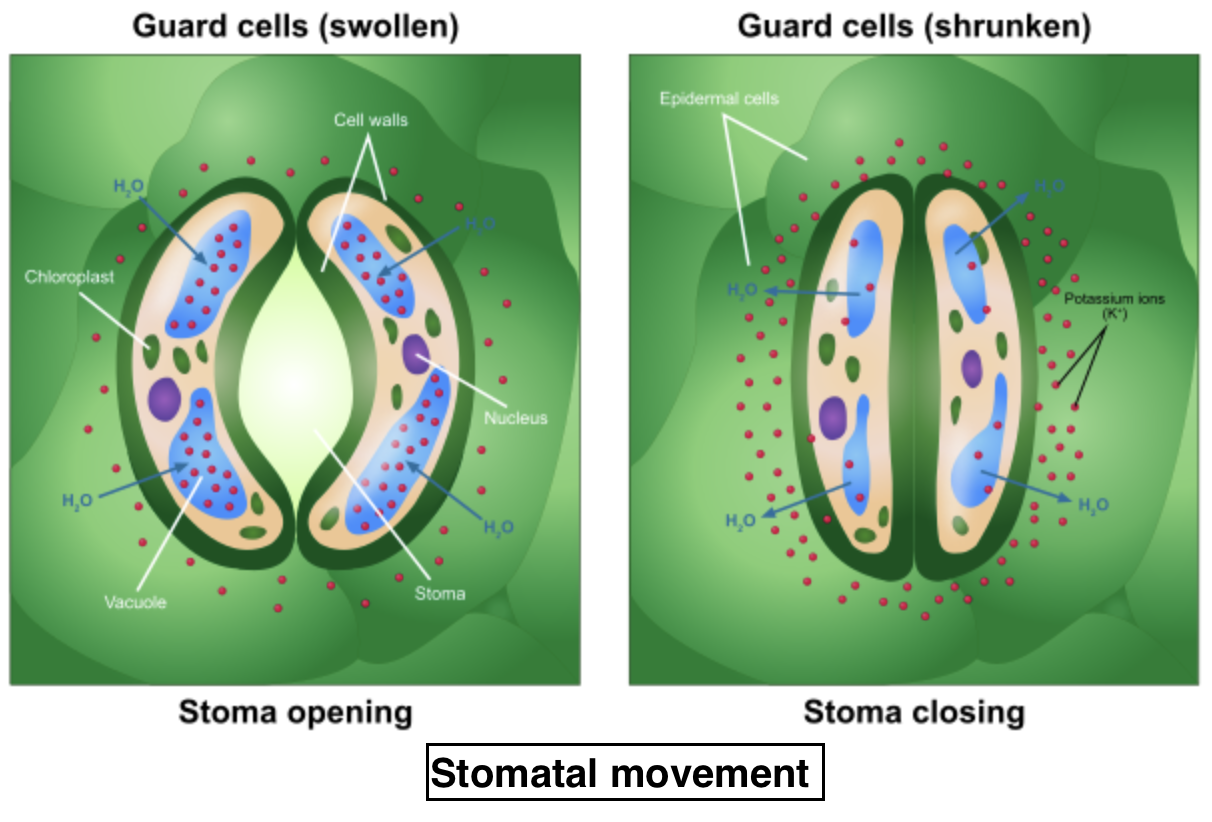
- Stomata are present at the underside of the leaf lamina which are very tiny pores. They help in the exchange of gases that is the intake of carbon dioxide and the release of oxygen during photosynthesis.
- It also functions in letting out drops of water from the lamina of the leaf during transpiration.
Additional information: By the name we can say that stomata are containing pores, a stoma (also stomate; plural stomata) is a tiny opening or pore that is used for gas exchange. Stomata are found below the surface of the leaves. Stomata are mostly found in all land plants. The stomata are present on both the surface of the leaf in the case of an amphistomatous leaf. The stomata are present on the lower surface in case of both the surface of the leaf in case of A hypostomatous leaf. Some of the species in which hypostomatous leaves are present are horse chestnut.
Note: So the correct answer is Intake of ${ CO }_{ 2 }$ during photosynthesis, Release of ${ O }_{ 2 }$ during photosynthesis, Release of water vapor during transpiration.
The discovery of stomata was done by Pfeffer. Malpighi was the person responsible for naming the word stomata. The surface area covered by the leaf is $1\%- 2\%$.
Complete step by step answer:
Stomata are also called leaf pause which plays a crucial role in the process of photosynthesis and in maintaining water levels in plants.
- Stomata are present at the underside of the leaf lamina which are very tiny pores. They help in the exchange of gases that is the intake of carbon dioxide and the release of oxygen during photosynthesis.
- It also functions in letting out drops of water from the lamina of the leaf during transpiration.
Additional information: By the name we can say that stomata are containing pores, a stoma (also stomate; plural stomata) is a tiny opening or pore that is used for gas exchange. Stomata are found below the surface of the leaves. Stomata are mostly found in all land plants. The stomata are present on both the surface of the leaf in the case of an amphistomatous leaf. The stomata are present on the lower surface in case of both the surface of the leaf in case of A hypostomatous leaf. Some of the species in which hypostomatous leaves are present are horse chestnut.
Note: So the correct answer is Intake of ${ CO }_{ 2 }$ during photosynthesis, Release of ${ O }_{ 2 }$ during photosynthesis, Release of water vapor during transpiration.
The discovery of stomata was done by Pfeffer. Malpighi was the person responsible for naming the word stomata. The surface area covered by the leaf is $1\%- 2\%$.
Recently Updated Pages
Master Class 11 Social Science: Engaging Questions & Answers for Success

Master Class 11 Chemistry: Engaging Questions & Answers for Success
Master Class 9 General Knowledge: Engaging Questions & Answers for Success
Master Class 9 Maths: Engaging Questions & Answers for Success
Master Class 9 Science: Engaging Questions & Answers for Success
Master Class 9 English: Engaging Questions & Answers for Success
Trending doubts
One Metric ton is equal to kg A 10000 B 1000 C 100 class 11 physics CBSE
Difference Between Prokaryotic Cells and Eukaryotic Cells
Two of the body parts which do not appear in MRI are class 11 biology CBSE
1 ton equals to A 100 kg B 1000 kg C 10 kg D 10000 class 11 physics CBSE
10 examples of friction in our daily life
Name the Largest and the Smallest Cell in the Human Body ?