




What is the lattice energy of Calcium Chloride?
Answer
 Verified
582.3k+ views
Hint :The Born-Haber cycle is a very useful method in calculating the lattice enthalpy of any compound. To find out the lattice enthalpy we need the total ionization energy when the compound is prepared from its constituent atoms or ions. We also need sublimation energy, dissociation energy, ionization energy and electron affinity values.
Complete Step By Step Answer:
Let us first consider the Born-Haber Cycle of $ CaC{l_2} $ . Only by seeing this we can calculate the lattice energy of the compound.
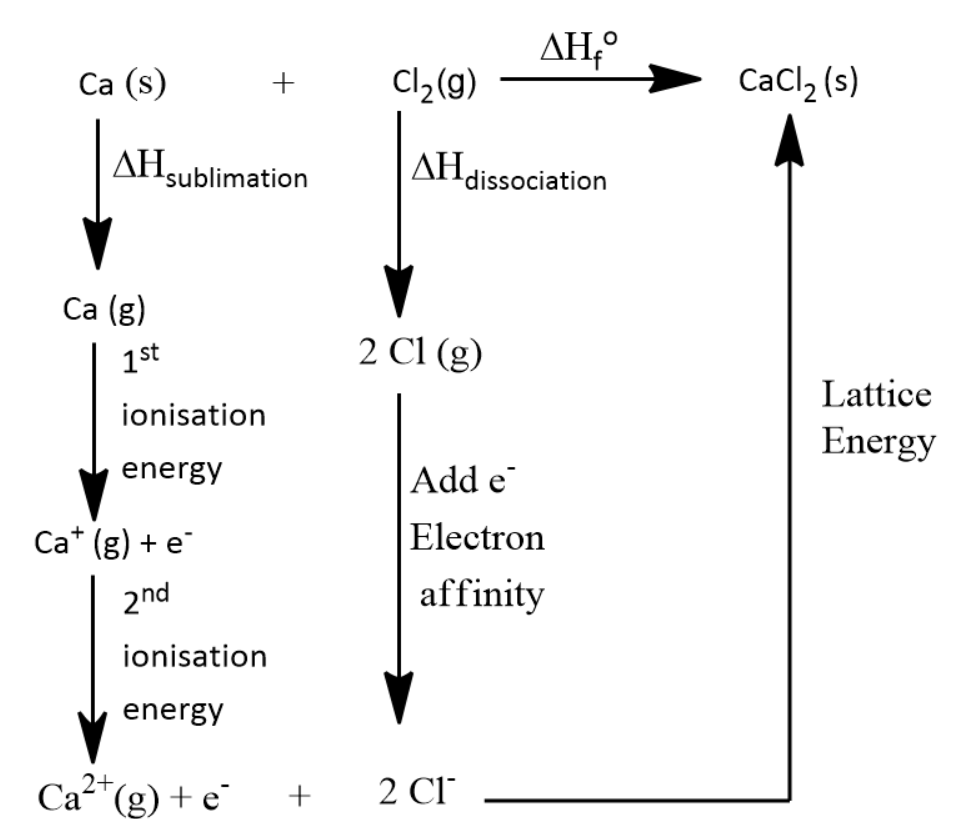
By the above diagram we can say that
Standard enthalpy of formation ( $ \Delta H_f^o $ ) = lattice energy + (2 $ \times $ Electron affinity for chlorine) + Bond Energy of Chlorine gas + first and second ionisation energy of calcium + Sublimation energy of Calcium solid.
$ \Delta {H_{{\text{sublimation}}}}{\text{ }} = {\text{ }}121{\text{ }}kJ $
1st Ionization Energy of Ca = 589.5 $ kJ $
2nd Ionization Energy of Ca = 1145 $ kJ $
Bond Energy of Cl2 = 242.7 $ kJ $
Electron Affinity for chlorine = 2 $ \times $ (−349 $ kJ $ )
Standard Enthalpy of Formation of CaCl2 (s) = −795 $ kJ $
We can substitute these values in the equation to find out the lattice energy
$ \Rightarrow - 795{\text{ }}kJ{\text{ }} = {\text{ Lattice Energy }} + {\text{ }}2 \times \left( { - 349{\text{ }}kJ} \right){\text{ }} + {\text{ }}242.4{\text{ }}kJ{\text{ }} + {\text{ }}1145{\text{ }}kJ{\text{ }} + {\text{ }}589.5{\text{ }}kJ{\text{ }} + {\text{ }}121{\text{ }}kJ $
$ \Rightarrow {\text{Lattice Energy = }} - 795{\text{ }}kJ - 2 \times \left( { - 349{\text{ }}kJ} \right) - 242.4{\text{ }}kJ - 1145{\text{ }}kJ - 589.5{\text{ }}kJ - 121{\text{ }}kJ $
$ \Rightarrow {\text{Lattice Energy}} = - 2195.2{\text{ }}kJ/mol $
This is how we find the lattice energy of calcium chloride by using Born-Haber cycle.
Note :
We can also use another method to find out the lattice energy of a compound
This method is by using the Born-Lande Equation, given by
$ Lattice{\text{ }}Energy = \dfrac{{{N_A} \times M \times {z^ + } \times {z^ - } \times {e^2}}}{{4\pi {\varepsilon _o}r}}\left( {1 - \dfrac{1}{n}} \right) $
Where $ {N_A} $ is the Avogadro number
$ M $ is the Madelung Constant
$ {z^ + },{z^ - } $ are the charges of cation and anion respectively
$ e $ is the electronic charge
$ {\varepsilon _o} $ is permittivity of free space
$ r $ is the radial distance
$ n $ is the born exponent.
Complete Step By Step Answer:
Let us first consider the Born-Haber Cycle of $ CaC{l_2} $ . Only by seeing this we can calculate the lattice energy of the compound.
By the above diagram we can say that
Standard enthalpy of formation ( $ \Delta H_f^o $ ) = lattice energy + (2 $ \times $ Electron affinity for chlorine) + Bond Energy of Chlorine gas + first and second ionisation energy of calcium + Sublimation energy of Calcium solid.
$ \Delta {H_{{\text{sublimation}}}}{\text{ }} = {\text{ }}121{\text{ }}kJ $
1st Ionization Energy of Ca = 589.5 $ kJ $
2nd Ionization Energy of Ca = 1145 $ kJ $
Bond Energy of Cl2 = 242.7 $ kJ $
Electron Affinity for chlorine = 2 $ \times $ (−349 $ kJ $ )
Standard Enthalpy of Formation of CaCl2 (s) = −795 $ kJ $
We can substitute these values in the equation to find out the lattice energy
$ \Rightarrow - 795{\text{ }}kJ{\text{ }} = {\text{ Lattice Energy }} + {\text{ }}2 \times \left( { - 349{\text{ }}kJ} \right){\text{ }} + {\text{ }}242.4{\text{ }}kJ{\text{ }} + {\text{ }}1145{\text{ }}kJ{\text{ }} + {\text{ }}589.5{\text{ }}kJ{\text{ }} + {\text{ }}121{\text{ }}kJ $
$ \Rightarrow {\text{Lattice Energy = }} - 795{\text{ }}kJ - 2 \times \left( { - 349{\text{ }}kJ} \right) - 242.4{\text{ }}kJ - 1145{\text{ }}kJ - 589.5{\text{ }}kJ - 121{\text{ }}kJ $
$ \Rightarrow {\text{Lattice Energy}} = - 2195.2{\text{ }}kJ/mol $
This is how we find the lattice energy of calcium chloride by using Born-Haber cycle.
Note :
We can also use another method to find out the lattice energy of a compound
This method is by using the Born-Lande Equation, given by
$ Lattice{\text{ }}Energy = \dfrac{{{N_A} \times M \times {z^ + } \times {z^ - } \times {e^2}}}{{4\pi {\varepsilon _o}r}}\left( {1 - \dfrac{1}{n}} \right) $
Where $ {N_A} $ is the Avogadro number
$ M $ is the Madelung Constant
$ {z^ + },{z^ - } $ are the charges of cation and anion respectively
$ e $ is the electronic charge
$ {\varepsilon _o} $ is permittivity of free space
$ r $ is the radial distance
$ n $ is the born exponent.
Recently Updated Pages
Which will be the least stable resonating structure class 11 chemistry CBSE

How many 5 digit telephone numbers can be construc-class-11-maths-CBSE
How do you find the angle of the resultant vector class 11 physics CBSE
Draw labelled diagram of the following i Gram seed class 11 biology CBSE
1 Quintal is equal to a 110 kg b 10 kg c 100kg d 1000 class 11 physics CBSE
What is the need and importance of classification class 11 biology CBSE
Trending doubts
One Metric ton is equal to kg A 10000 B 1000 C 100 class 11 physics CBSE
Find the value of the expression given below sin 30circ class 11 maths CBSE
Draw a diagram of nephron and explain its structur class 11 biology CBSE
10 examples of friction in our daily life
Draw a diagram of a plant cell and label at least eight class 11 biology CBSE
Difference Between Prokaryotic Cells and Eukaryotic Cells