




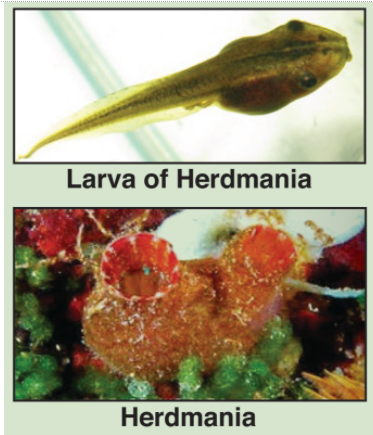
Larva of Herdmania is
(a)Muller’s larva
(b)Tadpole
(c)Tornaria
(d)All of the above
Answer
 Verified
635.1k+ views
Hint: It is also called a pollywog and is a stage in the life cycle of an amphibian. They are most fully aquatic but some species are terrestrial. These may not have some characteristics that may not be present in adults like gills, a lateral line, and tails.
Complete answer:
Herdmania also known as sea squirts is a hermaphrodite animal and is the genus of ascidians. Fertilization in these organisms happens externally and usually, cross-fertilization takes place. The eggs undergo holoblastic and unequal cleavage which then develops to form the blastula. This blastula shows upper micromeres and lower macromeres and then the structure of the gastrula is formed with the taking place of gastrulation. The gastrula develops into a tailed larva and is called ascidian tadpole larva. It is about 1.5 mm long and motile. The body is covered by a thin tunic secreted by the ectoderm. The body has a short oval head and a posterior long tail. They have a long tail which shows the caudal fin and have an oval body. The tail is also characterized by the presence of a notochord which has muscles present on the other side. The larva swims in search of an attachment after feeding. It needs advanced features for its free-swimming existence and shows all chordate characters. It possesses advanced characters and undergoes retrogressive metamorphosis to develop into an adult Herdmania.
So, the correct answer is ‘tadpole’.
Note: Metamorphosis means after form state. It refers to the degenerative changes in the active larva during post-embryonic development into a sedentary adult. It refers to a dramatic change in the habitat of the animal. Here it involves the transformation of an active tailed larva having features into an adult.
Complete answer:
Herdmania also known as sea squirts is a hermaphrodite animal and is the genus of ascidians. Fertilization in these organisms happens externally and usually, cross-fertilization takes place. The eggs undergo holoblastic and unequal cleavage which then develops to form the blastula. This blastula shows upper micromeres and lower macromeres and then the structure of the gastrula is formed with the taking place of gastrulation. The gastrula develops into a tailed larva and is called ascidian tadpole larva. It is about 1.5 mm long and motile. The body is covered by a thin tunic secreted by the ectoderm. The body has a short oval head and a posterior long tail. They have a long tail which shows the caudal fin and have an oval body. The tail is also characterized by the presence of a notochord which has muscles present on the other side. The larva swims in search of an attachment after feeding. It needs advanced features for its free-swimming existence and shows all chordate characters. It possesses advanced characters and undergoes retrogressive metamorphosis to develop into an adult Herdmania.
So, the correct answer is ‘tadpole’.
Note: Metamorphosis means after form state. It refers to the degenerative changes in the active larva during post-embryonic development into a sedentary adult. It refers to a dramatic change in the habitat of the animal. Here it involves the transformation of an active tailed larva having features into an adult.
Recently Updated Pages
Basicity of sulphurous acid and sulphuric acid are

Master Class 11 English: Engaging Questions & Answers for Success
Master Class 11 Physics: Engaging Questions & Answers for Success
Master Class 11 Computer Science: Engaging Questions & Answers for Success
Master Class 11 Chemistry: Engaging Questions & Answers for Success
Master Class 11 Social Science: Engaging Questions & Answers for Success
Trending doubts
Difference Between Prokaryotic Cells and Eukaryotic Cells
Two of the body parts which do not appear in MRI are class 11 biology CBSE
One Metric ton is equal to kg A 10000 B 1000 C 100 class 11 physics CBSE
10 examples of friction in our daily life
Draw a diagram of nephron and explain its structur class 11 biology CBSE
What will happen if the mucus is not secreted by the class 11 biology CBSE