




Larva of Bombyx mori
A. Caterpillar
B. Trochophore
C. Nymph
D. Cocoon
Answer
 Verified
568.8k+ views
Hint: Bombyx mori, the domestic silkmoth, is an insect from the moth Bombycidae. It's the closest relative of Bombyx mandarina, the wild silk moth. The silkworm is the larva or caterpillar of a silk moth.
Complete answer: The larvae of B. mori are caterpillars that are about 4 cm long, including their horned tail. They're buff-colored with brown thoracic markings. The adults are moths with a 4 cm wingspan. They're also buff-colored but have thin brown lines on their whole bodies. Another silkworm, Bombyx mandarina, appears to be a wild race of B. mori. Domestic silkworm moths are holometabolous and reproduce sexually. After 10 days, the eggs hatch, and hungry larvae emerge. They're segmented and have hair. The larvae eat and grow for about 6 weeks, then they start the subsequent stage of their lives. Domestic silkworm moths produce a fluid in their silk glands that are forced through spinnerets on their mouths. This fluid hardens within the air to supply the silk thread that they're going to wrap around themselves to make their cocoons.
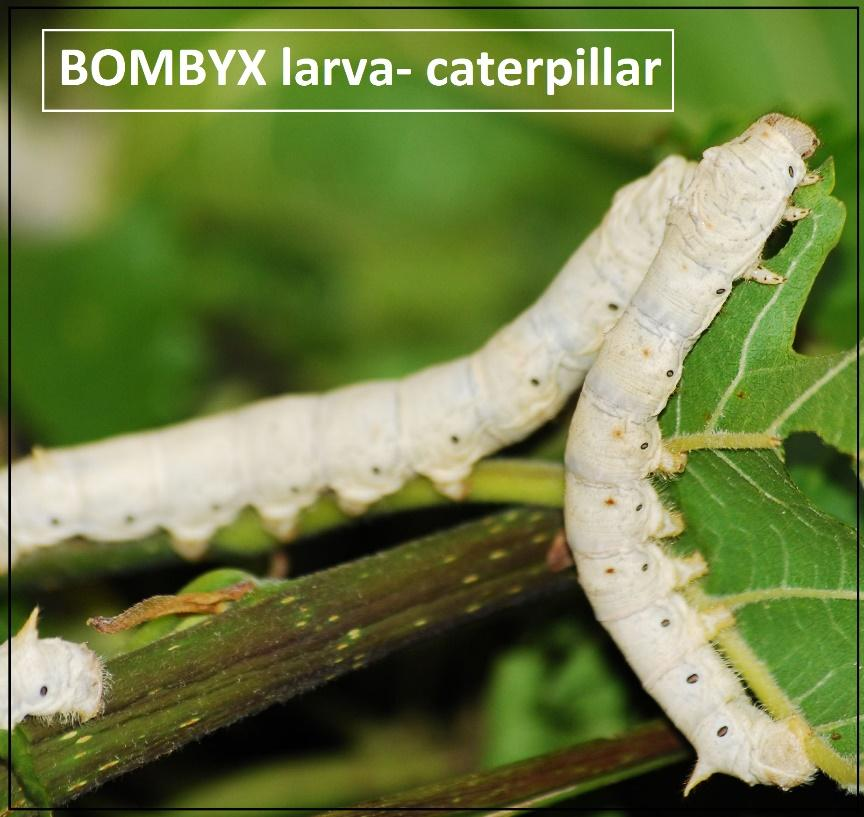
So, the right answer would be A. Caterpillar.
Note: It is important to note that domestic silkworm moths spend 2 weeks as pupae within the safety of their cocoons before emerging as adults. Inside the cocoon, much of their bodies die by an attack of their own digestive juices. This process, histolysis, clears away the old parts to form a way for the new ones which will develop during this pupal state. After this process is completed, the adults break away from the cocoon.
Complete answer: The larvae of B. mori are caterpillars that are about 4 cm long, including their horned tail. They're buff-colored with brown thoracic markings. The adults are moths with a 4 cm wingspan. They're also buff-colored but have thin brown lines on their whole bodies. Another silkworm, Bombyx mandarina, appears to be a wild race of B. mori. Domestic silkworm moths are holometabolous and reproduce sexually. After 10 days, the eggs hatch, and hungry larvae emerge. They're segmented and have hair. The larvae eat and grow for about 6 weeks, then they start the subsequent stage of their lives. Domestic silkworm moths produce a fluid in their silk glands that are forced through spinnerets on their mouths. This fluid hardens within the air to supply the silk thread that they're going to wrap around themselves to make their cocoons.
So, the right answer would be A. Caterpillar.
Note: It is important to note that domestic silkworm moths spend 2 weeks as pupae within the safety of their cocoons before emerging as adults. Inside the cocoon, much of their bodies die by an attack of their own digestive juices. This process, histolysis, clears away the old parts to form a way for the new ones which will develop during this pupal state. After this process is completed, the adults break away from the cocoon.
Recently Updated Pages
Master Class 11 Computer Science: Engaging Questions & Answers for Success

Master Class 11 Business Studies: Engaging Questions & Answers for Success
Master Class 11 Economics: Engaging Questions & Answers for Success
Master Class 11 English: Engaging Questions & Answers for Success
Master Class 11 Maths: Engaging Questions & Answers for Success
Master Class 11 Biology: Engaging Questions & Answers for Success
Trending doubts
One Metric ton is equal to kg A 10000 B 1000 C 100 class 11 physics CBSE
There are 720 permutations of the digits 1 2 3 4 5 class 11 maths CBSE
Discuss the various forms of bacteria class 11 biology CBSE
Draw a diagram of a plant cell and label at least eight class 11 biology CBSE
State the laws of reflection of light
10 examples of friction in our daily life