




Knee joint is an example for
(a) Ball and socket joint
(b) Hinge joint
(c) Pivot joint
(d) Gliding joint
Answer
 Verified
612.3k+ views
Hint: In the knee, one form of synovial joint is present. This sort of joint is part of the shoulder, elbow, and knee joints. The articular surfaces of this joint are moulded in such a way that the movement occurs only in one plane.
Complete step by step answer:
In the human skeleton, there are several kinds of joints. This form of joint makes it possible to shift flexibly.
The hinge form of the joint is the knee joint. This form of joint allows for the single axis to travel along.
At right angles, this movement happens. The joints between the patella, femur, and tibia form the knee joint.
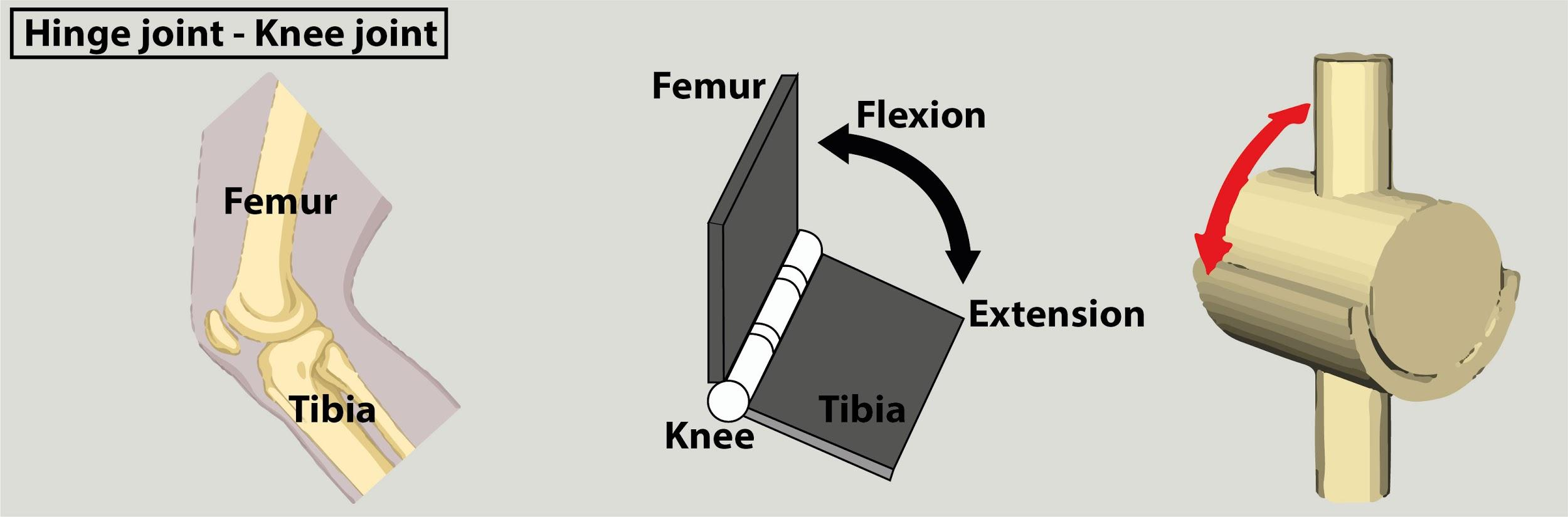
There are four major movements allowed by the knee joint:
Extension: Formed by the quadriceps femoris, which is introduced into the tibial tuberosity.
Flexion: The hamstrings, gracilis, sartorius, and popliteus produce this movement.
Lateral rotation: Generated by the biceps femoris.
Medial rotation: Five muscles are produced. They are semimembranosus, semitendinosus, sartorius, gracilis, and popliteus.
So, the correct answer is, ‘Hinge joint’.
Additional information: The joint is the contact point between the two bones. The different kinds of joints present in the body are:
Ball and socket joint: In the socket of another bone, the ball of one bone articulates. The head of the humerus and the glenoid cavity of the pectoral girdle, femur, and acetabulum, the joint between the incus and the stapes.
Pivot joint: Assists with turning moments. One of the bones is set and the other is articulated. The atlas and the skull axial rotates with the axis vertebrae.
Gliding joint: In all directions, minimal movement. Ulna and radius.
Saddle joint: It is a joint like a ball and socket, but it is not fully formed. Thumb Metacarpals and carpals of the hand.
Note: The knee joint comprises 2 articulations like the tibiofemoral and patellofemoral joint. The joint surfaces are coated with cartilage hyaline and are enclosed within a single cavity of the joint.
Blood supply to the knee joint is supplied by the genicular anastomosis around the knee, supplied by the femoral and popliteal artery genicular branches.
Complete step by step answer:
In the human skeleton, there are several kinds of joints. This form of joint makes it possible to shift flexibly.
The hinge form of the joint is the knee joint. This form of joint allows for the single axis to travel along.
At right angles, this movement happens. The joints between the patella, femur, and tibia form the knee joint.
There are four major movements allowed by the knee joint:
Extension: Formed by the quadriceps femoris, which is introduced into the tibial tuberosity.
Flexion: The hamstrings, gracilis, sartorius, and popliteus produce this movement.
Lateral rotation: Generated by the biceps femoris.
Medial rotation: Five muscles are produced. They are semimembranosus, semitendinosus, sartorius, gracilis, and popliteus.
So, the correct answer is, ‘Hinge joint’.
Additional information: The joint is the contact point between the two bones. The different kinds of joints present in the body are:
Ball and socket joint: In the socket of another bone, the ball of one bone articulates. The head of the humerus and the glenoid cavity of the pectoral girdle, femur, and acetabulum, the joint between the incus and the stapes.
Pivot joint: Assists with turning moments. One of the bones is set and the other is articulated. The atlas and the skull axial rotates with the axis vertebrae.
Gliding joint: In all directions, minimal movement. Ulna and radius.
Saddle joint: It is a joint like a ball and socket, but it is not fully formed. Thumb Metacarpals and carpals of the hand.
Note: The knee joint comprises 2 articulations like the tibiofemoral and patellofemoral joint. The joint surfaces are coated with cartilage hyaline and are enclosed within a single cavity of the joint.
Blood supply to the knee joint is supplied by the genicular anastomosis around the knee, supplied by the femoral and popliteal artery genicular branches.
Recently Updated Pages
Master Class 12 Economics: Engaging Questions & Answers for Success

Master Class 12 English: Engaging Questions & Answers for Success
Master Class 12 Social Science: Engaging Questions & Answers for Success
Master Class 12 Maths: Engaging Questions & Answers for Success
Master Class 12 Physics: Engaging Questions & Answers for Success
Master Class 9 General Knowledge: Engaging Questions & Answers for Success
Trending doubts
One Metric ton is equal to kg A 10000 B 1000 C 100 class 11 physics CBSE
Difference Between Prokaryotic Cells and Eukaryotic Cells
Two of the body parts which do not appear in MRI are class 11 biology CBSE
1 ton equals to A 100 kg B 1000 kg C 10 kg D 10000 class 11 physics CBSE
Draw a diagram of nephron and explain its structur class 11 biology CBSE
10 examples of friction in our daily life