




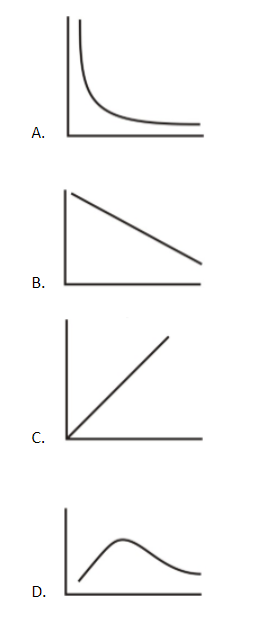
How is the kinetic energy versus temperature graph for a given substance?
Answer
 Verified
612.9k+ views
Hint: Write the relationship between the average kinetic energy of the molecules and absolute temperature. From this relationship, decide if the plot is a straight line or a curve. For a curve, decide the shape of the curve from the relationship. If a straight line is obtained, then decide if the slope is positive or negative.
Complete Step by step answer: The average kinetic energy of the molecules is \[{\text{K}}{\text{.E = }}\dfrac{3}{2}{\text{kT }}\]
Here, \[{\text{K}}{\text{.E}}\] represents the average kinetic energy of the molecules, \[{\text{k}}\] represents the Boltzmann constant whereas \[{\text{T}}\] represents the absolute temperature.
Thus, the average kinetic energy of the molecules is directly proportional to the absolute temperature.
\[{\text{K}}{\text{.E }} \propto {\text{T}}\]
At absolute zero, the average kinetic energy of the molecules has a value of zero. With increase in the absolute temperature, the average kinetic energy of the molecules also increases.
For one mole of the ideal gas, the average molecular kinetic energy of molecules is plotted on the Y axis whereas the absolute temperature is plotted on the X axis. The plot is a straight line passing through the origin and having a positive slope. Such a plot is obtained in the plot of the option (C).
Hence, the correct option is the option (C).
Note: We should note that the kinetic energy is expressed in terms of temperature and not the velocity. So we can also say that there would be relation in between the temperature and the velocity of molecules.The Boltzmann constant \[{\text{k = }}\dfrac{{\text{R}}}{{{{\text{N}}_{\text{A}}}}}\] .Here, \[{\text{R}}\] is the ideal gas constant and \[{{\text{N}}_{\text{A}}}\] is the Avogadro’s number. The value of the Boltzmann constant is \[{\text{1}}{\text{.38}} \times {\text{1}}{{\text{0}}^{ - {\text{23}}}}{\text{ Joule molecul}}{{\text{e}}^{ - 1}}{\text{ }}{{\text{K}}^{ - 1}}\] .
Complete Step by step answer: The average kinetic energy of the molecules is \[{\text{K}}{\text{.E = }}\dfrac{3}{2}{\text{kT }}\]
Here, \[{\text{K}}{\text{.E}}\] represents the average kinetic energy of the molecules, \[{\text{k}}\] represents the Boltzmann constant whereas \[{\text{T}}\] represents the absolute temperature.
Thus, the average kinetic energy of the molecules is directly proportional to the absolute temperature.
\[{\text{K}}{\text{.E }} \propto {\text{T}}\]
At absolute zero, the average kinetic energy of the molecules has a value of zero. With increase in the absolute temperature, the average kinetic energy of the molecules also increases.
For one mole of the ideal gas, the average molecular kinetic energy of molecules is plotted on the Y axis whereas the absolute temperature is plotted on the X axis. The plot is a straight line passing through the origin and having a positive slope. Such a plot is obtained in the plot of the option (C).
Hence, the correct option is the option (C).
Note: We should note that the kinetic energy is expressed in terms of temperature and not the velocity. So we can also say that there would be relation in between the temperature and the velocity of molecules.The Boltzmann constant \[{\text{k = }}\dfrac{{\text{R}}}{{{{\text{N}}_{\text{A}}}}}\] .Here, \[{\text{R}}\] is the ideal gas constant and \[{{\text{N}}_{\text{A}}}\] is the Avogadro’s number. The value of the Boltzmann constant is \[{\text{1}}{\text{.38}} \times {\text{1}}{{\text{0}}^{ - {\text{23}}}}{\text{ Joule molecul}}{{\text{e}}^{ - 1}}{\text{ }}{{\text{K}}^{ - 1}}\] .
Recently Updated Pages
Master Class 11 English: Engaging Questions & Answers for Success

Master Class 11 Social Science: Engaging Questions & Answers for Success
Master Class 11 Maths: Engaging Questions & Answers for Success
Master Class 11 Biology: Engaging Questions & Answers for Success
Master Class 11 Physics: Engaging Questions & Answers for Success
Master Class 11 Chemistry: Engaging Questions & Answers for Success
Trending doubts
One Metric ton is equal to kg A 10000 B 1000 C 100 class 11 physics CBSE
Difference Between Prokaryotic Cells and Eukaryotic Cells
Find the value of the expression given below sin 30circ class 11 maths CBSE
Difference between physical and chemical change class 11 chemistry CBSE
Two of the body parts which do not appear in MRI are class 11 biology CBSE
Draw a diagram of a plant cell and label at least eight class 11 biology CBSE