




What is joint? Explain ball and socket joint along with diagram.
Answer
 Verified
612.9k+ views
Hint: Joint occurs where two bones meet. They make the skeleton flexible. The skeleton of the human body is a framework of a total 206 bones of different shapes and sizes. The framework provides support to the body and also protects vital internal organs. There are three types of connective tissue in the skeletal system which hold bones together. They are tendons, ligaments and cartilage.
Complete Answer:
Joint is the position where two bones meet. They make the skeleton flexible. There are types of joints namely:
(a) Immovable joints: The joints that are present in the skull are called immovable joints. The bones in the skull are fixed and do not move.
(b) Partially movable: These joints are little free and are able to show little movement. Example: Bones between rule brain spine.
(c) Freely movable: These joints are also called synovial joints. These joints move in many directions. Location of freely movable joints are hip, shoulder, elbows, knees, wrists and ankles.
Ball and socket joint: These joints allow the bones to move freely in all directions. Ball and socket joints are found in the hips and shoulder region. Hips and shoulders have this type of joint in which the rounded of long bone i.e. ball fits into a hollow portion (socket) of another bone.
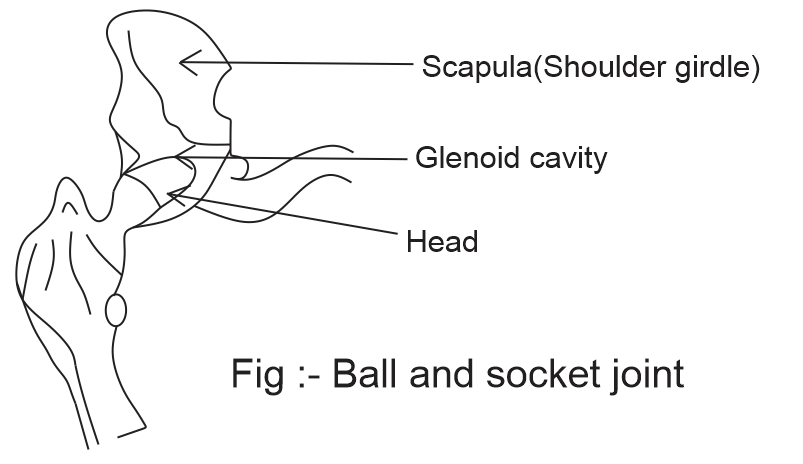
Note: Joints help in movement. The different major freely movable joints in the human body are ball and socket joints, hinge joint, pivot joint and gliding joint.
Complete Answer:
Joint is the position where two bones meet. They make the skeleton flexible. There are types of joints namely:
(a) Immovable joints: The joints that are present in the skull are called immovable joints. The bones in the skull are fixed and do not move.
(b) Partially movable: These joints are little free and are able to show little movement. Example: Bones between rule brain spine.
(c) Freely movable: These joints are also called synovial joints. These joints move in many directions. Location of freely movable joints are hip, shoulder, elbows, knees, wrists and ankles.
Ball and socket joint: These joints allow the bones to move freely in all directions. Ball and socket joints are found in the hips and shoulder region. Hips and shoulders have this type of joint in which the rounded of long bone i.e. ball fits into a hollow portion (socket) of another bone.
Note: Joints help in movement. The different major freely movable joints in the human body are ball and socket joints, hinge joint, pivot joint and gliding joint.
Recently Updated Pages
Master Class 11 English: Engaging Questions & Answers for Success

Master Class 11 Social Science: Engaging Questions & Answers for Success
Master Class 11 Maths: Engaging Questions & Answers for Success
Master Class 11 Chemistry: Engaging Questions & Answers for Success
Master Class 11 Biology: Engaging Questions & Answers for Success
Master Class 11 Physics: Engaging Questions & Answers for Success
Trending doubts
One Metric ton is equal to kg A 10000 B 1000 C 100 class 11 physics CBSE
Difference Between Prokaryotic Cells and Eukaryotic Cells
Find the value of the expression given below sin 30circ class 11 maths CBSE
1 ton equals to A 100 kg B 1000 kg C 10 kg D 10000 class 11 physics CBSE
Two of the body parts which do not appear in MRI are class 11 biology CBSE
What are hard magnetic materials class 11 physics CBSE