




It is given that in $\Delta ABC,\overrightarrow {AD} $ is a median, hence according to the Apollonius theorem which one of the following results is true?
A)$A{B^2} + A{C^2} = 2\left( {A{D^2} + B{C^2}} \right)$
B)$A{B^2} + A{C^2} = 2\left( {B{D^2} + D{C^2}} \right)$
C)$A{B^2} + A{C^2} = 2\left( {A{D^2} + D{C^2}} \right)$
D)$A{B^2} + A{C^2} = 2\left( {B{D^2} + B{C^2}} \right)$
Answer
 Verified
623.4k+ views
Hint- In this question, we have to apply Apollonius theorem, which states that the sum of squares of any two sides of a triangle equals twice its square on half of the third side along with twice of its square on the median bisecting the third side. For this we will make use of the Pythagoras theorem on sub right-angled triangles.
Complete step-by-step answer:
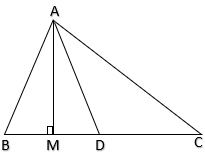
Let AM be perpendicular to BC and AD be median to BC such
that $BD = CD = \dfrac{{BC}}{2}$ ---(A)
Using the Pythagorean theorem, which simply states that in a right-angled triangle, the square of the hypotenuse side is equal to the sum of squares of the other two sides. The sides of this triangle have been named as Perpendicular, Base and Hypotenuse. Here, the hypotenuse is the longest side, as it is opposite to the angle 90°.
${H^2} = {P^2} + {B^2}$ where H = Hypotenuse, P = Perpendicular, B = Base
Here, Using Pythagorean theorem we get in $\Delta AMB$
$ \Rightarrow A{B^2} = A{M^2} + B{M^2}$ ---(1)
Using Pythagorean theorem in $\Delta AMD$
$ \Rightarrow A{D^2} = A{M^2} + M{D^2}$ ----(2)
Using Pythagorean theorem in $\Delta AMC$
$ \Rightarrow A{C^2} = A{M^2} + M{C^2}$ ----(3)
Adding (1) and (3)
$ \Rightarrow A{B^2} + A{C^2} = 2A{M^2} + M{C^2} + B{M^2}$
$ = 2A{M^2} + M{C^2} + B{M^2} + 2D{M^2} - 2D{M^2}$
$ = 2A{M^2} + 2D{M^2} + M{C^2} - D{M^2} + B{M^2} - D{M^2}$
Taking 2 common from the first two terms and applying ${a^2} - {b^2} = (a + b)(a - b)$ on the other terms separately.
$ = 2(A{M^2} + D{M^2}) + (MC + DM)(MC - DM) + (BM + DM)(BM - DM)$
Using (2) here for the first two terms and also, we know that MC – DM = DC and BM + DM =
BD
$ = 2(A{M^2} + D{M^2}) + (MC + DM)DC + BD(BM - DM)$
Now using (A) here we get,
$ = 2A{D^2} + (MC + DM)DC + DC(BM - DM)$
$ = 2A{D^2} + DC(MC + BM)$
Also, MC + BM = BC from the figure above
\[ = 2A{D^2} + DC \times BC\]
Again using (A) which states that $DC = \dfrac{{BC}}{2}$ or $BC = 2DC$
$ = 2A{D^2} + DC \times 2DC$
$ = 2A{D^2} + 2D{C^2}$
Taking 2 common from both we get,
$ \Rightarrow A{B^2} + A{C^2} = 2(A{D^2} + D{C^2})$
Hence, $A{B^2} + A{C^2} = 2(A{D^2} + D{C^2})$
$\therefore $ Option C. is the correct answer.
Note- In these types of questions, always try to use Pythagorean theorem which simply states that in a right-angled triangle, the square of the hypotenuse side is equal to the sum of squares of the other two sides to suitable triangles and arrange the results to find the answer.
Complete step-by-step answer:
Let AM be perpendicular to BC and AD be median to BC such
that $BD = CD = \dfrac{{BC}}{2}$ ---(A)
Using the Pythagorean theorem, which simply states that in a right-angled triangle, the square of the hypotenuse side is equal to the sum of squares of the other two sides. The sides of this triangle have been named as Perpendicular, Base and Hypotenuse. Here, the hypotenuse is the longest side, as it is opposite to the angle 90°.
${H^2} = {P^2} + {B^2}$ where H = Hypotenuse, P = Perpendicular, B = Base
Here, Using Pythagorean theorem we get in $\Delta AMB$
$ \Rightarrow A{B^2} = A{M^2} + B{M^2}$ ---(1)
Using Pythagorean theorem in $\Delta AMD$
$ \Rightarrow A{D^2} = A{M^2} + M{D^2}$ ----(2)
Using Pythagorean theorem in $\Delta AMC$
$ \Rightarrow A{C^2} = A{M^2} + M{C^2}$ ----(3)
Adding (1) and (3)
$ \Rightarrow A{B^2} + A{C^2} = 2A{M^2} + M{C^2} + B{M^2}$
$ = 2A{M^2} + M{C^2} + B{M^2} + 2D{M^2} - 2D{M^2}$
$ = 2A{M^2} + 2D{M^2} + M{C^2} - D{M^2} + B{M^2} - D{M^2}$
Taking 2 common from the first two terms and applying ${a^2} - {b^2} = (a + b)(a - b)$ on the other terms separately.
$ = 2(A{M^2} + D{M^2}) + (MC + DM)(MC - DM) + (BM + DM)(BM - DM)$
Using (2) here for the first two terms and also, we know that MC – DM = DC and BM + DM =
BD
$ = 2(A{M^2} + D{M^2}) + (MC + DM)DC + BD(BM - DM)$
Now using (A) here we get,
$ = 2A{D^2} + (MC + DM)DC + DC(BM - DM)$
$ = 2A{D^2} + DC(MC + BM)$
Also, MC + BM = BC from the figure above
\[ = 2A{D^2} + DC \times BC\]
Again using (A) which states that $DC = \dfrac{{BC}}{2}$ or $BC = 2DC$
$ = 2A{D^2} + DC \times 2DC$
$ = 2A{D^2} + 2D{C^2}$
Taking 2 common from both we get,
$ \Rightarrow A{B^2} + A{C^2} = 2(A{D^2} + D{C^2})$
Hence, $A{B^2} + A{C^2} = 2(A{D^2} + D{C^2})$
$\therefore $ Option C. is the correct answer.
Note- In these types of questions, always try to use Pythagorean theorem which simply states that in a right-angled triangle, the square of the hypotenuse side is equal to the sum of squares of the other two sides to suitable triangles and arrange the results to find the answer.
Recently Updated Pages
Basicity of sulphurous acid and sulphuric acid are

Master Class 10 English: Engaging Questions & Answers for Success
Master Class 10 Social Science: Engaging Questions & Answers for Success
Master Class 10 Computer Science: Engaging Questions & Answers for Success
Class 10 Question and Answer - Your Ultimate Solutions Guide
Master Class 10 General Knowledge: Engaging Questions & Answers for Success
Trending doubts
Who is known as the "Little Master" in Indian cricket history?
Explain the Treaty of Vienna of 1815 class 10 social science CBSE
A boat goes 24 km upstream and 28 km downstream in class 10 maths CBSE
Which are the three major ports of Tamil Nadu A Chennai class 10 social science CBSE
The highest dam in India is A Bhakra dam B Tehri dam class 10 social science CBSE
Describe the process of Unification of Italy class 10 social science CBSE