




Isobutyl magnesium bromide with dry ether and absolute alcohol gives:
A.$\
C{H_3} - CH - C{H_2}OH \\
\,\,\,\,\,\,\,\,\,\,\,\,\,\,| \\
\,\,\,\,\,\,\,\,\,\,\,\,\,C{H_3} \\
\ $ and $C{H_3}C{H_2}MgBr$
B. $\
C{H_3} - CH - C{H_2} - C{H_{3\,}} \\
\,\,\,\,\,\,\,\,\,\,\,\,\,\,\,| \\
\,\,\,\,\,\,\,\,\,\,\,\,\,\,C{H_3} \\
\ $ and $Mg(OH)Br$
C. $\
C{H_3} - CH - C{H_3}CH2 - C{H_{2\,}} \\
\,\,\,\,\,\,\,\,\,\,\,\,\,\,\,\,| \\
\,\,\,\,\,\,\,\,\,\,\,\,\,\,\,\,C{H_3} \\
\,\,\,\,\,\,\,\,\,\,\,\, \\
\ $and $Mg\left( {OH} \right)Br$
D. $\
C{H_{_3}} - CH - C{H_3} \\
\,\,\,\,\,\,\,\,\,\,\,\,\,\,\,\,| \\
\,\,\,\,\,\,\,\,\,\,\,\,\,\,\,C{H_3} \\
\ $ and $C{H_3}C{H_2}OMgBr$
Answer
 Verified
605.1k+ views
Hint: The compounds having a generic formula of $R - Mg - X$ where $X$ is the halogen and $R$ is usually an alkyl or aryl group is called Grignard reagent of Grignard compound. In organic synthesis Grignard reagent is popular in the synthesis of new carbon - carbon bonds.
Complete step by step answer:
In this reaction isobutyl magnesium bromide reacts with absolute alcohol where isobutyl magnesium bromide acts as Grignard reagent and reacts with absolute alcohol. Here Grignard reagents react with the active hydrogen present in absolute alcohol. During this reaction the active hydrogen present in the absolute alcohol gets swapped with $MgBr$ present in isobutyl magnesium bromide forming isobutane and magnesium bromide ethanoate as the end products.
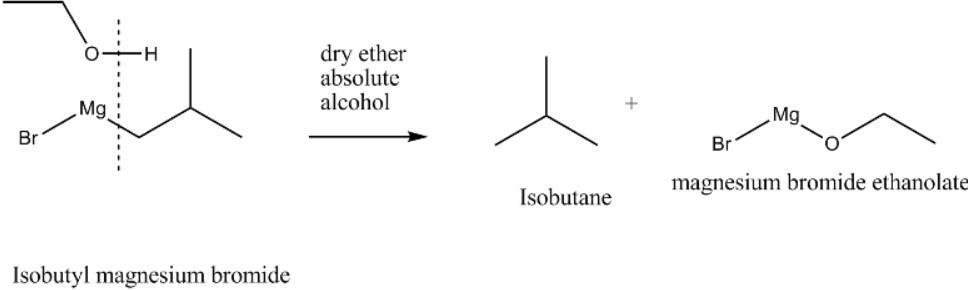
Hence, we get the final products isobutane and magnesium bromide ethanoate.
So, the correct answer is Option D.
Additional information:
Pure Grignard reagents are extremely reactive solids hence they are usually handled as solutions in solvents like diethyl ether or tetrahydrofuran which are stable as long as water is excluded. In those mediums Grignard reagent is invariably present as a complex along with magnesium atoms connected with two ether oxygens by means of coordination bonds.
Note: Grignard reagents are prepared by treating organic handles (normally organo bromine) with magnesium metal. In order to stabilize organo magnesium compounds cyclic or acyclic ethers are used. Water and air rapidly destroys the reagent by protonolysis or oxidation are excluded using air free techniques.
Complete step by step answer:
In this reaction isobutyl magnesium bromide reacts with absolute alcohol where isobutyl magnesium bromide acts as Grignard reagent and reacts with absolute alcohol. Here Grignard reagents react with the active hydrogen present in absolute alcohol. During this reaction the active hydrogen present in the absolute alcohol gets swapped with $MgBr$ present in isobutyl magnesium bromide forming isobutane and magnesium bromide ethanoate as the end products.
Hence, we get the final products isobutane and magnesium bromide ethanoate.
So, the correct answer is Option D.
Additional information:
Pure Grignard reagents are extremely reactive solids hence they are usually handled as solutions in solvents like diethyl ether or tetrahydrofuran which are stable as long as water is excluded. In those mediums Grignard reagent is invariably present as a complex along with magnesium atoms connected with two ether oxygens by means of coordination bonds.
Note: Grignard reagents are prepared by treating organic handles (normally organo bromine) with magnesium metal. In order to stabilize organo magnesium compounds cyclic or acyclic ethers are used. Water and air rapidly destroys the reagent by protonolysis or oxidation are excluded using air free techniques.
Recently Updated Pages
Difference Between Prokaryotic Cells and Eukaryotic Cells

If x a + bt + ct2 where x is in meters and t is in class 11 physics CBSE
A car covers the first half distance between two places class 11 physics CBSE
The resultant of two vectors overrightarrow P and overrightarrow class 11 physics CBSE
Find the value of cos 135 class 11 maths CBSE
A mass M is held in place by an applied force F and class 11 physics CBSE
Trending doubts
One Metric ton is equal to kg A 10000 B 1000 C 100 class 11 physics CBSE
Find the value of the expression given below sin 30circ class 11 maths CBSE
Draw a diagram of nephron and explain its structur class 11 biology CBSE
10 examples of friction in our daily life
Proton was discovered by A Thomson B Rutherford C Chadwick class 11 chemistry CBSE
Bond order ofO2 O2+ O2 and O22 is in order A O2 langle class 11 chemistry CBSE