




Is turmeric an underground stem?
Answer
 Verified
536.7k+ views
Hint: The stem is the plant's axis, bearing shoots, leaves, buds, and basal end-roots. The stem is changed in some plants to perform additional roles such as food storage, support, vegetative propagation, and protection. Modified stems are simply referred to as such, and they are divided into several categories. The stem helps to give the plant structure and stability. It is divided into three categories: Underground Modifications, Aerial Modifications and Sub-aerial Modifications.
Complete answer:
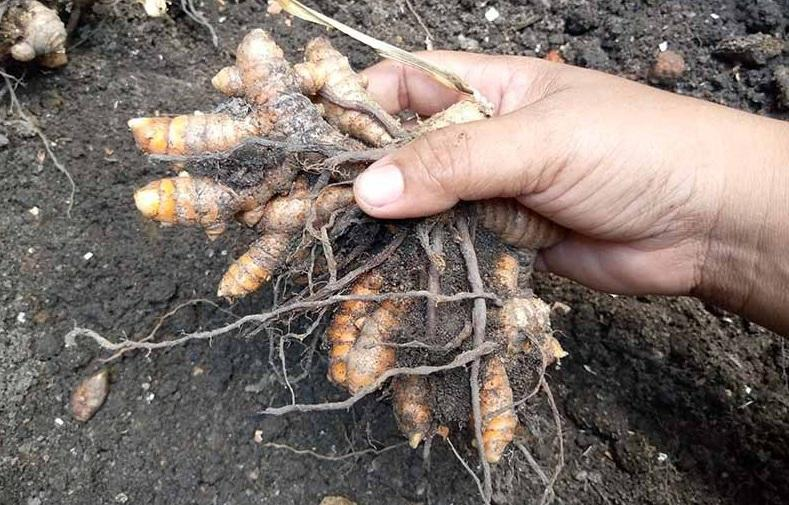
Turmeric is a ginger-like plant's rhizome, or underground stem (rhizome).
The subterranean stem of turmeric is called a rhizome, and it is divided into two parts: the core pear-shaped mother rhizome, and the lateral axillary branches, which are called fingers. They are usually found in the ground as a brilliant yellow, fine powder. Turmeric is a tuberous rhizome with a rough, segmented surface. The rhizome is yellowish-brown in colour with a dull orange inside that turns bright yellow when powdered.
Additional information:
Underground stems are plants that have been engineered to generate from stem tissue yet dwell beneath the soil surface. They serve as food and nutrient storage. Bulbs, corms, rhizomes, stolons, spindle-shaped, and tubers are some of the several types. Roots do not have nodes with buds where leaves and flowers emerge at specified points, as do stems.
Note:
A rhizome is a subterranean plant stem that has been adapted to send roots and shoots out of its nodes. Crawling roots talks are another name for rhizomes. Rhizomes are horizontally growing rhizomes that emerge from axillary buds. The ability of the rhizome to let new shoots grow upwards is also preserved. A rhizome is a plant's main stem that extends horizontally underground.
Complete answer:
Turmeric is a ginger-like plant's rhizome, or underground stem (rhizome).
The subterranean stem of turmeric is called a rhizome, and it is divided into two parts: the core pear-shaped mother rhizome, and the lateral axillary branches, which are called fingers. They are usually found in the ground as a brilliant yellow, fine powder. Turmeric is a tuberous rhizome with a rough, segmented surface. The rhizome is yellowish-brown in colour with a dull orange inside that turns bright yellow when powdered.
Additional information:
Underground stems are plants that have been engineered to generate from stem tissue yet dwell beneath the soil surface. They serve as food and nutrient storage. Bulbs, corms, rhizomes, stolons, spindle-shaped, and tubers are some of the several types. Roots do not have nodes with buds where leaves and flowers emerge at specified points, as do stems.
Note:
A rhizome is a subterranean plant stem that has been adapted to send roots and shoots out of its nodes. Crawling roots talks are another name for rhizomes. Rhizomes are horizontally growing rhizomes that emerge from axillary buds. The ability of the rhizome to let new shoots grow upwards is also preserved. A rhizome is a plant's main stem that extends horizontally underground.
Recently Updated Pages
Master Class 12 Economics: Engaging Questions & Answers for Success

Master Class 12 English: Engaging Questions & Answers for Success
Master Class 12 Social Science: Engaging Questions & Answers for Success
Master Class 12 Maths: Engaging Questions & Answers for Success
Master Class 12 Physics: Engaging Questions & Answers for Success
Master Class 11 Social Science: Engaging Questions & Answers for Success
Trending doubts
One Metric ton is equal to kg A 10000 B 1000 C 100 class 11 physics CBSE
Difference Between Prokaryotic Cells and Eukaryotic Cells
Find the value of the expression given below sin 30circ class 11 maths CBSE
Two of the body parts which do not appear in MRI are class 11 biology CBSE
Draw a diagram of nephron and explain its structur class 11 biology CBSE
10 examples of friction in our daily life