




Is the pith of plants ground tissue?
Answer
 Verified
557.4k+ views
Hint: Ground tissue in the plants is inclusive of tissues, which are neither vascular nor dermal. The ground tissue system arises from the ground tissue meristem. Based on the nature of the cell walls, the ground tissue is divided into three types, namely, parenchyma, sclerenchyma, and collenchyma. Ground tissue surrounds the pericycle and vascular cylinder.
Complete answer:
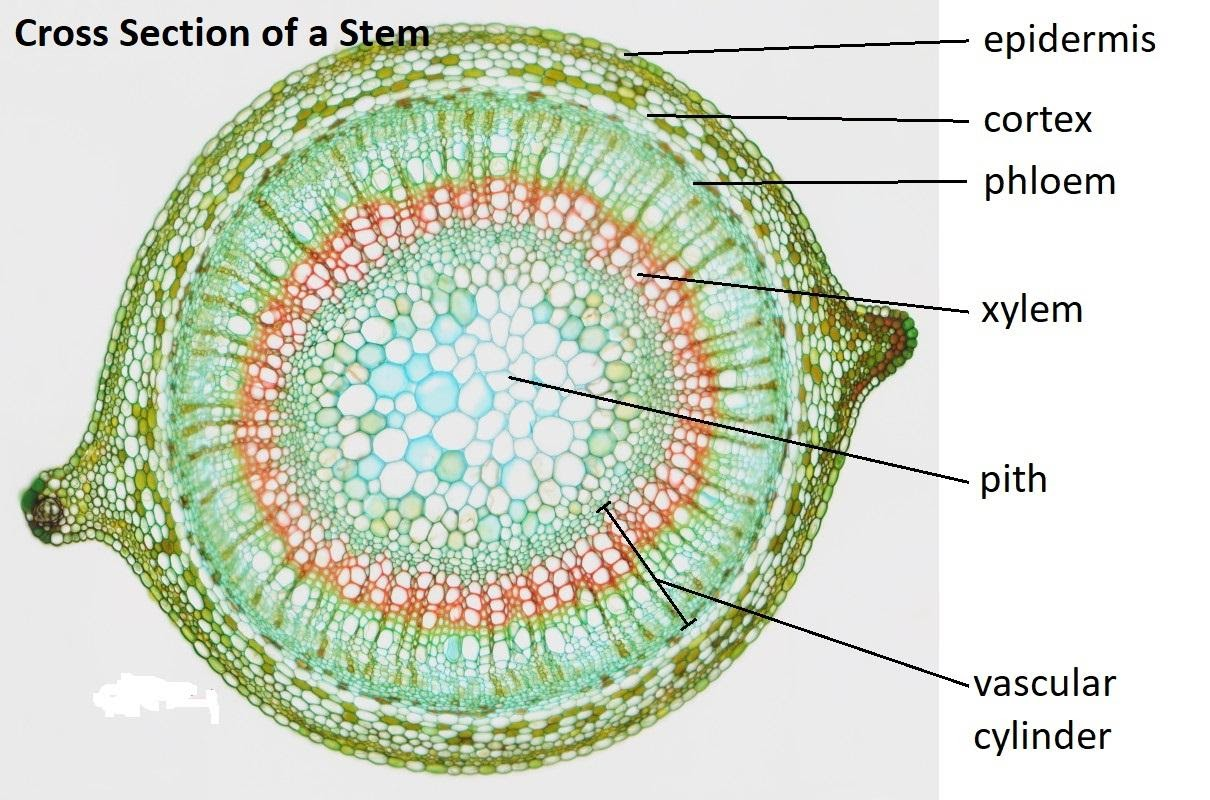
Fig: Internal Anatomy of Stem
As the pith of plants is composed of parenchyma cells, it is ground tissue.
Pith is present in the central portion of the stem. The cells of the pith are rounded in shape, with large intercellular spaces. The cells of the pith, which are present between the vascular bundles, constitute the pith rays, which are otherwise known as medullary rays. As the parenchyma cells are radially arranged in between the bundles, the arrangement provides the appearance of rays. These pith rays aid in the radial conduction of food. Pith offers structure to the stem at the center.
Pith performs storage of food. So the cells are unspecialized since storage is not an active function. The tissue exists and stores different substances. It is the central parenchyma cell in the stem and is primarily used for storage.
In the dicot root, the xylem and phloem form an X-shape at the center of the root, while in the monocot root, the phloem and the xylem form a characteristic ring around the pith. Thus, the center of the monocot root is filled with pith.
Note:
When the ground tissue is present in the root center, it is the pith. At the same time, when the ground tissue is present at the root periphery, it is the cortex. Parenchyma aids in the photosynthesis of leaves and storage in roots. Collenchyma provides support to the shoot in areas of active growth. Sclerenchyma displays support for the shoot in the areas where the growth has ceased.
Complete answer:
Fig: Internal Anatomy of Stem
As the pith of plants is composed of parenchyma cells, it is ground tissue.
Pith is present in the central portion of the stem. The cells of the pith are rounded in shape, with large intercellular spaces. The cells of the pith, which are present between the vascular bundles, constitute the pith rays, which are otherwise known as medullary rays. As the parenchyma cells are radially arranged in between the bundles, the arrangement provides the appearance of rays. These pith rays aid in the radial conduction of food. Pith offers structure to the stem at the center.
Pith performs storage of food. So the cells are unspecialized since storage is not an active function. The tissue exists and stores different substances. It is the central parenchyma cell in the stem and is primarily used for storage.
In the dicot root, the xylem and phloem form an X-shape at the center of the root, while in the monocot root, the phloem and the xylem form a characteristic ring around the pith. Thus, the center of the monocot root is filled with pith.
Note:
When the ground tissue is present in the root center, it is the pith. At the same time, when the ground tissue is present at the root periphery, it is the cortex. Parenchyma aids in the photosynthesis of leaves and storage in roots. Collenchyma provides support to the shoot in areas of active growth. Sclerenchyma displays support for the shoot in the areas where the growth has ceased.
Recently Updated Pages
Which will be the least stable resonating structure class 11 chemistry CBSE

How many 5 digit telephone numbers can be construc-class-11-maths-CBSE
How do you find the angle of the resultant vector class 11 physics CBSE
Draw labelled diagram of the following i Gram seed class 11 biology CBSE
1 Quintal is equal to a 110 kg b 10 kg c 100kg d 1000 class 11 physics CBSE
What is the need and importance of classification class 11 biology CBSE
Trending doubts
Find the value of the expression given below sin 30circ class 11 maths CBSE
One Metric ton is equal to kg A 10000 B 1000 C 100 class 11 physics CBSE
10 examples of friction in our daily life
Draw a diagram of a plant cell and label at least eight class 11 biology CBSE
Difference between physical and chemical change class 11 chemistry CBSE
Proton was discovered by A Thomson B Rutherford C Chadwick class 11 chemistry CBSE