




Is skin color an example of incomplete dominance in humans?
Answer
 Verified
540.3k+ views
Hint: Dwarf, tall, and pink are all phenotypic or morphological characteristics, as we all know. The experiment Portrayed by Gregor Mendel, in his studies of the genetics of the pea plant. Each being carries two copies of trait- one was dominant trait and one is recessive. Heterozygous tall plant with pink flower is test crossed with homozygous recessive as a result different phenotypes are produced in the \[F1\] offspring.
Complete answer:
By performing a test cross, it can be determined that the individual is homozygous or heterozygous dominant. In a test cross, an individual bred with another individual that is homozygous for the recessive trait and offspring of the test cross is determined. The test has two possibilities- if any offspring produced expresses the recessive trait, the individual is heterozygous. If all the offspring produced express a dominant trait, the individual is homozygous for the dominant allele.
Test crosses have a variety of applications like- model organisms such as Caenorhabditis elegans and drosophila melanogaster. There are also limitations in test cross- It can be time-consuming for some experiments as organisms require long time for growth and generation. A large number of offspring require reliable data due to statistics. Test crosses are only useful when complete dominance is there. Incomplete dominance does not show test cross.
Note:
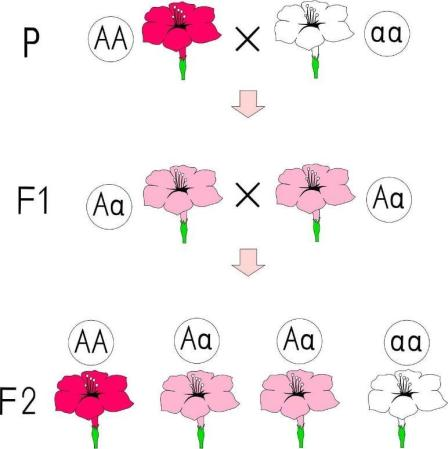
Skin color is shown by the amount of melanin pigment in the body. The amount of pigment is demonstrated by certain genes. Hence, skin color is an example of incomplete dominance as it is maintained by multiple genes. And also, they show polygenic inheritance. Another example of incomplete dominance is mirabilis Jalapa also known as $4$o’ clock plant which bears flowers of white and pink pigment color when red and white flowers are crossbred together.
Complete answer:
By performing a test cross, it can be determined that the individual is homozygous or heterozygous dominant. In a test cross, an individual bred with another individual that is homozygous for the recessive trait and offspring of the test cross is determined. The test has two possibilities- if any offspring produced expresses the recessive trait, the individual is heterozygous. If all the offspring produced express a dominant trait, the individual is homozygous for the dominant allele.
Test crosses have a variety of applications like- model organisms such as Caenorhabditis elegans and drosophila melanogaster. There are also limitations in test cross- It can be time-consuming for some experiments as organisms require long time for growth and generation. A large number of offspring require reliable data due to statistics. Test crosses are only useful when complete dominance is there. Incomplete dominance does not show test cross.
Note:
Skin color is shown by the amount of melanin pigment in the body. The amount of pigment is demonstrated by certain genes. Hence, skin color is an example of incomplete dominance as it is maintained by multiple genes. And also, they show polygenic inheritance. Another example of incomplete dominance is mirabilis Jalapa also known as $4$o’ clock plant which bears flowers of white and pink pigment color when red and white flowers are crossbred together.
Recently Updated Pages
Master Class 12 Business Studies: Engaging Questions & Answers for Success

Master Class 12 Chemistry: Engaging Questions & Answers for Success
Master Class 12 Biology: Engaging Questions & Answers for Success
Class 12 Question and Answer - Your Ultimate Solutions Guide
Master Class 11 English: Engaging Questions & Answers for Success
Master Class 11 Social Science: Engaging Questions & Answers for Success
Trending doubts
Which are the Top 10 Largest Countries of the World?
Draw a labelled sketch of the human eye class 12 physics CBSE
Differentiate between homogeneous and heterogeneous class 12 chemistry CBSE
Why is the cell called the structural and functional class 12 biology CBSE
Draw ray diagrams each showing i myopic eye and ii class 12 physics CBSE
Which is the correct genotypic ratio of mendel dihybrid class 12 biology CBSE