




Is $ N{O^ - } $ paramagnetic or diamagnetic?
Answer
 Verified
560.4k+ views
Hint: Draw the molecular orbital diagram for $ N{O^ - } $ and look for the presence of any unpaired electrons. If there are unpaired electrons then it will be paramagnetic otherwise it will be diamagnetic. MOT uses quantum mechanics to describe the electronic structure of molecules.
Complete answer:
Whether a compound or a molecule is paramagnetic or diamagnetic can be known by drawing the molecular orbital theory (MOT) diagram.
Molecular orbital theory, abbreviated as MOT, is a method for describing the electronic structure of molecules using quantum mechanics. MOT uses a linear combination of atomic orbitals to represent molecular orbitals resulting from bonds between atoms. These are often divided into three types, bonding, antibonding, and non-bonding.
Now let us draw the molecular orbital diagram for $ N{O^ - } $ . The MO diagram for $ N{O^ - } $ is as follows:
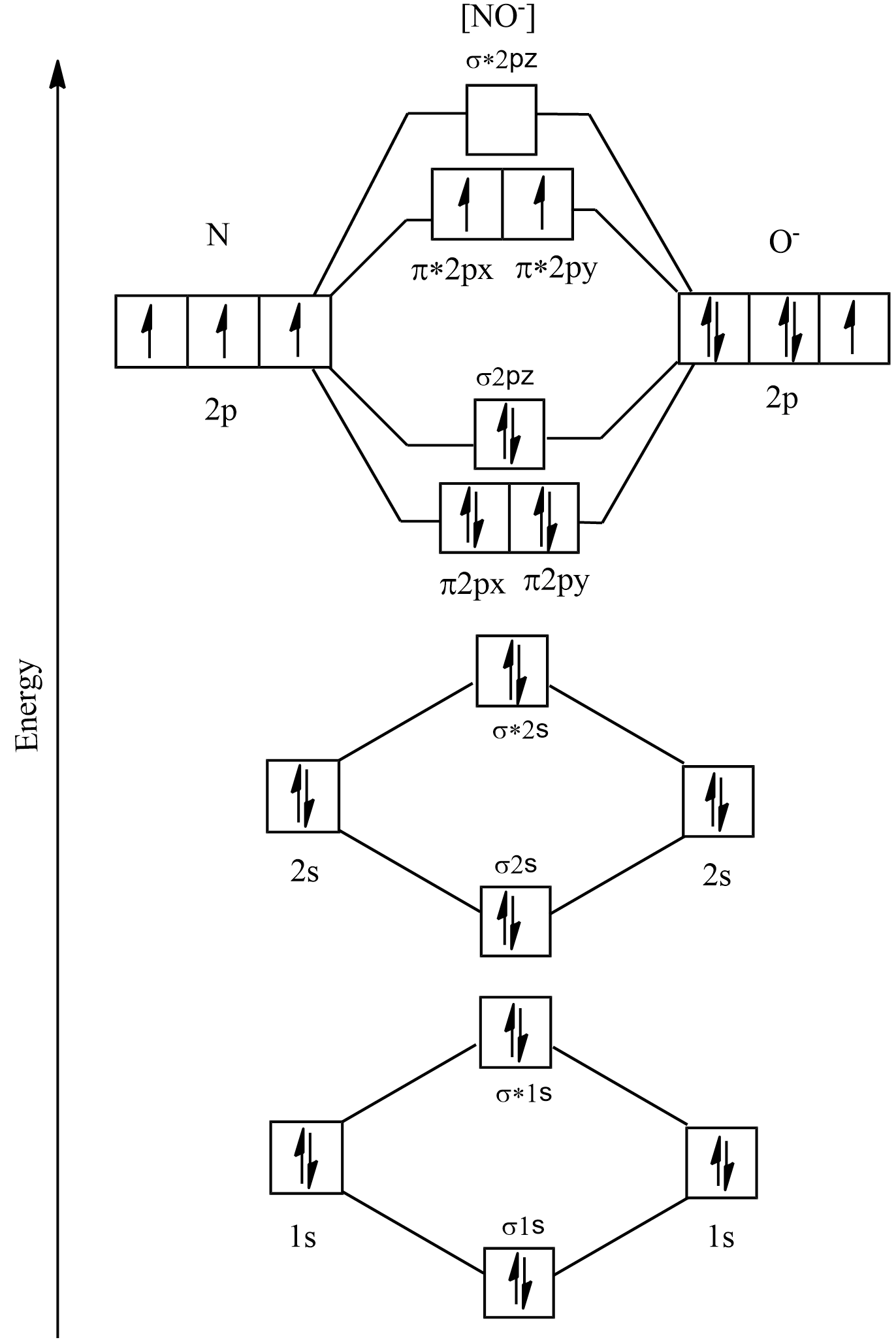
In the above image we can see that all the $ 1s $ and $ 2s $ orbitals are completely filled. But when it comes to the $ 2p $ orbitals, it can be seen that the bonding orbitals are completely filled whereas in the antibonding orbitals two of them have unpaired electrons, that is two of them are singly filled. Thus it can be said that it is paramagnetic.
Therefore, $ N{O^ - } $ is paramagnetic.
The electronic configuration of $ N{O^ - } $ according to MOT becomes $ {(\sigma 1s)^2}{(\sigma *1s)^2}{(\sigma 2s)^2}{(\sigma *2s)^2}{(\pi 2px)^2}{(\pi 2py)^2}{(\sigma 2pz)^2}{(\pi *2px)^1}{\left( {\pi *2py} \right)^1} $
Note:
While drawing the molecular orbital diagram it is important to draw the orbitals as shown above. The orbitals are placed according to their energy. The orbitals placed below are lower in energy and the ones placed above are higher in energy. Often it is said that MOT is a better approach because it has many advantages. It can predict the magnetic properties; it correctly explains the electronic structures of molecules that do not follow Lewis dot structure and so on.
Complete answer:
Whether a compound or a molecule is paramagnetic or diamagnetic can be known by drawing the molecular orbital theory (MOT) diagram.
Molecular orbital theory, abbreviated as MOT, is a method for describing the electronic structure of molecules using quantum mechanics. MOT uses a linear combination of atomic orbitals to represent molecular orbitals resulting from bonds between atoms. These are often divided into three types, bonding, antibonding, and non-bonding.
Now let us draw the molecular orbital diagram for $ N{O^ - } $ . The MO diagram for $ N{O^ - } $ is as follows:
In the above image we can see that all the $ 1s $ and $ 2s $ orbitals are completely filled. But when it comes to the $ 2p $ orbitals, it can be seen that the bonding orbitals are completely filled whereas in the antibonding orbitals two of them have unpaired electrons, that is two of them are singly filled. Thus it can be said that it is paramagnetic.
Therefore, $ N{O^ - } $ is paramagnetic.
The electronic configuration of $ N{O^ - } $ according to MOT becomes $ {(\sigma 1s)^2}{(\sigma *1s)^2}{(\sigma 2s)^2}{(\sigma *2s)^2}{(\pi 2px)^2}{(\pi 2py)^2}{(\sigma 2pz)^2}{(\pi *2px)^1}{\left( {\pi *2py} \right)^1} $
Note:
While drawing the molecular orbital diagram it is important to draw the orbitals as shown above. The orbitals are placed according to their energy. The orbitals placed below are lower in energy and the ones placed above are higher in energy. Often it is said that MOT is a better approach because it has many advantages. It can predict the magnetic properties; it correctly explains the electronic structures of molecules that do not follow Lewis dot structure and so on.
Recently Updated Pages
Write structures of the following compounds i 2 Chloro3methylpentane class 11 chemistry CBSE

What is BLO What is the full form of BLO class 8 social science CBSE
Explain the Treaty of Vienna of 1815 class 10 social science CBSE
A Paragraph on Pollution in about 100-150 Words
XIX+XXX A 49 B 51 C 55 D 44 class 5 maths CBSE
If x a + bt + ct2 where x is in meters and t is in class 11 physics CBSE
Trending doubts
One Metric ton is equal to kg A 10000 B 1000 C 100 class 11 physics CBSE
What do you mean by retardation What is its SI uni class 11 physics CBSE
Draw a diagram of nephron and explain its structur class 11 biology CBSE
10 examples of friction in our daily life
Difference between physical and chemical change class 11 chemistry CBSE
Proton was discovered by A Thomson B Rutherford C Chadwick class 11 chemistry CBSE