




Is Nitrogen gas inert?
Answer
 Verified
511.5k+ views
Hint: Nitrogen was discovered by Rutherford and A. Lavoisier in $1772$ . The atomic number assigned to the atomic nitrogen is $7$ because of presences of $7$ electrons in total to it. The atomic mass of the nitrogen was calculated to be $14.0067\,u$ . The nitrogen gas or dinitrogen or the ${N_2}$ accounts for the $78\% $ of the volume of earth’s atmosphere.
Complete answer:
Nitrogen is an essential element of the periodic table. It is present in minute essential organic groups like amino acids to other important day to day useful things. Though ${N_2}$ accounts for the $78\% $ of the volume of earth’s atmosphere, still the raw ${N_2}$ is very rare on the earth's surface.
The electronic configuration of $N$ is as follows: $1{s^2},\,2{s^2}2{p^3}$ . Thus, required only three more electrons to attain the nearest next noble gas configuration of $Ne$ i.e., neon.
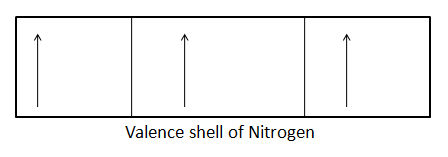
Thus by getting three more electrons, the nitrogen will be stabilized. Molecular nitrogen reacts with hydrogen to produce ammonia. It also reacts with oxygen to produce various products like dinitrogen oxide, nitrogen monoxide, dinitrogen trioxide, nitrogen dioxide, dinitrogen tetroxide, dinitrogen pentoxide. Reacts with both oxygen and hydrogen to produce nitric acid.
However if an atomic nitrogen forms a triple bond with another atomic nitrogen which then leads to dinitrogen gas or commonly called nitrogen gas. This nitrogen gas is inert because of fully filled valence shell of the nitrogen, which is as shown below
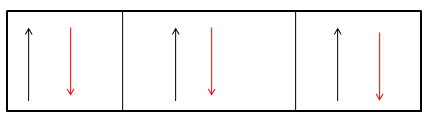
As one can see a fully filled valence shell, thus this means that the nitrogen attains the nearest noble gas configuration and attains the stability.
Note:
Dinitrogen is converted to ammonia by Haber’s process. While filling electrons to any sub shell one revise all the laws or the rules of the configuration namely aufbau rule ( electrons are filled in various subshell in the increasing order of the energy of the subshell ), hund's rule ( pairing of electrons will takes place ), pauli exclusion principle ( opposite spin of the electrons ) and the bohr bury rule.
Complete answer:
Nitrogen is an essential element of the periodic table. It is present in minute essential organic groups like amino acids to other important day to day useful things. Though ${N_2}$ accounts for the $78\% $ of the volume of earth’s atmosphere, still the raw ${N_2}$ is very rare on the earth's surface.
The electronic configuration of $N$ is as follows: $1{s^2},\,2{s^2}2{p^3}$ . Thus, required only three more electrons to attain the nearest next noble gas configuration of $Ne$ i.e., neon.
Thus by getting three more electrons, the nitrogen will be stabilized. Molecular nitrogen reacts with hydrogen to produce ammonia. It also reacts with oxygen to produce various products like dinitrogen oxide, nitrogen monoxide, dinitrogen trioxide, nitrogen dioxide, dinitrogen tetroxide, dinitrogen pentoxide. Reacts with both oxygen and hydrogen to produce nitric acid.
However if an atomic nitrogen forms a triple bond with another atomic nitrogen which then leads to dinitrogen gas or commonly called nitrogen gas. This nitrogen gas is inert because of fully filled valence shell of the nitrogen, which is as shown below
As one can see a fully filled valence shell, thus this means that the nitrogen attains the nearest noble gas configuration and attains the stability.
Note:
Dinitrogen is converted to ammonia by Haber’s process. While filling electrons to any sub shell one revise all the laws or the rules of the configuration namely aufbau rule ( electrons are filled in various subshell in the increasing order of the energy of the subshell ), hund's rule ( pairing of electrons will takes place ), pauli exclusion principle ( opposite spin of the electrons ) and the bohr bury rule.
Recently Updated Pages
Basicity of sulphurous acid and sulphuric acid are

Master Class 11 Business Studies: Engaging Questions & Answers for Success
Master Class 11 Computer Science: Engaging Questions & Answers for Success
Master Class 11 Economics: Engaging Questions & Answers for Success
Master Class 11 Social Science: Engaging Questions & Answers for Success
Master Class 11 English: Engaging Questions & Answers for Success
Trending doubts
Draw a diagram of nephron and explain its structur class 11 biology CBSE
Explain zero factorial class 11 maths CBSE
Chemical formula of Bleaching powder is A Ca2OCl2 B class 11 chemistry CBSE
Name the part of the brain responsible for the precision class 11 biology CBSE
The growth of tendril in pea plants is due to AEffect class 11 biology CBSE
One Metric ton is equal to kg A 10000 B 1000 C 100 class 11 physics CBSE