




Is E. coli a eukaryotic?
Answer
 Verified
574.5k+ views
Hint: Cells are broadly classified into two main types- Prokaryotic and Eukaryotic.
A prokaryotic cell is the one which lacks most of the membrane-bound organelles like mitochondria, Golgi body, etc. and lacks a proper membrane-bound nucleus. This is a primitive type of cell common among bacteria and most unicellular organisms.
A eukaryotic cell has a well-organized membrane-bound nucleus and has advanced cell organelles like ER, Golgi body, lysosomes, etc.
Complete answer:
When we see the structure of E. coli, to identify the type of cell, we observe some identifiable features:
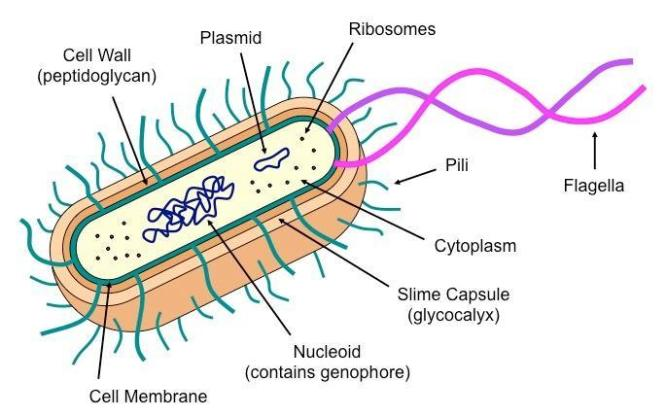
A prokaryotic cell diagram
The organism does not contain a distinct membrane-bound nucleus. Rather, the genetic material just floats over the cytoplasm of the cell.
Most of the organelles like the ER (Endoplasmic reticulum), Golgi body, mitochondria, lysosomes, etc. are absent.
This is enough to prove that E. coli is a prokaryotic cell, and not a eukaryote.
Now, the cell has some unique features too. Some of them are:
In addition to the genomic DNA, some strains of the bacterium may contain a small circular DNA called plasmid outside the DNA. The plasmid confers some special properties to the cell. The presence or absence of a plasmid does not have any effect on the activities of the cell. Like the ‘pili’ in E. coli is due to the presence of $F^+$ plasmid (fertility plasmid).
The cell locomotes with the help of flagella.
This organism is a common habitant in the human alimentary system (in the colon portion) where it acts as a symbiont; it draws nutrition from humans and as a reward synthesizes vitamin K for the body.
Note:
Nowadays, many biologists often consider E. coli as an organism in between prokaryotes and eukaryotes. Some scientists even claim that the organism contains eukaryotic genes. But this research is an ongoing thing and no such fact has been established firmly. So, based on the characteristics, E. coli is a prokaryotic organism.
A prokaryotic cell is the one which lacks most of the membrane-bound organelles like mitochondria, Golgi body, etc. and lacks a proper membrane-bound nucleus. This is a primitive type of cell common among bacteria and most unicellular organisms.
A eukaryotic cell has a well-organized membrane-bound nucleus and has advanced cell organelles like ER, Golgi body, lysosomes, etc.
Complete answer:
When we see the structure of E. coli, to identify the type of cell, we observe some identifiable features:
A prokaryotic cell diagram
The organism does not contain a distinct membrane-bound nucleus. Rather, the genetic material just floats over the cytoplasm of the cell.
Most of the organelles like the ER (Endoplasmic reticulum), Golgi body, mitochondria, lysosomes, etc. are absent.
This is enough to prove that E. coli is a prokaryotic cell, and not a eukaryote.
Now, the cell has some unique features too. Some of them are:
In addition to the genomic DNA, some strains of the bacterium may contain a small circular DNA called plasmid outside the DNA. The plasmid confers some special properties to the cell. The presence or absence of a plasmid does not have any effect on the activities of the cell. Like the ‘pili’ in E. coli is due to the presence of $F^+$ plasmid (fertility plasmid).
The cell locomotes with the help of flagella.
This organism is a common habitant in the human alimentary system (in the colon portion) where it acts as a symbiont; it draws nutrition from humans and as a reward synthesizes vitamin K for the body.
Note:
Nowadays, many biologists often consider E. coli as an organism in between prokaryotes and eukaryotes. Some scientists even claim that the organism contains eukaryotic genes. But this research is an ongoing thing and no such fact has been established firmly. So, based on the characteristics, E. coli is a prokaryotic organism.
Recently Updated Pages
Write structures of the following compounds i 2 Chloro3methylpentane class 11 chemistry CBSE

What is BLO What is the full form of BLO class 8 social science CBSE
Explain the Treaty of Vienna of 1815 class 10 social science CBSE
A Paragraph on Pollution in about 100-150 Words
XIX+XXX A 49 B 51 C 55 D 44 class 5 maths CBSE
If x a + bt + ct2 where x is in meters and t is in class 11 physics CBSE
Trending doubts
One Metric ton is equal to kg A 10000 B 1000 C 100 class 11 physics CBSE
Find the value of the expression given below sin 30circ class 11 maths CBSE
Draw a diagram of nephron and explain its structur class 11 biology CBSE
10 examples of friction in our daily life
Draw a diagram of a plant cell and label at least eight class 11 biology CBSE
Proton was discovered by A Thomson B Rutherford C Chadwick class 11 chemistry CBSE