




Is benzene an aromatic compound? What about cyclohexane, cyclohexene and 1,4-cyclohexadiene?
Answer
 Verified
562.2k+ views
Hint: All aromatic compounds have alternate double bonds, and the pi electrons are delocalized. All the three compounds given to us have a six membered cyclic ring, they only differ in the presence and number of double bonds.
Complete answer:
A compound is considered aromatic is it fulfills the following conditions:
Compounds should be flat and planar; it should be cyclic and have a conjugated double bond system. All the aromatic compounds should follow Huckel's rule which states that for a compound to be aromatic it must have $4n + 2$ pi electrons in the overlapping p orbital. Here n is any integer. According to this rule, compounds with 2,6,10,14… pi electrons are considered to be aromatic.
Let us consider the first compound given to us Benzene. Benzene is the parent compound of the family of organic compounds. Benzene has only 6 hydrogen atoms having a molecular formula of ${C_6}{H_6}$. Hence, we can infer that there are unsaturated bonds present. Benzene has alternating double bonds, and the pi electrons are free to move completely around the ring, i.e., it is delocalised. Benzene is planar and cyclic and has $4n + 2$ pi electrons (where n is 1). There are two resonating structures of benzene found.
Therefore, Benzene is an aromatic compound
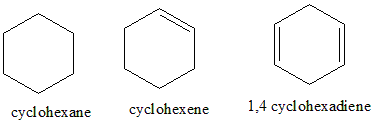
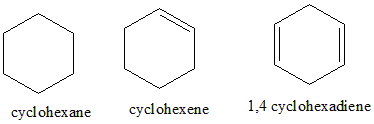
Cyclohexane has the formula ${C_6}{H_{12}}$, the compound is planar and cyclic, but doesn’t have delocalised pi electrons (there are no pi bonds present) and also doesn’t follow the Huckel’s rule. Hence, it is not aromatic. Cyclohexene is planar and cyclic; it contains one unsaturation which doesn’t satisfy the $4n + 2$ pi electrons rule. Hence it is also not aromatic. 1,4-cyclohexadiene is planar, cyclic, has 4 pi electrons, it has $4n$ , the pi bonds are not localised, hence it is not aromatic.
Note:
The compounds that have $4n$ pi electrons are antiaromatic. 1,4-cyclohexadiene is an anti-aromatic compound. The compounds which are non-planar, non-cyclic, and do not have a conjugated pi bond system are said to be non-aromatic compounds.
Complete answer:
A compound is considered aromatic is it fulfills the following conditions:
Compounds should be flat and planar; it should be cyclic and have a conjugated double bond system. All the aromatic compounds should follow Huckel's rule which states that for a compound to be aromatic it must have $4n + 2$ pi electrons in the overlapping p orbital. Here n is any integer. According to this rule, compounds with 2,6,10,14… pi electrons are considered to be aromatic.
Let us consider the first compound given to us Benzene. Benzene is the parent compound of the family of organic compounds. Benzene has only 6 hydrogen atoms having a molecular formula of ${C_6}{H_6}$. Hence, we can infer that there are unsaturated bonds present. Benzene has alternating double bonds, and the pi electrons are free to move completely around the ring, i.e., it is delocalised. Benzene is planar and cyclic and has $4n + 2$ pi electrons (where n is 1). There are two resonating structures of benzene found.
Therefore, Benzene is an aromatic compound
Cyclohexane has the formula ${C_6}{H_{12}}$, the compound is planar and cyclic, but doesn’t have delocalised pi electrons (there are no pi bonds present) and also doesn’t follow the Huckel’s rule. Hence, it is not aromatic. Cyclohexene is planar and cyclic; it contains one unsaturation which doesn’t satisfy the $4n + 2$ pi electrons rule. Hence it is also not aromatic. 1,4-cyclohexadiene is planar, cyclic, has 4 pi electrons, it has $4n$ , the pi bonds are not localised, hence it is not aromatic.
Note:
The compounds that have $4n$ pi electrons are antiaromatic. 1,4-cyclohexadiene is an anti-aromatic compound. The compounds which are non-planar, non-cyclic, and do not have a conjugated pi bond system are said to be non-aromatic compounds.
Recently Updated Pages
If x a + bt + ct2 where x is in meters and t is in class 11 physics CBSE

A car covers the first half distance between two places class 11 physics CBSE
The resultant of two vectors overrightarrow P and overrightarrow class 11 physics CBSE
Find the value of cos 135 class 11 maths CBSE
A mass M is held in place by an applied force F and class 11 physics CBSE
A solution of glucose in water is labelled as 10 dfracwv class 11 chemistry CBSE
Trending doubts
One Metric ton is equal to kg A 10000 B 1000 C 100 class 11 physics CBSE
Find the value of the expression given below sin 30circ class 11 maths CBSE
Draw a diagram of nephron and explain its structur class 11 biology CBSE
10 examples of friction in our daily life
Proton was discovered by A Thomson B Rutherford C Chadwick class 11 chemistry CBSE
Bond order ofO2 O2+ O2 and O22 is in order A O2 langle class 11 chemistry CBSE