




Is \[2 - \] hydroxy propanoic acid optically active?
Answer
 Verified
561k+ views
Hint: Optical activity of a compound is defined as the ability of a substance or compound to rotate the plane polarized light. When the plane polarized light passes through the solution of the substance, it can rotate the plane polarized light either in the clockwise direction or in the anti-clockwise direction.
Complete answer:
Optical activity of the compound is the function of the presence or the absence of the chiral atom in it.
So, the optically active compound can be in the dextrorotatory form and the Laevorotatory form.
So, let’s see the structure of the \[2 - \] hydroxy propanoic acid.
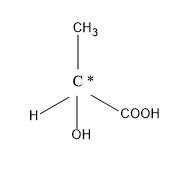
As we can see from the above figure that the \[2 - \] hydroxyl propanoic acid has a centre chiral atom or carbon, it has four different groups satisfying its valence. The four different groups bonded to the chiral centre are the hydrogen, the methyl group, the carboxylic group and the hydroxyl group.
So, we can say it is very clear from the above discussion that the \[2 - \] hydroxyl propanoic acid is an optically active compound as it has a chiral centre in it.
So the answer to our question is –: yes \[2 - \] hydroxy propanoic acid is optically active.
Note:
So, let’s see what is the chiral atom – so chiral atom is the atom which has all four different groups bonded to it. Only those substances are optically active, which have a chiral centre. Generally a chiral centre is denoted by the ‘asterisk sign’. This is an important aspect in determining structure.
Complete answer:
Optical activity of the compound is the function of the presence or the absence of the chiral atom in it.
So, the optically active compound can be in the dextrorotatory form and the Laevorotatory form.
So, let’s see the structure of the \[2 - \] hydroxy propanoic acid.
As we can see from the above figure that the \[2 - \] hydroxyl propanoic acid has a centre chiral atom or carbon, it has four different groups satisfying its valence. The four different groups bonded to the chiral centre are the hydrogen, the methyl group, the carboxylic group and the hydroxyl group.
So, we can say it is very clear from the above discussion that the \[2 - \] hydroxyl propanoic acid is an optically active compound as it has a chiral centre in it.
So the answer to our question is –: yes \[2 - \] hydroxy propanoic acid is optically active.
Note:
So, let’s see what is the chiral atom – so chiral atom is the atom which has all four different groups bonded to it. Only those substances are optically active, which have a chiral centre. Generally a chiral centre is denoted by the ‘asterisk sign’. This is an important aspect in determining structure.
Recently Updated Pages
Which will be the least stable resonating structure class 11 chemistry CBSE

How many 5 digit telephone numbers can be construc-class-11-maths-CBSE
How do you find the angle of the resultant vector class 11 physics CBSE
Draw labelled diagram of the following i Gram seed class 11 biology CBSE
1 Quintal is equal to a 110 kg b 10 kg c 100kg d 1000 class 11 physics CBSE
What is the need and importance of classification class 11 biology CBSE
Trending doubts
One Metric ton is equal to kg A 10000 B 1000 C 100 class 11 physics CBSE
Find the value of the expression given below sin 30circ class 11 maths CBSE
Draw a diagram of nephron and explain its structur class 11 biology CBSE
10 examples of friction in our daily life
Proton was discovered by A Thomson B Rutherford C Chadwick class 11 chemistry CBSE
How many kilometers are there in 100 meters class 11 maths CBSE