




Intramolecular hydrogen bonding is found in:
A. salicylaldehyde
B. water
C. acetaldehyde
D. phenol
Answer
 Verified
595.5k+ views
Hint: Hydrogen bonding is a dipole-dipole attraction between the molecules, but is not a covalent bond to a hydrogen atom. When the hydrogen is attached to a very electronegative element, then this type of bonding takes place. It is represented by a dotted line.
Complete step by step answer:
Hydrogen bond or H-bond is a partial intermolecular bond between a lone pair which is on the electron rich donor atom and the antibonding molecular orbital of a H atom. Hydrogen bonds are of two types: intramolecular hydrogen bond and intermolecular hydrogen bond. In intramolecular H-bonding, the bonds occur in the same molecule of a solution whereas, in intermolecular H-bonding, the bonds occur between two different molecules of a solution.
Now, let's look at the options.
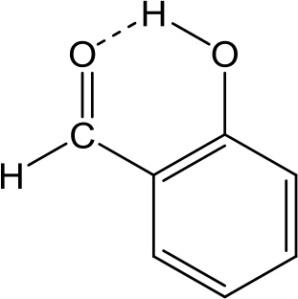
A. In salicylaldehyde, intramolecular H-bonds exist between the hydrogen atom from the hydroxy group and the oxygen atom from the aldehyde group.
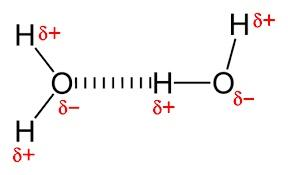
B. In water, the intermolecular H-bonding exists between the hydrogen atom from one molecule and the oxygen atom from another molecule.
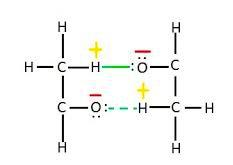
C. In acetaldehyde, the intermolecular H-bonding exists between the hydrogen atom from one molecule and the oxygen atom from another molecule.
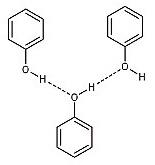
D. In phenol, the intermolecular H-bonding exists between the hydrogen atom from one molecule and the oxygen atom from another molecule.
Therefore, from the above diagrams, we can see that only salicylic acid has intramolecular hydrogen bonding.
Hence, the correct answer is option (a).
Note: Salicylic acid is a strong acid. The hydrogen bonding in salicylic acid lowers its free energy which makes salicylate a weaker conjugate base. And thus, salicylic acid is a strong acid.
Complete step by step answer:
Hydrogen bond or H-bond is a partial intermolecular bond between a lone pair which is on the electron rich donor atom and the antibonding molecular orbital of a H atom. Hydrogen bonds are of two types: intramolecular hydrogen bond and intermolecular hydrogen bond. In intramolecular H-bonding, the bonds occur in the same molecule of a solution whereas, in intermolecular H-bonding, the bonds occur between two different molecules of a solution.
Now, let's look at the options.
A. In salicylaldehyde, intramolecular H-bonds exist between the hydrogen atom from the hydroxy group and the oxygen atom from the aldehyde group.
B. In water, the intermolecular H-bonding exists between the hydrogen atom from one molecule and the oxygen atom from another molecule.
C. In acetaldehyde, the intermolecular H-bonding exists between the hydrogen atom from one molecule and the oxygen atom from another molecule.
D. In phenol, the intermolecular H-bonding exists between the hydrogen atom from one molecule and the oxygen atom from another molecule.
Therefore, from the above diagrams, we can see that only salicylic acid has intramolecular hydrogen bonding.
Hence, the correct answer is option (a).
Note: Salicylic acid is a strong acid. The hydrogen bonding in salicylic acid lowers its free energy which makes salicylate a weaker conjugate base. And thus, salicylic acid is a strong acid.
Recently Updated Pages
If x a + bt + ct2 where x is in meters and t is in class 11 physics CBSE

A car covers the first half distance between two places class 11 physics CBSE
The resultant of two vectors overrightarrow P and overrightarrow class 11 physics CBSE
Find the value of cos 135 class 11 maths CBSE
A mass M is held in place by an applied force F and class 11 physics CBSE
A solution of glucose in water is labelled as 10 dfracwv class 11 chemistry CBSE
Trending doubts
Find the value of the expression given below sin 30circ class 11 maths CBSE
One Metric ton is equal to kg A 10000 B 1000 C 100 class 11 physics CBSE
Draw a diagram of nephron and explain its structur class 11 biology CBSE
10 examples of friction in our daily life
Proton was discovered by A Thomson B Rutherford C Chadwick class 11 chemistry CBSE
Bond order ofO2 O2+ O2 and O22 is in order A O2 langle class 11 chemistry CBSE