




Inside water, an air bubble behaves___________
A. Always like a flat plate
B. Always like a concave lens
C. Always like a convex lens
D. Always like a concave mirror
Answer
 Verified
622.8k+ views
Hint: The air bubble inside water diverges the light rays incident on it. The light ray passes from one medium to another medium twice bending away or towards the normal. The resultant change in direction decides the optical property of the bubble.
Complete step by step solution:
When light travels from one medium to another, it undergoes what we call refraction. Refraction is the phenomena of bending of light when light travels from one medium to another. When light goes from rarer medium to denser medium (e.g. From air to water), it bends towards the normal at the point of incidence whereas when light travels from denser to rarer medium (e.g. From Water to air), it bends away from the normal. This occurs because the refractive index of water is greater than the refractive index of air.
In the case of a bubble in water, as shown in the figure, when light rays travel from water to air inside the bubble, it bends outwards as explained above. When it travels out of the bubble, which is from air to water, it bends inwards towards the normal.
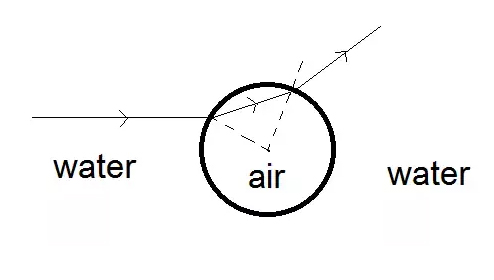
The net effect is that the ray is getting diverged which is exactly what happens in a concave lens.
Hence, the correct answer is option B.
Additional information:
The refraction of light can also be understood in the sense of change of speed of light when it travels from one medium to another. The speed of light reduces as it goes from rarer to denser medium, due to which it bends towards the normal. While reverse is true when it travels from denser to rarer medium.
Note: The student may make the mistake of thinking that since the bubble has a convex shape; it’ll act as a convex lens. But the case is actually opposite as explained in the answer above. The student should take care of the fact that the light rays behave when they pass through the bubble and always draw a ray diagram to understand the actual mechanism going on.
Complete step by step solution:
When light travels from one medium to another, it undergoes what we call refraction. Refraction is the phenomena of bending of light when light travels from one medium to another. When light goes from rarer medium to denser medium (e.g. From air to water), it bends towards the normal at the point of incidence whereas when light travels from denser to rarer medium (e.g. From Water to air), it bends away from the normal. This occurs because the refractive index of water is greater than the refractive index of air.
In the case of a bubble in water, as shown in the figure, when light rays travel from water to air inside the bubble, it bends outwards as explained above. When it travels out of the bubble, which is from air to water, it bends inwards towards the normal.
The net effect is that the ray is getting diverged which is exactly what happens in a concave lens.
Hence, the correct answer is option B.
Additional information:
The refraction of light can also be understood in the sense of change of speed of light when it travels from one medium to another. The speed of light reduces as it goes from rarer to denser medium, due to which it bends towards the normal. While reverse is true when it travels from denser to rarer medium.
Note: The student may make the mistake of thinking that since the bubble has a convex shape; it’ll act as a convex lens. But the case is actually opposite as explained in the answer above. The student should take care of the fact that the light rays behave when they pass through the bubble and always draw a ray diagram to understand the actual mechanism going on.
Recently Updated Pages
Master Class 11 Social Science: Engaging Questions & Answers for Success

Master Class 11 Physics: Engaging Questions & Answers for Success
Master Class 11 Maths: Engaging Questions & Answers for Success
Master Class 11 Economics: Engaging Questions & Answers for Success
Master Class 11 Computer Science: Engaging Questions & Answers for Success
Master Class 11 Chemistry: Engaging Questions & Answers for Success
Trending doubts
One Metric ton is equal to kg A 10000 B 1000 C 100 class 11 physics CBSE
There are 720 permutations of the digits 1 2 3 4 5 class 11 maths CBSE
1 Quintal is equal to a 110 kg b 10 kg c 100kg d 1000 class 11 physics CBSE
State and prove Bernoullis theorem class 11 physics CBSE
Difference Between Prokaryotic Cells and Eukaryotic Cells
Which among the following are examples of coming together class 11 social science CBSE