




Insect pollinated flowers usually possess
(a)Sticky pollens with a rough surface
(b)Large quantities if pollens
(c)Brightly colored pollens
(d)Dry pollens with smooth surfaces
Answer
 Verified
654.9k+ views
Hint: Insect pollinated flowers have developed all the modes and mechanisms that are needed to attract the insects as per the interest and nature of the insects so that the pollination can be completed successfully in such flowers.
Complete step-by-step answer:
The flowers that are pollinated by insects are highly specialized and have brightly colored and attractive petals because insects are attracted more towards bright colors. Besides these, the pollen is rough and has sticky material. These flowers are called entomophilous flowers and some of their properties have been listed below –
-The flowers are brightly colored and attractive in structure with colored petals.
-They often disperse fragrance that helps in attracting insects.
-The floral structures are often different from other flowers because, in these flowers, the structures are modified to be pollinated by the insects.
-Unlike the water or wind-pollinated flowers, the insect-pollinated flowers produce less number of pollen grains because there is less chance of wastage of pollen grains in comparison to the wind and water pollination.
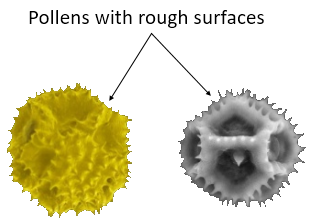
-The pollen grains in the insect-pollinated flowers are sticky and have rough surfaces so that they can be carried over by the insect by getting adhered to their body parts.
Pollens of insect-pollinated flowers have been shown in the diagram below –
So, the correct answer is ‘Sticky pollens with rough surface’.
Note: Large quantities of pollen are produced by wind and water pollinated plants because here, large numbers of pollen grains are required to enhance the chances of successful pollination. Dry pollens can’t stick to the insect body and thus the insect-pollinated flowers produce sticky pollens that are with rough surfaces for providing aid in the attachment.
Complete step-by-step answer:
The flowers that are pollinated by insects are highly specialized and have brightly colored and attractive petals because insects are attracted more towards bright colors. Besides these, the pollen is rough and has sticky material. These flowers are called entomophilous flowers and some of their properties have been listed below –
-The flowers are brightly colored and attractive in structure with colored petals.
-They often disperse fragrance that helps in attracting insects.
-The floral structures are often different from other flowers because, in these flowers, the structures are modified to be pollinated by the insects.
-Unlike the water or wind-pollinated flowers, the insect-pollinated flowers produce less number of pollen grains because there is less chance of wastage of pollen grains in comparison to the wind and water pollination.
-The pollen grains in the insect-pollinated flowers are sticky and have rough surfaces so that they can be carried over by the insect by getting adhered to their body parts.
Pollens of insect-pollinated flowers have been shown in the diagram below –
So, the correct answer is ‘Sticky pollens with rough surface’.
Note: Large quantities of pollen are produced by wind and water pollinated plants because here, large numbers of pollen grains are required to enhance the chances of successful pollination. Dry pollens can’t stick to the insect body and thus the insect-pollinated flowers produce sticky pollens that are with rough surfaces for providing aid in the attachment.
Recently Updated Pages
Master Class 11 Social Science: Engaging Questions & Answers for Success

Master Class 11 English: Engaging Questions & Answers for Success
Master Class 11 Accountancy: Engaging Questions & Answers for Success
Master Class 11 Physics: Engaging Questions & Answers for Success
Master Class 11 Computer Science: Engaging Questions & Answers for Success
Master Class 11 Business Studies: Engaging Questions & Answers for Success
Trending doubts
Find the value of the expression given below sin 30circ class 11 maths CBSE
One Metric ton is equal to kg A 10000 B 1000 C 100 class 11 physics CBSE
Draw a diagram of nephron and explain its structur class 11 biology CBSE
10 examples of friction in our daily life
Proton was discovered by A Thomson B Rutherford C Chadwick class 11 chemistry CBSE
The teeth used for biting and cutting food are called class 11 biology CBSE