




What information about the motion of a body can be obtained from its displacement-time graph?
A) Velocity of the body
B) Acceleration of the body
C) Force on the body
D) Retardation of the body
Answer
 Verified
615.6k+ views
Hint: In this question, we can use the concept that if a graph is plotted between two quantities then the two quantities are in ratio. We have to identify the ratio of displacement and time for the correct option.
Complete step by step answer:
We know when a body is moving than in a finite time the body covers a finite displacement.
When we plot a graph between the displacement and the time then we get a straight line or curve as the slope or gradient. While plotting the graph, we get two types of slopes. A straight line for uniform motion and a curve for non-uniform motion.
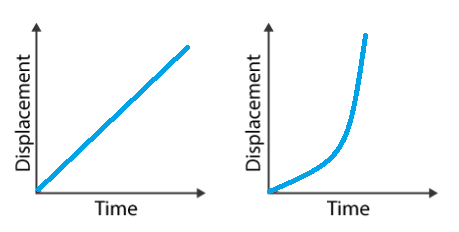
In a displacement-time graph, the slope or gradient of the slope is always equal to the velocity of the body. If the slope is straight then the motion is uniform and the body has constant velocity. If the slope is a curve then the motion is non-uniform and the body has variable velocity.
Hence option A correct.
Additional Information:
The slope of a velocity-time graph gives the acceleration of that body. If the slope of the velocity-time graph goes downwards then the slope of the graph shows the retardation of that body.
Note:
We have to remember that the ratio of displacement and time is always equal to velocity and the ratio of velocity and time is always equal to the acceleration of the body. A graph is always plotted between those quantities which are in some ratio. So, we have to remember the definitions of velocity and acceleration.
Complete step by step answer:
We know when a body is moving than in a finite time the body covers a finite displacement.
When we plot a graph between the displacement and the time then we get a straight line or curve as the slope or gradient. While plotting the graph, we get two types of slopes. A straight line for uniform motion and a curve for non-uniform motion.
In a displacement-time graph, the slope or gradient of the slope is always equal to the velocity of the body. If the slope is straight then the motion is uniform and the body has constant velocity. If the slope is a curve then the motion is non-uniform and the body has variable velocity.
Hence option A correct.
Additional Information:
The slope of a velocity-time graph gives the acceleration of that body. If the slope of the velocity-time graph goes downwards then the slope of the graph shows the retardation of that body.
Note:
We have to remember that the ratio of displacement and time is always equal to velocity and the ratio of velocity and time is always equal to the acceleration of the body. A graph is always plotted between those quantities which are in some ratio. So, we have to remember the definitions of velocity and acceleration.
Recently Updated Pages
Master Class 11 English: Engaging Questions & Answers for Success

Master Class 11 Social Science: Engaging Questions & Answers for Success
Master Class 11 Maths: Engaging Questions & Answers for Success
Master Class 11 Chemistry: Engaging Questions & Answers for Success
Master Class 11 Biology: Engaging Questions & Answers for Success
Master Class 11 Physics: Engaging Questions & Answers for Success
Trending doubts
One Metric ton is equal to kg A 10000 B 1000 C 100 class 11 physics CBSE
Difference Between Prokaryotic Cells and Eukaryotic Cells
Find the value of the expression given below sin 30circ class 11 maths CBSE
1 ton equals to A 100 kg B 1000 kg C 10 kg D 10000 class 11 physics CBSE
Two of the body parts which do not appear in MRI are class 11 biology CBSE
Draw a diagram of nephron and explain its structur class 11 biology CBSE