




Indian Telegraph plant (Desmodium gyrans) belongs to
A. Malvaceae
B. Leguminosae
C. Solanaceae
D. Liliaceae
Answer
 Verified
636.3k+ views
Hint: It is a large and most important family of the flowering plants which is commonly known as the bean family having fused sepals as the characteristic feature.
Complete answer:
Desmodium gyrans, commonly known as the Indian Telegraph plant. It belongs to the family Leguminosae, also known as family Fabaceae. It is commonly called pea or legume family.
Additional Information:
-The word Faba was derived from the Latin language which means the bean.
-The family Leguminosae is an older name for the family Fabaceae.
-The process of biological nitrogen fixation occurs in the family Leguminosae as the legumes are present in this family.
-It is most commonly found in the tropical rain forests and the dry forests of Africa and America.
-Desmodium is botanically known as Codariocalyx motorius.
-It is the group of few plants which show rapid movement including Mimosa pudica, and the Venus flytrap.
-The plant is small and has purple flowers.
-The leaves move at rapid speeds to maximize the light at the trophic level.
-Each leaf absorbs more energy because the weight of the leaves is more and the plant needs to spend more energy on its movement.
-These movements may form a butterfly mimicry which stops the eggs of the butterflies in the leaves.
-The leaves rotate about 3-6 minutes.
-The plant is described in detail in Charles Darwin The Power of Movement in plants'
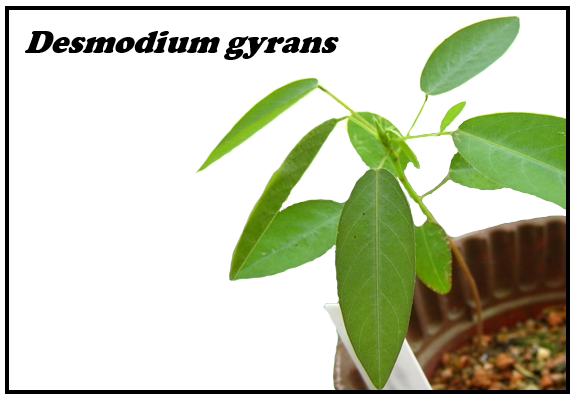
So, the correct answer is ‘Leguminosae’.
Note: The plant Desmodium gyrans is described in detail in 1880 by Charles Darwin, in his book ‘The Power of Movements in Plants’. It has been used as an ornament in a garden. They are erect plants but totally on their axes and move up and down under the influence of the sunshine.
Complete answer:
Desmodium gyrans, commonly known as the Indian Telegraph plant. It belongs to the family Leguminosae, also known as family Fabaceae. It is commonly called pea or legume family.
Additional Information:
-The word Faba was derived from the Latin language which means the bean.
-The family Leguminosae is an older name for the family Fabaceae.
-The process of biological nitrogen fixation occurs in the family Leguminosae as the legumes are present in this family.
-It is most commonly found in the tropical rain forests and the dry forests of Africa and America.
-Desmodium is botanically known as Codariocalyx motorius.
-It is the group of few plants which show rapid movement including Mimosa pudica, and the Venus flytrap.
-The plant is small and has purple flowers.
-The leaves move at rapid speeds to maximize the light at the trophic level.
-Each leaf absorbs more energy because the weight of the leaves is more and the plant needs to spend more energy on its movement.
-These movements may form a butterfly mimicry which stops the eggs of the butterflies in the leaves.
-The leaves rotate about 3-6 minutes.
-The plant is described in detail in Charles Darwin The Power of Movement in plants'
So, the correct answer is ‘Leguminosae’.
Note: The plant Desmodium gyrans is described in detail in 1880 by Charles Darwin, in his book ‘The Power of Movements in Plants’. It has been used as an ornament in a garden. They are erect plants but totally on their axes and move up and down under the influence of the sunshine.
Recently Updated Pages
Master Class 5 English: Engaging Questions & Answers for Success

Master Class 5 Maths: Engaging Questions & Answers for Success
Master Class 5 Social Science: Engaging Questions & Answers for Success
Master Class 5 Science: Engaging Questions & Answers for Success
Class 5 Question and Answer - Your Ultimate Solutions Guide
Master Class 9 General Knowledge: Engaging Questions & Answers for Success
Trending doubts
One Metric ton is equal to kg A 10000 B 1000 C 100 class 11 physics CBSE
What is cell theory Who formulated it class 11 biology CBSE
Phyllotaxy is the arrangement of ALeaflets BLeaves class 11 biology CBSE
Difference Between Prokaryotic Cells and Eukaryotic Cells
The symbiotic association of fungi and algae is called class 11 biology CBSE
Cell theory was formulated by A Schleiden and Schwann class 11 biology CBSE