




Incipient nucleus is present in
A) Chlorophyceae
B) Rhodophyceae
C) Myxophyceae
D) Phaeophyceae
Answer
 Verified
653.4k+ views
Hint: It is present in the prokaryotic organisms, which include the blue-green algae and is found in the damp terrestrial or aquatic region.
Complete Answer:
Myxophyceae is a class of algae which is now called cyanobacteria and is commonly known as blue-green algae. The incipient nucleus is not a true nucleus and is also known as a nucleoid, it is found in prokaryotes. The group Myxophyceae comes under prokaryotes.
Additional information:
-The incipient nucleus is the immature nucleus of prokaryotes.
-The nucleoid is not double membranous and is not fully developed.
-The incipient nucleus is the precursor of the eukaryotic nucleus from which it is developed.
-The incipient nucleus is made up of a circular double-stranded DNA.
-The DNA of the incipient nucleus does not condense and is not organized in the form of chromosomes.
-The DNA is present in a dense form in the center of the cell.
-It is irregular in the shaped nucleus without any histone proteins.
-It is commonly found in bacteria.
-The centroplasm represents the nucleus sometimes.
-Centroplasm is the colorless inner region of the cytoplasm which contains the nuclear body.
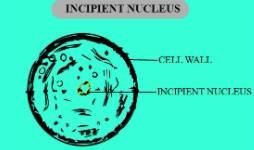
So, the correct answer is ‘Myxophyceae’.
Note: The Myxophyceae (Cyanophyceae) consists of free-living photosynthetic bacteria and endosymbiotic plastids. They are capable of natural genetic transformation. They are sometimes sold as food containing substances like amino acids, fatty acids, proteins, vitamins, minerals, pigments, etc. Chlorophyceae is also called green algae, due to the presence of the chlorophyll pigment. Rhodophyceae is also known as red algae because of the presence of phycoerythrin pigment. Phaeophyceae is also known as the brown algae, it is due to the presence of fucoxanthin pigment.
Complete Answer:
Myxophyceae is a class of algae which is now called cyanobacteria and is commonly known as blue-green algae. The incipient nucleus is not a true nucleus and is also known as a nucleoid, it is found in prokaryotes. The group Myxophyceae comes under prokaryotes.
Additional information:
-The incipient nucleus is the immature nucleus of prokaryotes.
-The nucleoid is not double membranous and is not fully developed.
-The incipient nucleus is the precursor of the eukaryotic nucleus from which it is developed.
-The incipient nucleus is made up of a circular double-stranded DNA.
-The DNA of the incipient nucleus does not condense and is not organized in the form of chromosomes.
-The DNA is present in a dense form in the center of the cell.
-It is irregular in the shaped nucleus without any histone proteins.
-It is commonly found in bacteria.
-The centroplasm represents the nucleus sometimes.
-Centroplasm is the colorless inner region of the cytoplasm which contains the nuclear body.
So, the correct answer is ‘Myxophyceae’.
Note: The Myxophyceae (Cyanophyceae) consists of free-living photosynthetic bacteria and endosymbiotic plastids. They are capable of natural genetic transformation. They are sometimes sold as food containing substances like amino acids, fatty acids, proteins, vitamins, minerals, pigments, etc. Chlorophyceae is also called green algae, due to the presence of the chlorophyll pigment. Rhodophyceae is also known as red algae because of the presence of phycoerythrin pigment. Phaeophyceae is also known as the brown algae, it is due to the presence of fucoxanthin pigment.
Recently Updated Pages
Master Class 11 Social Science: Engaging Questions & Answers for Success

Master Class 11 English: Engaging Questions & Answers for Success
Master Class 11 Accountancy: Engaging Questions & Answers for Success
Master Class 11 Physics: Engaging Questions & Answers for Success
Master Class 11 Computer Science: Engaging Questions & Answers for Success
Master Class 11 Business Studies: Engaging Questions & Answers for Success
Trending doubts
One Metric ton is equal to kg A 10000 B 1000 C 100 class 11 physics CBSE
Find the value of the expression given below sin 30circ class 11 maths CBSE
Draw a diagram of nephron and explain its structur class 11 biology CBSE
10 examples of friction in our daily life
Proton was discovered by A Thomson B Rutherford C Chadwick class 11 chemistry CBSE
The teeth used for biting and cutting food are called class 11 biology CBSE