




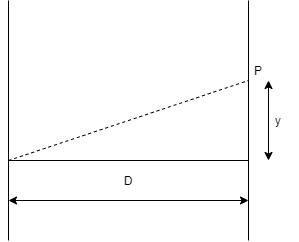
In YDSC there is a point P on the screen. What is path difference at point P. Given $d = 1mm, y = 2mm, D = 1m$
Answer
 Verified
593.1k+ views
Hint: The path difference is defined as the difference in the distance traveled by the two waves from their source to a given point. In this figure, if we consider O as the point of origin for the two waves, the path difference is given by,
$P.D = OP - D$
Complete step by step answer:
Consider Young’s double-slit experiment as shown in the above figure
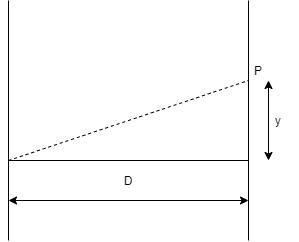
We see in this given figure that there is no presence of the slits as the dotted line at P actually, represents the path difference. By writing the actual figure denoting the two slits and the two wavefronts individually, we get a modified diagram like this,
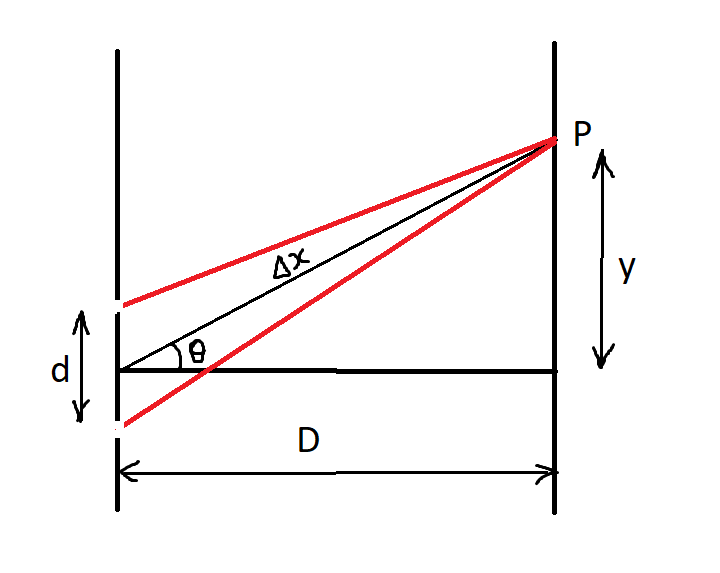
$\theta $ is the angle between the path difference and the horizontal reference line as shown.
The path difference, $\Delta x = d\sin \theta $
Since the angle $\theta $ is very small, we can say that, $\sin \theta = \tan \theta $
Substituting, we get,
$\Delta x = d\tan \theta $
From the figure, $\tan \theta = \dfrac{y}{D}$
Thus, substituting the value of $\tan \theta $, we get,
$
\Delta x = d\tan \theta \\
\Rightarrow \Delta x = d \times \dfrac{y}{D} \\
$
Substituting the values, we get
$
\Delta x = d \times \dfrac{y}{D} \\
\Rightarrow \Delta x = 1 \times \dfrac{2}{{1000}} \\
\Rightarrow \Delta x = 2 \times {10^{ - 3}}mm \\
\Rightarrow \Delta x = 2\mu m \\
$
Hence, the path difference, $\Delta x = 2\mu m$
Note:
At point P, there are two things that could happen. Either a bright fringe can be formed at the point of a dark fringe that can be formed at the point. The criteria for deciding this is solely, based on the path difference at that point.
If the path difference is equal to even multiples of $\dfrac{\lambda }{2}$ such as $\lambda, 2\lambda, 3\lambda ...2n\dfrac{\lambda }{2}$, there is a constructive interference at this point and we obtain a bright fringe.
If the path difference is equal to odd multiples of $\dfrac{\lambda }{2}$ such as $\dfrac{\lambda }{2},\dfrac{{3\lambda }}{2},\dfrac{{5\lambda }}{2}...\left( {2n + 1} \right)\dfrac{\lambda }{2}$, there is a destructive interference at this point and we obtain a dark fringe.
$P.D = OP - D$
Complete step by step answer:
Consider Young’s double-slit experiment as shown in the above figure
We see in this given figure that there is no presence of the slits as the dotted line at P actually, represents the path difference. By writing the actual figure denoting the two slits and the two wavefronts individually, we get a modified diagram like this,
$\theta $ is the angle between the path difference and the horizontal reference line as shown.
The path difference, $\Delta x = d\sin \theta $
Since the angle $\theta $ is very small, we can say that, $\sin \theta = \tan \theta $
Substituting, we get,
$\Delta x = d\tan \theta $
From the figure, $\tan \theta = \dfrac{y}{D}$
Thus, substituting the value of $\tan \theta $, we get,
$
\Delta x = d\tan \theta \\
\Rightarrow \Delta x = d \times \dfrac{y}{D} \\
$
Substituting the values, we get
$
\Delta x = d \times \dfrac{y}{D} \\
\Rightarrow \Delta x = 1 \times \dfrac{2}{{1000}} \\
\Rightarrow \Delta x = 2 \times {10^{ - 3}}mm \\
\Rightarrow \Delta x = 2\mu m \\
$
Hence, the path difference, $\Delta x = 2\mu m$
Note:
At point P, there are two things that could happen. Either a bright fringe can be formed at the point of a dark fringe that can be formed at the point. The criteria for deciding this is solely, based on the path difference at that point.
If the path difference is equal to even multiples of $\dfrac{\lambda }{2}$ such as $\lambda, 2\lambda, 3\lambda ...2n\dfrac{\lambda }{2}$, there is a constructive interference at this point and we obtain a bright fringe.
If the path difference is equal to odd multiples of $\dfrac{\lambda }{2}$ such as $\dfrac{\lambda }{2},\dfrac{{3\lambda }}{2},\dfrac{{5\lambda }}{2}...\left( {2n + 1} \right)\dfrac{\lambda }{2}$, there is a destructive interference at this point and we obtain a dark fringe.
Recently Updated Pages
Basicity of sulphurous acid and sulphuric acid are

Master Class 10 English: Engaging Questions & Answers for Success
Master Class 10 Social Science: Engaging Questions & Answers for Success
Master Class 10 Computer Science: Engaging Questions & Answers for Success
Class 10 Question and Answer - Your Ultimate Solutions Guide
Master Class 10 General Knowledge: Engaging Questions & Answers for Success
Trending doubts
Which country won the ICC Men's ODI World Cup in 2023?
In cricket, how many legal balls are there in a standard over?
Explain the Treaty of Vienna of 1815 class 10 social science CBSE
A boat goes 24 km upstream and 28 km downstream in class 10 maths CBSE
What does "powerplay" mean in limited-overs cricket?
What is the "Powerplay" in T20 cricket?