




In which organelle of cell hydrolytic enzymes are found and also mention the role/function of that organelle.
Answer
 Verified
589.2k+ views
Hint: A lysosome is a membrane-bound organelle that is involved with various cell processes and helps in the breakdown of excess, worn-out cell parts. It is the suicidal cell organelles of the cell.
Complete answer:
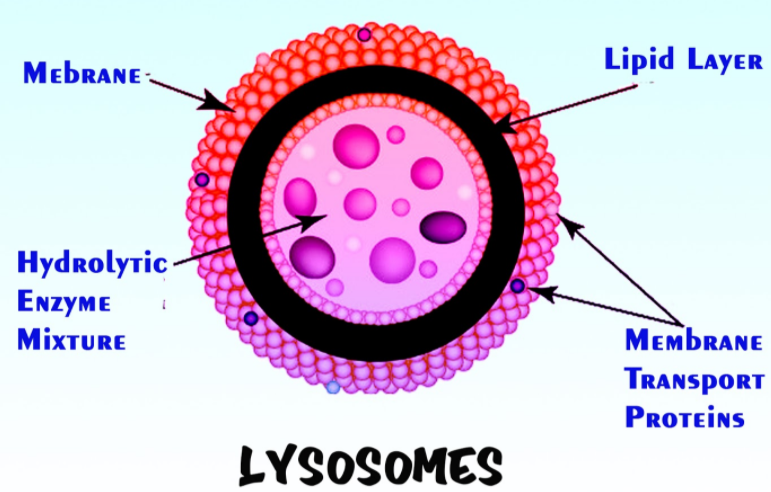
Lysosomes are the reservoirs of hydrolytic enzymes which are the important enzymes that are acid phosphates, proteases, sulfatases, peptidases, nucleases, and glycosidases. They are structurally spherical vesicles that contain hydrolytic enzymes for The breakdown of biomolecules and have a composition of membrane proteins and lumenal proteins. Lysosomes are involved in the degradation of polymers and in various cell processes which include the secretion, cell signaling, plasma membrane repair, apoptosis, and energy metabolism. They after the waste disposal system of the cell by the digestion of materials in the cytoplasm from inside and outside of the cell. They take the material from outside the cell through the process of endocytosis and the material from the inside of the cell is digested through the process of autophagy. The organelles vary in size from the larger to the smaller ones. daily digest the materials which are taken into the cell and recycle the intracellular materials.
Additional information:
The food material enters into the food vacuole through the plasma membrane by the process of endocytosis and the lysosome consisting of active hydrolytic enzyme moves away from the plasma membrane. The lysosome fusing with the food vacuole and the hydrolytic enzymes enter into the food vacuole and the hydrolytic enzymes digest the food particles. It consists of more than 60 different enzymes and has 50 membrane proteins. The enzymes get synthesized in the rough endoplasmic reticulum and are exported to the Golgi apparatus for recruitment by the complex composed of proteins. They fuse with the larger acidic vesicles and are destined for lysosomes which are specifically tagged with the molecule and are properly sorted into the acidified vesicles.
So, the correct answer is 'Lysosome'.
Note:
Lysosomes are eukaryotic cells that cannot be found in the prokaryotes and are the only vesicles that have a specific composition of protein in its lumen and its plasma membrane. The lysosome becomes toxic when there are no enzymes and are unable to break down the substances which build up in the cells.
Complete answer:
Lysosomes are the reservoirs of hydrolytic enzymes which are the important enzymes that are acid phosphates, proteases, sulfatases, peptidases, nucleases, and glycosidases. They are structurally spherical vesicles that contain hydrolytic enzymes for The breakdown of biomolecules and have a composition of membrane proteins and lumenal proteins. Lysosomes are involved in the degradation of polymers and in various cell processes which include the secretion, cell signaling, plasma membrane repair, apoptosis, and energy metabolism. They after the waste disposal system of the cell by the digestion of materials in the cytoplasm from inside and outside of the cell. They take the material from outside the cell through the process of endocytosis and the material from the inside of the cell is digested through the process of autophagy. The organelles vary in size from the larger to the smaller ones. daily digest the materials which are taken into the cell and recycle the intracellular materials.
Additional information:
The food material enters into the food vacuole through the plasma membrane by the process of endocytosis and the lysosome consisting of active hydrolytic enzyme moves away from the plasma membrane. The lysosome fusing with the food vacuole and the hydrolytic enzymes enter into the food vacuole and the hydrolytic enzymes digest the food particles. It consists of more than 60 different enzymes and has 50 membrane proteins. The enzymes get synthesized in the rough endoplasmic reticulum and are exported to the Golgi apparatus for recruitment by the complex composed of proteins. They fuse with the larger acidic vesicles and are destined for lysosomes which are specifically tagged with the molecule and are properly sorted into the acidified vesicles.
So, the correct answer is 'Lysosome'.
Note:
Lysosomes are eukaryotic cells that cannot be found in the prokaryotes and are the only vesicles that have a specific composition of protein in its lumen and its plasma membrane. The lysosome becomes toxic when there are no enzymes and are unable to break down the substances which build up in the cells.
Recently Updated Pages
Basicity of sulphurous acid and sulphuric acid are

Master Class 11 English: Engaging Questions & Answers for Success
Master Class 11 Physics: Engaging Questions & Answers for Success
Master Class 11 Computer Science: Engaging Questions & Answers for Success
Master Class 11 Chemistry: Engaging Questions & Answers for Success
Master Class 11 Social Science: Engaging Questions & Answers for Success
Trending doubts
Difference Between Prokaryotic Cells and Eukaryotic Cells
Two of the body parts which do not appear in MRI are class 11 biology CBSE
One Metric ton is equal to kg A 10000 B 1000 C 100 class 11 physics CBSE
10 examples of friction in our daily life
Draw a diagram of nephron and explain its structur class 11 biology CBSE
What will happen if the mucus is not secreted by the class 11 biology CBSE