




In which one of the following processes ${ C }{ O }_{ 2 }$ is not released?
(A) Aerobic respiration in plants
(B) Aerobic respiration in animals
(C) Alcoholic fermentation
(D) Lactate fermentation
Answer
 Verified
605.1k+ views
Hint: The above-mentioned process in which ${ C }{ O }_{ 2 }$ is not released is a metabolic process by which glucose and many other six-carbon sugars are converted into cellular energy and a specific metabolite.
Complete answer:
The processes in which ${ C }{ O }_{ 2 }$ is not released is the Lactate fermentation. Lactate fermentation is an anaerobic fermentation reaction that will take place in some types of bacteria and animal cells, like muscle cells. Lactate dehydrogenase catalyzes the interconversion of pyruvate and also the lactate with concomitant interconversion of the molecule NADH and ${ NAD }^{ + }$.
Additional Information: Fermentation is the process of manufacturing ATP within the absence of oxygen, through glycolysis alone. As you know that glycolysis breaks a glucose molecule into two pyruvate molecules, producing a net gain of two ATP and two NADH molecules. Lactic acid or Carboxylic acid fermentation is the type of anaerobic respiration administered by yogurt bacteria (Lactobacillus and others) and by your own muscle cells once you work them hard and fast.
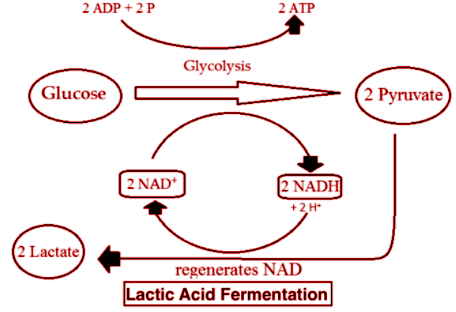
Lactic acid fermentation performs the conversion of the 3-carbon pyruvate to the 3-carbon carboxylic acid (${ C }_{ 3 }{ H }_{ 6 }{ O }_{ 3 }$) and regenerates ${ NAD }^{ + }$ within the process, which helps the glycolysis to still make ATP in low-oxygen conditions. Since there's a limited supply of ${ NAD }^{ + }$ available in any given cell, this electron acceptor must be regenerated to permit ATP production to continue. to realize this, NADH donates its extra electrons to the pyruvate molecules, regenerating ${ NAD }^{ + }$. carboxylic acid is made by the reduction of pyruvate.
$\underset { PYRUVATE }{ { C }_{ 3 }{ H }_{ 3 }{ O }_{ 3 } } { + }{ NADH }{ \rightarrow }\underset { LACTIC ACID }{ { C }_{ 3 }{ H }_{ 6 }{ O }_{ 3 } } { + }{ NAD }^{ + }$
Lactic Acid Fermentation
So, the correct answer is ‘(D) Lactate fermentation’.
Note: The very important genus of bacteria used in lactic acid fermentation is the commonly known Lactobacillus, though other bacteria and even yeast are sometimes used. Two of the foremost common applications of carboxylic acid fermentation are within the production of yogurt and sauerkraut.
Complete answer:
The processes in which ${ C }{ O }_{ 2 }$ is not released is the Lactate fermentation. Lactate fermentation is an anaerobic fermentation reaction that will take place in some types of bacteria and animal cells, like muscle cells. Lactate dehydrogenase catalyzes the interconversion of pyruvate and also the lactate with concomitant interconversion of the molecule NADH and ${ NAD }^{ + }$.
Additional Information: Fermentation is the process of manufacturing ATP within the absence of oxygen, through glycolysis alone. As you know that glycolysis breaks a glucose molecule into two pyruvate molecules, producing a net gain of two ATP and two NADH molecules. Lactic acid or Carboxylic acid fermentation is the type of anaerobic respiration administered by yogurt bacteria (Lactobacillus and others) and by your own muscle cells once you work them hard and fast.
Lactic acid fermentation performs the conversion of the 3-carbon pyruvate to the 3-carbon carboxylic acid (${ C }_{ 3 }{ H }_{ 6 }{ O }_{ 3 }$) and regenerates ${ NAD }^{ + }$ within the process, which helps the glycolysis to still make ATP in low-oxygen conditions. Since there's a limited supply of ${ NAD }^{ + }$ available in any given cell, this electron acceptor must be regenerated to permit ATP production to continue. to realize this, NADH donates its extra electrons to the pyruvate molecules, regenerating ${ NAD }^{ + }$. carboxylic acid is made by the reduction of pyruvate.
$\underset { PYRUVATE }{ { C }_{ 3 }{ H }_{ 3 }{ O }_{ 3 } } { + }{ NADH }{ \rightarrow }\underset { LACTIC ACID }{ { C }_{ 3 }{ H }_{ 6 }{ O }_{ 3 } } { + }{ NAD }^{ + }$
Lactic Acid Fermentation
So, the correct answer is ‘(D) Lactate fermentation’.
Note: The very important genus of bacteria used in lactic acid fermentation is the commonly known Lactobacillus, though other bacteria and even yeast are sometimes used. Two of the foremost common applications of carboxylic acid fermentation are within the production of yogurt and sauerkraut.
Recently Updated Pages
Master Class 12 Economics: Engaging Questions & Answers for Success

Master Class 12 English: Engaging Questions & Answers for Success
Master Class 12 Social Science: Engaging Questions & Answers for Success
Master Class 12 Maths: Engaging Questions & Answers for Success
Master Class 12 Physics: Engaging Questions & Answers for Success
Master Class 9 General Knowledge: Engaging Questions & Answers for Success
Trending doubts
One Metric ton is equal to kg A 10000 B 1000 C 100 class 11 physics CBSE
Difference Between Prokaryotic Cells and Eukaryotic Cells
Two of the body parts which do not appear in MRI are class 11 biology CBSE
1 ton equals to A 100 kg B 1000 kg C 10 kg D 10000 class 11 physics CBSE
Draw a diagram of nephron and explain its structur class 11 biology CBSE
10 examples of friction in our daily life