




In which of the following types of nano-material, one dimensional is outside the nanoscale?
(A) One dimensional nano-materials
(B) Two dimensional nano-materials
(C) Three dimensional nano-materials
(D) Zero dimensional nano-materials
Answer
 Verified
574.2k+ views
Hint :We know that like all the matter, nano-material is also three dimensional. But it’s not necessary that all three dimensions of nano-materials have to be under nano scale i.e. less than $ 100 $ nanometers. These can affect the optical, electrical and magnetic behaviour of materials, particularly as the structure or particle size approaches the smaller end of the Nanoscale.
Complete Step By Step Answer:
Usually nano-materials are measured within the nano scale of size $ \left( <100\text{ }nm \right). $ Nano materials are classified into following categories on the basis of the scale of their dimensions; quantum effects can begin to dominate the properties of matter as size is reduced to the Nanoscale. Materials that exploit these effects include quantum dots, and quantum well lasers for optoelectronics.
Zero dimensional nano-materials: The zero dimensional nano-materials are measured within the nano scale means that all three dimensions are under the scale of $ 100nm, $ mostly nanoparticles fall into the $ 0D $ nano-materials category.
One dimensional nano-material: In one dimensional nano-material one dimension is out of the nano scale and two are within the same, you can visualise it as a wire. Examples for $ 1D $ nano-material are nanotubes, nanorods and nanowires.
Two dimensional nano-materials: two dimensions are out of the nano scale in $ 2D $ nanomaterials and only one dimension is under nanoscale, it could be visualised as an incredibly thin sheet with thickness of nanometers. This class exhibits plate-like shapes and includes grapheme, nanofilms, nanolayers, and nanocoatings.
Three dimensional nano-materials: All three dimensions are exceeding the nano scale in three dimensional nano-materials; this class can contain bulk powders, dispersions of nanoparticles, bundles of nanowires, and nanotubes as well as multi-nanolayers.
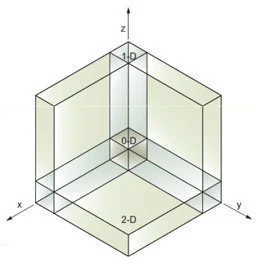
$ 0D $ All dimensions at the nanoscale;
$ 1-D $ Two dimensions at the nanoscale, one dimension at the macro scale;
$ 2-D $ One dimensions at the nanoscale, two dimensions at the macro scale;
$ 3-D $ No dimensions at the nanoscale, all dimensions at the macro scale;
Therefore the correct answer is option A i.e. the type of nano-material, one dimensional outside the nanoscale is one dimensional nano-material.
Note :
Note that the word 'nano' used in the nano-materials does not literally imply that they are of nano sizes. Yes, most of the nano-materials are under the nano scale but it’s not the compulsory condition as there exists nanoparticles over the nanoscale.
Complete Step By Step Answer:
Usually nano-materials are measured within the nano scale of size $ \left( <100\text{ }nm \right). $ Nano materials are classified into following categories on the basis of the scale of their dimensions; quantum effects can begin to dominate the properties of matter as size is reduced to the Nanoscale. Materials that exploit these effects include quantum dots, and quantum well lasers for optoelectronics.
Zero dimensional nano-materials: The zero dimensional nano-materials are measured within the nano scale means that all three dimensions are under the scale of $ 100nm, $ mostly nanoparticles fall into the $ 0D $ nano-materials category.
One dimensional nano-material: In one dimensional nano-material one dimension is out of the nano scale and two are within the same, you can visualise it as a wire. Examples for $ 1D $ nano-material are nanotubes, nanorods and nanowires.
Two dimensional nano-materials: two dimensions are out of the nano scale in $ 2D $ nanomaterials and only one dimension is under nanoscale, it could be visualised as an incredibly thin sheet with thickness of nanometers. This class exhibits plate-like shapes and includes grapheme, nanofilms, nanolayers, and nanocoatings.
Three dimensional nano-materials: All three dimensions are exceeding the nano scale in three dimensional nano-materials; this class can contain bulk powders, dispersions of nanoparticles, bundles of nanowires, and nanotubes as well as multi-nanolayers.
$ 0D $ All dimensions at the nanoscale;
$ 1-D $ Two dimensions at the nanoscale, one dimension at the macro scale;
$ 2-D $ One dimensions at the nanoscale, two dimensions at the macro scale;
$ 3-D $ No dimensions at the nanoscale, all dimensions at the macro scale;
Therefore the correct answer is option A i.e. the type of nano-material, one dimensional outside the nanoscale is one dimensional nano-material.
Note :
Note that the word 'nano' used in the nano-materials does not literally imply that they are of nano sizes. Yes, most of the nano-materials are under the nano scale but it’s not the compulsory condition as there exists nanoparticles over the nanoscale.
Recently Updated Pages
Master Class 11 Social Science: Engaging Questions & Answers for Success

Master Class 11 English: Engaging Questions & Answers for Success
Master Class 11 Maths: Engaging Questions & Answers for Success
Master Class 11 Chemistry: Engaging Questions & Answers for Success
Master Class 11 Biology: Engaging Questions & Answers for Success
Class 11 Question and Answer - Your Ultimate Solutions Guide
Trending doubts
One Metric ton is equal to kg A 10000 B 1000 C 100 class 11 physics CBSE
Difference Between Prokaryotic Cells and Eukaryotic Cells
Find the value of the expression given below sin 30circ class 11 maths CBSE
1 ton equals to A 100 kg B 1000 kg C 10 kg D 10000 class 11 physics CBSE
Two of the body parts which do not appear in MRI are class 11 biology CBSE
Draw a diagram of nephron and explain its structur class 11 biology CBSE