




In which of the following, the image of an object placed at infinity will be highly diminished and point sized?
A. Concave mirror only
B. Convex mirror only
C. Convex lens only
D. Concave mirror, convex mirror, concave lens and convex lens.
Answer
 Verified
500.4k+ views
Hint:Ray diagrams assist us in tracing the path of light for a person viewing a point on an image of an item. The incident and reflected rays are represented by lines with arrows in a ray diagram. It also aids us in determining the direction of the light.
Complete step by step answer:
When light rays from infinity strike a concave mirror, convex mirror, concave lens, or convex lens, a drastically decreased picture is generated at the focus, as illustrated in the figure.
The mirror equation and lens equation can be used to confirm this.
Mirror Equation is given by: $\dfrac{1}{v} + \dfrac{1}{u} = \dfrac{1}{f}$
Lens Equation is given by: $\dfrac{1}{v} - \dfrac{1}{u} = \dfrac{1}{f}$
Substituting \[u = - \,\infty \] , \[v = f\]
Magnification \[m = \dfrac{v}{u} = \dfrac{f}{\infty } = 0\]
Hence, the image is point size.
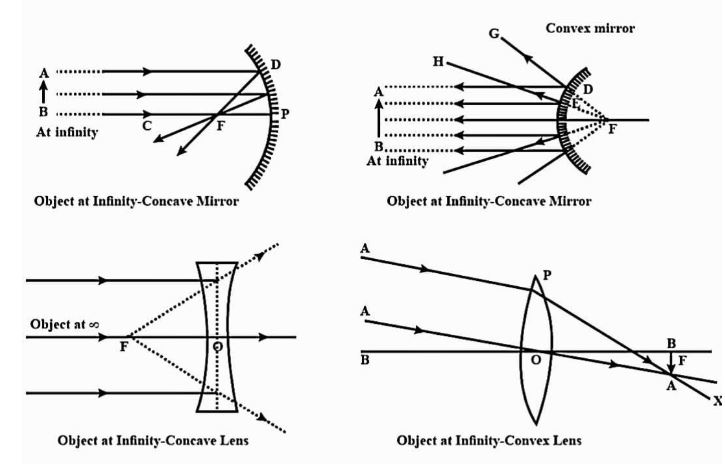
So, the correct option is D.
Note: The focal length of all optical lenses is the distance from the lens to the focus point along the optical axis of the lens. The focal length of a lens is determined by three factors: the radius of curvature of the lens, the refractive index of the substrate from which the lens is constructed, and the medium in which the lens sits. Lenses with a highly curved shape and a high refractive index that are placed in a medium with a big difference in refractive index will have a shorter focal length and thus be more powerful. A lens' focal length can be estimated using the lens manufacturer's formula.
Complete step by step answer:
When light rays from infinity strike a concave mirror, convex mirror, concave lens, or convex lens, a drastically decreased picture is generated at the focus, as illustrated in the figure.
The mirror equation and lens equation can be used to confirm this.
Mirror Equation is given by: $\dfrac{1}{v} + \dfrac{1}{u} = \dfrac{1}{f}$
Lens Equation is given by: $\dfrac{1}{v} - \dfrac{1}{u} = \dfrac{1}{f}$
Substituting \[u = - \,\infty \] , \[v = f\]
Magnification \[m = \dfrac{v}{u} = \dfrac{f}{\infty } = 0\]
Hence, the image is point size.
So, the correct option is D.
Note: The focal length of all optical lenses is the distance from the lens to the focus point along the optical axis of the lens. The focal length of a lens is determined by three factors: the radius of curvature of the lens, the refractive index of the substrate from which the lens is constructed, and the medium in which the lens sits. Lenses with a highly curved shape and a high refractive index that are placed in a medium with a big difference in refractive index will have a shorter focal length and thus be more powerful. A lens' focal length can be estimated using the lens manufacturer's formula.
Recently Updated Pages
Master Class 10 Computer Science: Engaging Questions & Answers for Success

Master Class 10 General Knowledge: Engaging Questions & Answers for Success
Master Class 10 English: Engaging Questions & Answers for Success
Master Class 10 Social Science: Engaging Questions & Answers for Success
Master Class 10 Maths: Engaging Questions & Answers for Success
Master Class 10 Science: Engaging Questions & Answers for Success
Trending doubts
Explain the Treaty of Vienna of 1815 class 10 social science CBSE
Who Won 36 Oscar Awards? Record Holder Revealed
What is the median of the first 10 natural numbers class 10 maths CBSE
Why is it 530 pm in india when it is 1200 afternoon class 10 social science CBSE
Select the word that is correctly spelled a Twelveth class 10 english CBSE
Why is there a time difference of about 5 hours between class 10 social science CBSE