




In which of the following steps in DNA fingerprinting techniques are labelled VNTR probes used?
A) During isolation of DNA
B) During digestion of DNA by REN
C) During electrophoresis
D) During Hybridization
Answer
 Verified
613.2k+ views
Hint: Hybridization is the process in which a single-stranded DNA binds (anneals) to another complementary strand. Probe is used, it can be radioactive/ fluorescent labeling
Complete answer:
- DNA Probes can be used to locate specific alleles of interest by attaching a probe to a manufactured strand.
- The manufactured strand will have complementary base pairs to the desired allele and as a result, will bind to the strand of DNA. The position at which it binds will result in the marker becoming visible.
- The way in which this is detected will be dependent upon the marker used. If a radioactive probe marker is used, this would display dark bands at the position to which the probe had bound. If the fluorescent probe marker is used, then that particular area will become fluorescent.
- Hence in order to locate the desired allele , a DNA strand must be generated containing the same nucleotide base seq as the desired allele to ensure that if that allele is present in the DNA mix., the 2 strands can bind (anneal). This manufactured strand must also have a marker attached to ensure that upon binding it can be detected.
General mechanism of DNA Fingerprinting:
1. DNA extracted from the sample, many copies are made (PCR)
2. Restriction enzymes are used to cut the DNA into small pieces.
3. Gel electrophoresis (separation of the band).
4. Southern blotting is used.
5. DNA bands are compared from the questioned person.
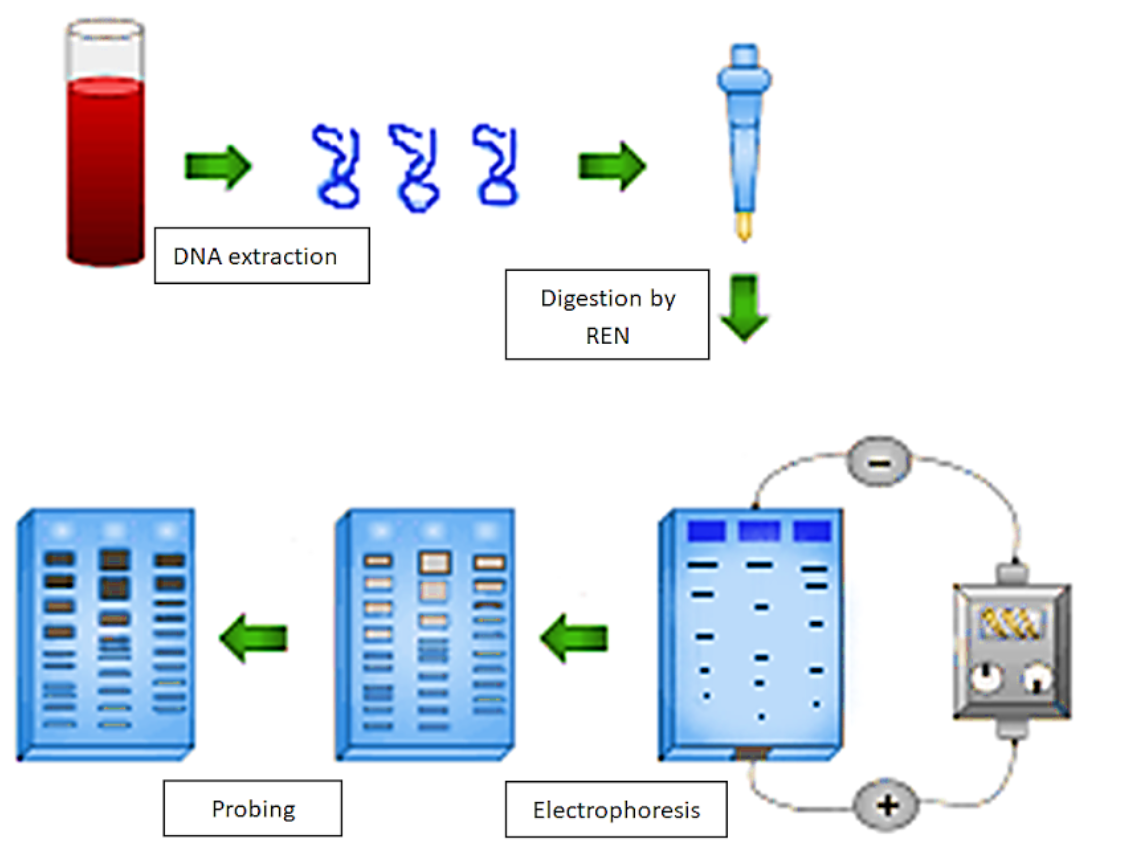
Additional information:
- During the DNA isolation step, the cell wall and cell membranes of the cell are broken down and chelating ions are introduced to save the DNA from endonuclease activities.
- During digestion of DNA by REN the restriction endonuclease enzymes cut the DNA strands from specific locations, to obtain DNA fragments with desired ends.
- During electrophoresis the DNA fragments get separated on the basis fragment size, the heavier and larger fragments travel less and hence on the top, whereas the shorter and lighter fragments travel farther and thus at the lower end (away from the wells).
Note: DNA fingerprinting used to find criminals by the forensic department. It is also used to solve paternity disputes. It is also used to find inherited diseases in newborn and prenatal babies.
Complete answer:
- DNA Probes can be used to locate specific alleles of interest by attaching a probe to a manufactured strand.
- The manufactured strand will have complementary base pairs to the desired allele and as a result, will bind to the strand of DNA. The position at which it binds will result in the marker becoming visible.
- The way in which this is detected will be dependent upon the marker used. If a radioactive probe marker is used, this would display dark bands at the position to which the probe had bound. If the fluorescent probe marker is used, then that particular area will become fluorescent.
- Hence in order to locate the desired allele , a DNA strand must be generated containing the same nucleotide base seq as the desired allele to ensure that if that allele is present in the DNA mix., the 2 strands can bind (anneal). This manufactured strand must also have a marker attached to ensure that upon binding it can be detected.
General mechanism of DNA Fingerprinting:
1. DNA extracted from the sample, many copies are made (PCR)
2. Restriction enzymes are used to cut the DNA into small pieces.
3. Gel electrophoresis (separation of the band).
4. Southern blotting is used.
5. DNA bands are compared from the questioned person.
Additional information:
- During the DNA isolation step, the cell wall and cell membranes of the cell are broken down and chelating ions are introduced to save the DNA from endonuclease activities.
- During digestion of DNA by REN the restriction endonuclease enzymes cut the DNA strands from specific locations, to obtain DNA fragments with desired ends.
- During electrophoresis the DNA fragments get separated on the basis fragment size, the heavier and larger fragments travel less and hence on the top, whereas the shorter and lighter fragments travel farther and thus at the lower end (away from the wells).
Note: DNA fingerprinting used to find criminals by the forensic department. It is also used to solve paternity disputes. It is also used to find inherited diseases in newborn and prenatal babies.
Recently Updated Pages
Master Class 12 Business Studies: Engaging Questions & Answers for Success

Master Class 12 Biology: Engaging Questions & Answers for Success
Master Class 12 Chemistry: Engaging Questions & Answers for Success
Class 12 Question and Answer - Your Ultimate Solutions Guide
Master Class 11 Social Science: Engaging Questions & Answers for Success
Master Class 11 English: Engaging Questions & Answers for Success
Trending doubts
Which are the Top 10 Largest Countries of the World?
Draw a labelled sketch of the human eye class 12 physics CBSE
Name the crygenes that control cotton bollworm and class 12 biology CBSE
Differentiate between homogeneous and heterogeneous class 12 chemistry CBSE
Ribosomal RNA is actively synthesised in A Nucleoplasm class 12 biology CBSE
How many molecules of ATP and NADPH are required information class 12 biology CBSE