



In which of the following expressions, prime factorization has been done:
a)\[24 = 2 \times 3 \times 4\]
b)\[56 = 1 \times 7 \times 2 \times 2 \times 2\]
c)\[54 = 2 \times 3 \times 9\]
Answer
 Verified
605.4k+ views
Hint: Here we will check the given expression by doing prime factorization of every number. Then we will check the factors of the numbers given in the question whether it is prime number or not. If the numbers contain the prime factors only then the prime factorization has been done in the expression otherwise not.
Complete step-by-step answer:
a)\[24 = 2 \times 3 \times 4\]
We will now find the prime factorization of 24.
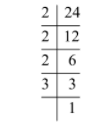
So we can write the 24 as the product of prime factors.
\[24 = 2 \times 2 \times 2 \times 3\]
But, in question 4 is given as one of the products, which is not a prime number.
So prime factorization has not been done in this question.
b)\[56 = 1 \times 7 \times 2 \times 2 \times 2\]
We will first find the prime factorization of 56.
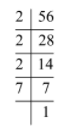
Therefore, we can write the 56 as the product of prime factors.
\[56 = 2 \times 2 \times 2 \times 7{\rm{ }}\]
We got the prime factors same as the given question i.e. all factors are prime numbers. So, prime factorization has been done in this question.
c)\[54 = 2 \times 3 \times 9\]
Let’s find the prime factorization of 54.
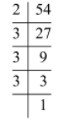
So we can write the 54 as the product of prime factors.
\[54 = 2 \times 3 \times 3 \times 3\]
But here in the question 9 is given which is not a prime number. So prime factorization has not been done in this question.
Hence none of the given option prime factorization is given.
Note: Prime factorization is a way of finding all the prime numbers that can be multiplied to get the original number. Here, in the prime factorization of 24, 4 is given as one of the factors. We might think 2 multiplied by 2 is 4 so the prime factorization is done. But that is not correct because prime factorization means to have only a prime number as a factor and not a composite number. Similarly, for prime factorization of 54, 9 is given. As 9 is a composite number so we cannot consider it to be a prime factor. Prime numbers are the numbers that have only two factors and they are 1 and itself. On the other hand, composite numbers are the ones, which have more than 2 factors.
Complete step-by-step answer:
a)\[24 = 2 \times 3 \times 4\]
We will now find the prime factorization of 24.
So we can write the 24 as the product of prime factors.
\[24 = 2 \times 2 \times 2 \times 3\]
But, in question 4 is given as one of the products, which is not a prime number.
So prime factorization has not been done in this question.
b)\[56 = 1 \times 7 \times 2 \times 2 \times 2\]
We will first find the prime factorization of 56.
Therefore, we can write the 56 as the product of prime factors.
\[56 = 2 \times 2 \times 2 \times 7{\rm{ }}\]
We got the prime factors same as the given question i.e. all factors are prime numbers. So, prime factorization has been done in this question.
c)\[54 = 2 \times 3 \times 9\]
Let’s find the prime factorization of 54.
So we can write the 54 as the product of prime factors.
\[54 = 2 \times 3 \times 3 \times 3\]
But here in the question 9 is given which is not a prime number. So prime factorization has not been done in this question.
Hence none of the given option prime factorization is given.
Note: Prime factorization is a way of finding all the prime numbers that can be multiplied to get the original number. Here, in the prime factorization of 24, 4 is given as one of the factors. We might think 2 multiplied by 2 is 4 so the prime factorization is done. But that is not correct because prime factorization means to have only a prime number as a factor and not a composite number. Similarly, for prime factorization of 54, 9 is given. As 9 is a composite number so we cannot consider it to be a prime factor. Prime numbers are the numbers that have only two factors and they are 1 and itself. On the other hand, composite numbers are the ones, which have more than 2 factors.

Recently Updated Pages
Master Class 12 Business Studies: Engaging Questions & Answers for Success

Master Class 12 Biology: Engaging Questions & Answers for Success
Master Class 12 Chemistry: Engaging Questions & Answers for Success
Class 12 Question and Answer - Your Ultimate Solutions Guide
Master Class 11 Social Science: Engaging Questions & Answers for Success
Master Class 11 English: Engaging Questions & Answers for Success
Trending doubts
Convert 200 Million dollars in rupees class 7 maths CBSE
Full Form of IASDMIPSIFSIRSPOLICE class 7 social science CBSE
100 million is equal to begingathered A 1 crore B -class-7-maths-CBSE
List of coprime numbers from 1 to 100 class 7 maths CBSE
There are three types of tickets economy business and class 7 maths CBSE
Write a summary of the poem the quality of mercy by class 7 english CBSE