




In $$\triangle ABC$$, $$BC^{2}+AB^{2}=AC^{2}$$, then ______ is a right angle.
Answer
 Verified
596.7k+ views
- Hint: In this question it is given that we have to find which angle of the given triangle $$\triangle ABC$$ is a right angle. So to find the solution we need to know the pythagorean theorem, which states that for an right angle triangle the summation of the squares of the base and height is equal to the square of the hypotenuse.
i.e, $$\left( \text{base} \right)^{2} +\left( \text{perpendicular } \right)^{2} =\left( \text{hypotenuse} \right)^{2} $$.......(1)
And the opposite angle of the hypotenuse is called the right angle.
Complete step-by-step solution -
Here it is given,
$$BC^{2}+AB^{2}=AC^{2}$$......(2)
Now if we compare equation (2) with the pythagorean theorem, then we get,
base = BC, perpendicular = AB and hypotenuse = AC.
Now if we mark the sides on the diagram then we get,
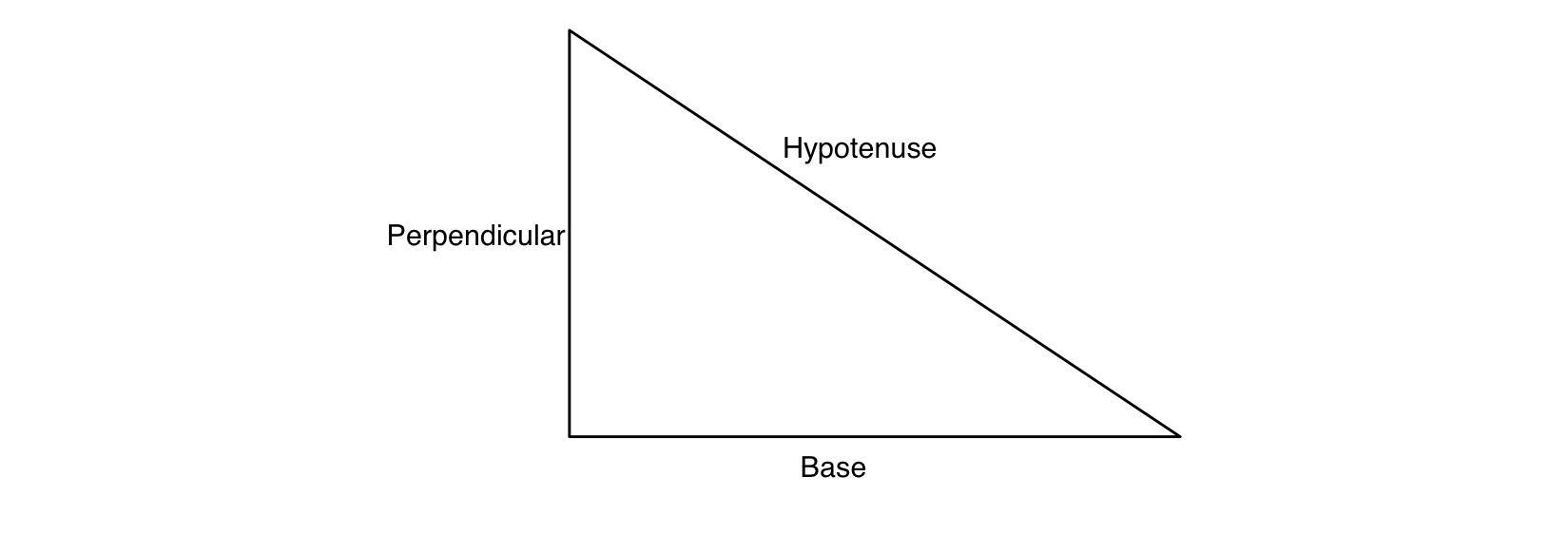
Here AC is the hypotenuse and since, hypotenuse is the longest side of a right-angled triangle and the opposite angle of the hypotenuse is called the right angle.
And as we know that the opposite angle of the side AC is $$\angle B$$.
Therefore $$\angle B$$ is the right angle of $$\triangle ABC$$.
Note: A right-angled triangle is a triangle in which one angle is a right angle (that is, a 90-degree angle). The relation between the sides and angles of a right triangle is the basis for trigonometry.
The side opposite the right angle is called the hypotenuse . The sides adjacent to the right angle are called legs among them one is called base and another is called height (sometimes perpendicular). The angle which is opposite to the hypotenuse is called the right angle.
If the lengths of all three sides of a right triangle are integers, the triangle is said to be a Pythagorean triangle and its side lengths are collectively known as a Pythagorean triple.
i.e, $$\left( \text{base} \right)^{2} +\left( \text{perpendicular } \right)^{2} =\left( \text{hypotenuse} \right)^{2} $$.......(1)
And the opposite angle of the hypotenuse is called the right angle.
Complete step-by-step solution -
Here it is given,
$$BC^{2}+AB^{2}=AC^{2}$$......(2)
Now if we compare equation (2) with the pythagorean theorem, then we get,
base = BC, perpendicular = AB and hypotenuse = AC.
Now if we mark the sides on the diagram then we get,
Here AC is the hypotenuse and since, hypotenuse is the longest side of a right-angled triangle and the opposite angle of the hypotenuse is called the right angle.
And as we know that the opposite angle of the side AC is $$\angle B$$.
Therefore $$\angle B$$ is the right angle of $$\triangle ABC$$.
Note: A right-angled triangle is a triangle in which one angle is a right angle (that is, a 90-degree angle). The relation between the sides and angles of a right triangle is the basis for trigonometry.
The side opposite the right angle is called the hypotenuse . The sides adjacent to the right angle are called legs among them one is called base and another is called height (sometimes perpendicular). The angle which is opposite to the hypotenuse is called the right angle.
If the lengths of all three sides of a right triangle are integers, the triangle is said to be a Pythagorean triangle and its side lengths are collectively known as a Pythagorean triple.
Recently Updated Pages
Master Class 10 Computer Science: Engaging Questions & Answers for Success

Master Class 10 General Knowledge: Engaging Questions & Answers for Success
Master Class 10 English: Engaging Questions & Answers for Success
Master Class 10 Social Science: Engaging Questions & Answers for Success
Master Class 10 Maths: Engaging Questions & Answers for Success
Master Class 10 Science: Engaging Questions & Answers for Success
Trending doubts
What is the median of the first 10 natural numbers class 10 maths CBSE
Which women's tennis player has 24 Grand Slam singles titles?
Who is the Brand Ambassador of Incredible India?
Why is there a time difference of about 5 hours between class 10 social science CBSE
Write a letter to the principal requesting him to grant class 10 english CBSE
State and prove converse of BPT Basic Proportionality class 10 maths CBSE