




In triangle ABC, AD is perpendicular to BC, $\sin {\text{B}} = 0.8$, BD = 9 cm and $\tan {\text{C}} = 1$. Find the length of AB.
Answer
 Verified
621k+ views
Hint-Hint- Here, we will proceed by drawing the figure corresponding to the problem statement and then, we will use the identity to find cosB which will eventually give the value of the length AB.
Complete step-by-step answer:
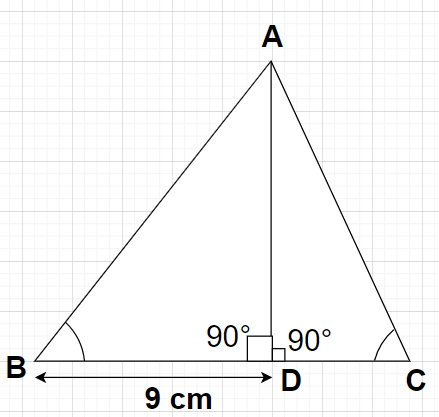
In $\vartriangle $ABC, $\sin {\text{B}} = 0.8$, BD = 9 cm and $\tan {\text{C}} = 1$
AD is the perpendicular drawn from point A to side BC of the triangle ABC which will divide the triangle ABC into two right angled triangles with right angle at vertex D.
As we know that ${\left( {\sin \theta } \right)^2} + {\left( {\cos \theta } \right)^2} = 1$
For angle B using the above identity, we can write
${\left( {\sin {\text{B}}} \right)^2} + {\left( {\cos {\text{B}}} \right)^2} = 1$
By substituting $\sin {\text{B}} = 0.8$ in the above equation, we get
$
\Rightarrow {\left( {0.8} \right)^2} + {\left( {\cos {\text{B}}} \right)^2} = 1 \\
\Rightarrow {\left( {\cos {\text{B}}} \right)^2} = 1 - {\left( {0.8} \right)^2} \\
\Rightarrow {\left( {\cos {\text{B}}} \right)^2} = 1 - 0.64 \\
\Rightarrow {\left( {\cos {\text{B}}} \right)^2} = 0.36 \\
\Rightarrow \cos {\text{B}} = \pm \sqrt {0.36} \\
\Rightarrow \cos {\text{B}} = \pm 0.6 \\
$
In any right angled triangle, according to the definition of cosine trigonometric function, we have
$\cos \theta = \dfrac{{{\text{Base}}}}{{{\text{Hypotenuse}}}}$
Using the above formula, we can write
$
\cos {\text{B}} = \dfrac{{{\text{BD}}}}{{{\text{AB}}}} \\
\Rightarrow {\text{AB}} = \dfrac{{{\text{BD}}}}{{\cos {\text{B}}}} \\
$
By substituting BD = 9 cm and $\cos {\text{B}} = \pm 0.6$ in the above equation, we get
$ \Rightarrow {\text{AB}} = \dfrac{{\text{9}}}{{ \pm 0.6}}$
Here, we will be considering only the positive value of cosine of angle B because the length of the side of any triangle is always positive. So, cosB = -0.6 is neglected.
$
\Rightarrow {\text{AB}} = \dfrac{{\text{9}}}{{0.6}} = \dfrac{{90}}{6} \\
\Rightarrow {\text{AB}} = 15{\text{ cm}} \\
$
Therefore, the length of side AB of the triangle is 15 cm.
Note- In this particular problem, we can also find the length AD using the Pythagoras Theorem in triangle ABD i.e., ${\left( {{\text{Hypotenuse}}} \right)^2} = {\left( {{\text{Perpendicular}}} \right)^2} + {\left( {{\text{Base}}} \right)^2} \Rightarrow {\left( {{\text{AB}}} \right)^2} = {\left( {{\text{AD}}} \right)^2} + {\left( {{\text{BD}}} \right)^2}$. Also, using $\tan {\text{C}} = \dfrac{{{\text{AD}}}}{{{\text{CD}}}}$ we will get the length CD and for the length AC we will use Pythagoras Theorem in triangle ACD i.e., ${\left( {{\text{AC}}} \right)^2} = {\left( {{\text{AD}}} \right)^2} + {\left( {{\text{CD}}} \right)^2}$.
Complete step-by-step answer:
In $\vartriangle $ABC, $\sin {\text{B}} = 0.8$, BD = 9 cm and $\tan {\text{C}} = 1$
AD is the perpendicular drawn from point A to side BC of the triangle ABC which will divide the triangle ABC into two right angled triangles with right angle at vertex D.
As we know that ${\left( {\sin \theta } \right)^2} + {\left( {\cos \theta } \right)^2} = 1$
For angle B using the above identity, we can write
${\left( {\sin {\text{B}}} \right)^2} + {\left( {\cos {\text{B}}} \right)^2} = 1$
By substituting $\sin {\text{B}} = 0.8$ in the above equation, we get
$
\Rightarrow {\left( {0.8} \right)^2} + {\left( {\cos {\text{B}}} \right)^2} = 1 \\
\Rightarrow {\left( {\cos {\text{B}}} \right)^2} = 1 - {\left( {0.8} \right)^2} \\
\Rightarrow {\left( {\cos {\text{B}}} \right)^2} = 1 - 0.64 \\
\Rightarrow {\left( {\cos {\text{B}}} \right)^2} = 0.36 \\
\Rightarrow \cos {\text{B}} = \pm \sqrt {0.36} \\
\Rightarrow \cos {\text{B}} = \pm 0.6 \\
$
In any right angled triangle, according to the definition of cosine trigonometric function, we have
$\cos \theta = \dfrac{{{\text{Base}}}}{{{\text{Hypotenuse}}}}$
Using the above formula, we can write
$
\cos {\text{B}} = \dfrac{{{\text{BD}}}}{{{\text{AB}}}} \\
\Rightarrow {\text{AB}} = \dfrac{{{\text{BD}}}}{{\cos {\text{B}}}} \\
$
By substituting BD = 9 cm and $\cos {\text{B}} = \pm 0.6$ in the above equation, we get
$ \Rightarrow {\text{AB}} = \dfrac{{\text{9}}}{{ \pm 0.6}}$
Here, we will be considering only the positive value of cosine of angle B because the length of the side of any triangle is always positive. So, cosB = -0.6 is neglected.
$
\Rightarrow {\text{AB}} = \dfrac{{\text{9}}}{{0.6}} = \dfrac{{90}}{6} \\
\Rightarrow {\text{AB}} = 15{\text{ cm}} \\
$
Therefore, the length of side AB of the triangle is 15 cm.
Note- In this particular problem, we can also find the length AD using the Pythagoras Theorem in triangle ABD i.e., ${\left( {{\text{Hypotenuse}}} \right)^2} = {\left( {{\text{Perpendicular}}} \right)^2} + {\left( {{\text{Base}}} \right)^2} \Rightarrow {\left( {{\text{AB}}} \right)^2} = {\left( {{\text{AD}}} \right)^2} + {\left( {{\text{BD}}} \right)^2}$. Also, using $\tan {\text{C}} = \dfrac{{{\text{AD}}}}{{{\text{CD}}}}$ we will get the length CD and for the length AC we will use Pythagoras Theorem in triangle ACD i.e., ${\left( {{\text{AC}}} \right)^2} = {\left( {{\text{AD}}} \right)^2} + {\left( {{\text{CD}}} \right)^2}$.
Recently Updated Pages
Master Class 11 Business Studies: Engaging Questions & Answers for Success

Master Class 11 Computer Science: Engaging Questions & Answers for Success
Master Class 11 Economics: Engaging Questions & Answers for Success
Master Class 11 Social Science: Engaging Questions & Answers for Success
Master Class 11 English: Engaging Questions & Answers for Success
Master Class 11 Chemistry: Engaging Questions & Answers for Success
Trending doubts
Draw a diagram of nephron and explain its structur class 11 biology CBSE
Explain zero factorial class 11 maths CBSE
Chemical formula of Bleaching powder is A Ca2OCl2 B class 11 chemistry CBSE
Name the part of the brain responsible for the precision class 11 biology CBSE
The growth of tendril in pea plants is due to AEffect class 11 biology CBSE
One Metric ton is equal to kg A 10000 B 1000 C 100 class 11 physics CBSE