




In triangle ABC, A = (0, 8), B = (2, 4) and C = (6, 8). Find the equation of altitudes.
Answer
 Verified
638.7k+ views
Hint: To begin with, we will graph these points on a graph paper and draw the altitudes from each of the vertices. We should note that any triangle has 3 altitudes, one from each of the vertices. Then, to find the equation, we will find the slope of the base corresponding to one of the three vertices of the triangle. We know that the altitude is perpendicular to the base of the triangle. Keeping this in mind, we can find the slope of any line perpendicular to the base with the relation ${{m}_{1}}{{m}_{2}}=-1$, where ${{m}_{1}}$ and ${{m}_{2}}$ are two slopes of lines at the right angle. Once we find the slope of altitude, we can find the equation of a line passing through the apex vertex and having the slope of the perpendicular line in the slope point form. We shall repeat this process for all three points.
Complete step-by-step solution:
The points given to us are A = (0, 8), B = (2, 4) and C = (6, 8). We will graph triangle ABC and draw the altitudes from all the points.
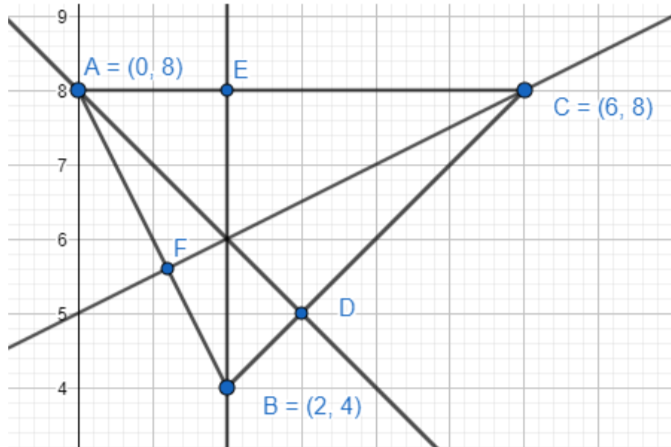
Therefore, AD is altitude with base BC, BE is altitude with base AC and CF is altitude with base AB.
First, let us consider that A is the apex and BC is the base.
Slope of line joining points $\left( {{x}_{1}},{{y}_{1}} \right)$ and $\left( {{x}_{2}},{{y}_{2}} \right)$ is given as $m=\dfrac{{{y}_{2}}-{{y}_{1}}}{{{x}_{2}}-{{x}_{1}}}$.
We will now find the slope of B = (2, 4) and C = (6, 8).
$\begin{align}
& \Rightarrow {{m}_{1}}=\dfrac{8-4}{6-2} \\
& \Rightarrow {{m}_{1}}=\dfrac{4}{4} \\
& \Rightarrow {{m}_{1}}=1 \\
\end{align}$
We know that the product of slopes of two perpendicular lines is given as –1.
Let ${{m}_{2}}$ be the slope of the perpendicular.
$\begin{align}
& \Rightarrow {{m}_{1}}{{m}_{2}}=-1 \\
& \Rightarrow \left( 1 \right){{m}_{2}}=-1 \\
& \Rightarrow {{m}_{2}}=-1 \\
\end{align}$
Thus, the slope of altitude with apex A is –1.
We know that equation of a line in slope-point form is given as $\left( y-{{y}_{1}} \right)=m\left( x-{{x}_{1}} \right)$, where $\left( {{x}_{1}},{{y}_{1}} \right)$ is the point on the line.
We will find the equation of altitude passing through A and having slope –1.
$\begin{align}
& \Rightarrow y-8=-1\left( x-0 \right) \\
& \Rightarrow y-8=-x \\
& \Rightarrow x+y=8 \\
\end{align}$
Therefore, the equation of one of the altitudes is $x+y=8$.
Now, we shall consider B as the apex and AC as the base.
The slope of base AC is given as follows:
$\begin{align}
& \Rightarrow {{m}_{1}}=\dfrac{8-8}{6-0} \\
& \Rightarrow {{m}_{1}}=0 \\
\end{align}$
Therefore, AC is parallel to the x – axis. This means the altitude BE will be parallel to y – axis.
Equation of a line parallel to y – axis is given as $x={{x}_{1}}$, $\left( {{x}_{1}},{{y}_{1}} \right)$ is a point on the line.
Therefore, the equation of altitude BE is given as
$\Rightarrow x=2$
Now, the last altitude will be with apex C and base AB.
Slope of AB is given as follows:
$\begin{align}
& \Rightarrow {{m}_{1}}=\dfrac{8-4}{0-2} \\
& \Rightarrow {{m}_{1}}=-2 \\
\end{align}$
Therefore, slope of the altitude is given as:
$\begin{align}
& \Rightarrow {{m}_{2}}\left( -2 \right)=-1 \\
& \Rightarrow {{m}_{2}}=\dfrac{1}{2} \\
\end{align}$
Therefore, the slope of altitude CF is $\dfrac{1}{2}$. The equation of line passing through C and having slope $\dfrac{1}{2}$.
$\begin{align}
& \Rightarrow y-8=\dfrac{1}{2}\left( x-6 \right) \\
& \Rightarrow 2y-16=x-6 \\
& \Rightarrow x-2y=-10 \\
\end{align}$
Therefore, the equations of altitudes are $x+y=8$, $x=2$ and $x-2y=-10$.
Note: The altitudes of a triangle are always concurrent. The point of intersection of three altitudes is known as the orthocentre of the triangle. Here students sometimes make mistakes by assuming the altitude as median and try to find the midpoint of all sides and find an equation from passing two given points(apex vertices and the opposite side’s midpoint) which is wrong so there is a need to keep in mind the concept of median, altitude.
Complete step-by-step solution:
The points given to us are A = (0, 8), B = (2, 4) and C = (6, 8). We will graph triangle ABC and draw the altitudes from all the points.
Therefore, AD is altitude with base BC, BE is altitude with base AC and CF is altitude with base AB.
First, let us consider that A is the apex and BC is the base.
Slope of line joining points $\left( {{x}_{1}},{{y}_{1}} \right)$ and $\left( {{x}_{2}},{{y}_{2}} \right)$ is given as $m=\dfrac{{{y}_{2}}-{{y}_{1}}}{{{x}_{2}}-{{x}_{1}}}$.
We will now find the slope of B = (2, 4) and C = (6, 8).
$\begin{align}
& \Rightarrow {{m}_{1}}=\dfrac{8-4}{6-2} \\
& \Rightarrow {{m}_{1}}=\dfrac{4}{4} \\
& \Rightarrow {{m}_{1}}=1 \\
\end{align}$
We know that the product of slopes of two perpendicular lines is given as –1.
Let ${{m}_{2}}$ be the slope of the perpendicular.
$\begin{align}
& \Rightarrow {{m}_{1}}{{m}_{2}}=-1 \\
& \Rightarrow \left( 1 \right){{m}_{2}}=-1 \\
& \Rightarrow {{m}_{2}}=-1 \\
\end{align}$
Thus, the slope of altitude with apex A is –1.
We know that equation of a line in slope-point form is given as $\left( y-{{y}_{1}} \right)=m\left( x-{{x}_{1}} \right)$, where $\left( {{x}_{1}},{{y}_{1}} \right)$ is the point on the line.
We will find the equation of altitude passing through A and having slope –1.
$\begin{align}
& \Rightarrow y-8=-1\left( x-0 \right) \\
& \Rightarrow y-8=-x \\
& \Rightarrow x+y=8 \\
\end{align}$
Therefore, the equation of one of the altitudes is $x+y=8$.
Now, we shall consider B as the apex and AC as the base.
The slope of base AC is given as follows:
$\begin{align}
& \Rightarrow {{m}_{1}}=\dfrac{8-8}{6-0} \\
& \Rightarrow {{m}_{1}}=0 \\
\end{align}$
Therefore, AC is parallel to the x – axis. This means the altitude BE will be parallel to y – axis.
Equation of a line parallel to y – axis is given as $x={{x}_{1}}$, $\left( {{x}_{1}},{{y}_{1}} \right)$ is a point on the line.
Therefore, the equation of altitude BE is given as
$\Rightarrow x=2$
Now, the last altitude will be with apex C and base AB.
Slope of AB is given as follows:
$\begin{align}
& \Rightarrow {{m}_{1}}=\dfrac{8-4}{0-2} \\
& \Rightarrow {{m}_{1}}=-2 \\
\end{align}$
Therefore, slope of the altitude is given as:
$\begin{align}
& \Rightarrow {{m}_{2}}\left( -2 \right)=-1 \\
& \Rightarrow {{m}_{2}}=\dfrac{1}{2} \\
\end{align}$
Therefore, the slope of altitude CF is $\dfrac{1}{2}$. The equation of line passing through C and having slope $\dfrac{1}{2}$.
$\begin{align}
& \Rightarrow y-8=\dfrac{1}{2}\left( x-6 \right) \\
& \Rightarrow 2y-16=x-6 \\
& \Rightarrow x-2y=-10 \\
\end{align}$
Therefore, the equations of altitudes are $x+y=8$, $x=2$ and $x-2y=-10$.
Note: The altitudes of a triangle are always concurrent. The point of intersection of three altitudes is known as the orthocentre of the triangle. Here students sometimes make mistakes by assuming the altitude as median and try to find the midpoint of all sides and find an equation from passing two given points(apex vertices and the opposite side’s midpoint) which is wrong so there is a need to keep in mind the concept of median, altitude.
Recently Updated Pages
Basicity of sulphurous acid and sulphuric acid are

Master Class 10 Computer Science: Engaging Questions & Answers for Success
Master Class 10 Social Science: Engaging Questions & Answers for Success
Master Class 10 Science: Engaging Questions & Answers for Success
Class 10 Question and Answer - Your Ultimate Solutions Guide
Master Class 10 Maths: Engaging Questions & Answers for Success
Trending doubts
What is the Total Duration of Football Match?
Explain the Treaty of Vienna of 1815 class 10 social science CBSE
In football, which nation is called "La Roja"?
Why is there a time difference of about 5 hours between class 10 social science CBSE
10 examples of evaporation in daily life with explanations
What is the full form of POSCO class 10 social science CBSE