




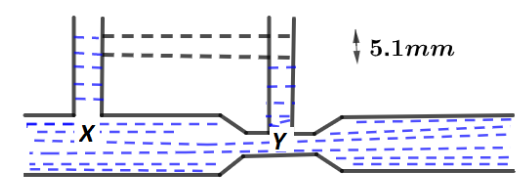
In the venturimeter as shown, water is flowing. Speed at $x$ is $2\,cm\,{\sec ^{ - 1}}$. The Speed of water at $y$ is ? $(g = 1000\,cm\,{\sec ^{ - 2}})$
A. $23\,cm\,{\sec ^{ - 1}}$
B. $32\,cm\,{\sec ^{ - 1}}$
C. $101\,cm\,{\sec ^{ - 1}}$
D. $1024\,cm\,{\sec ^{ - 1}}$
Answer
 Verified
522.6k+ views
Hint: In order to solve this question, we will use the definition of venturimeter. Venturimeter is a device that is used to measure the rate of flow of liquid through a pipe. This device is based on the principle of Bernoulli’s equation. It has three parts: Covering part, throat and Diverging part. Bernoulli’s principle depicts that when velocity increases pressure decreases. Water flows as there is pressure difference between inlet pipe and throat which can be measured using a differential manometer. After getting pressure difference flow rate is calculated
Complete step by step answer:
Given in question ${v_1} = 2\,cm\,{\sec ^{ - 1}}$ where ${v_1}$ is velocity of fluid at $x$
Similarly ${v_2} = v\,cm\,{\sec ^{ - 1}}$ , where ${v_2}$ is velocity of fluid at $y$
And $h = 5.1\,mm = 0.51\,cm$
Using Bernoulli’s Principle at $x$ and $y$ we get
$\dfrac{{{p_1}}}{{\rho g}} + \dfrac{{{v_1}^2}}{{2g}} + {z_1} = \dfrac{{{p_2}}}{{\rho g}} + \dfrac{{{v_2}^2}}{{2g}} + {z_2}$
$ \Rightarrow \dfrac{{{p_1}}}{{\rho g}} + \dfrac{{{v_1}^2}}{{2g}} = \dfrac{{{p_2}}}{{\rho g}} + \dfrac{{{v_2}^2}}{{2g}}$ since $({z_1} = {z_2} = 0)$ As the tube is horizontal
$ \Rightarrow \dfrac{{{p_1} - {p_2}}}{{\rho g}} = \dfrac{{{v_2}^2 - {v_1}^2}}{{2g}}$
$ \Rightarrow h = \dfrac{{{v_2}^2 - {v_1}^2}}{{2g}}$ Where $(h = \dfrac{{{p_1} - {p_2}}}{{\rho g}})$ is the height difference between two water level at x & y
${v_2}^2 = {v_1}^2 + 2gh$
Putting values in above equation we get
${v^2} = {(2cm{\sec ^{ - 1}})^2} + (2 \times 1000\,cm\,{\sec ^{ - 2}} \times 0.51\,cm)$
$ \Rightarrow {v^2} = 1024\,c{m^2}\,{\sec ^{ - 2}}$
$ \Rightarrow v = 32\,cm\,{\sec ^{ - 1}}$
Hence,The Speed of water at $y$ is $32\,cm\,{\sec ^{ - 1}}$.
Note: It should be remembered that, continuity equation always valid at both $x$ and $y$ so flow would be continuous also in Bernoulli’s Principle we have put ${z_1}\& {z_2}$ equal to zero because the venturimeter is horizontal in nature. It can be viewed that velocity at $y$ is greater than velocity at $x$ even pressure at $y$ is less than pressure at $x$ this clearly depicts the proof that Bernoulli's flow in the venturi meter could be laminar flow because of fluid continuity.
Complete step by step answer:
Given in question ${v_1} = 2\,cm\,{\sec ^{ - 1}}$ where ${v_1}$ is velocity of fluid at $x$
Similarly ${v_2} = v\,cm\,{\sec ^{ - 1}}$ , where ${v_2}$ is velocity of fluid at $y$
And $h = 5.1\,mm = 0.51\,cm$
Using Bernoulli’s Principle at $x$ and $y$ we get
$\dfrac{{{p_1}}}{{\rho g}} + \dfrac{{{v_1}^2}}{{2g}} + {z_1} = \dfrac{{{p_2}}}{{\rho g}} + \dfrac{{{v_2}^2}}{{2g}} + {z_2}$
$ \Rightarrow \dfrac{{{p_1}}}{{\rho g}} + \dfrac{{{v_1}^2}}{{2g}} = \dfrac{{{p_2}}}{{\rho g}} + \dfrac{{{v_2}^2}}{{2g}}$ since $({z_1} = {z_2} = 0)$ As the tube is horizontal
$ \Rightarrow \dfrac{{{p_1} - {p_2}}}{{\rho g}} = \dfrac{{{v_2}^2 - {v_1}^2}}{{2g}}$
$ \Rightarrow h = \dfrac{{{v_2}^2 - {v_1}^2}}{{2g}}$ Where $(h = \dfrac{{{p_1} - {p_2}}}{{\rho g}})$ is the height difference between two water level at x & y
${v_2}^2 = {v_1}^2 + 2gh$
Putting values in above equation we get
${v^2} = {(2cm{\sec ^{ - 1}})^2} + (2 \times 1000\,cm\,{\sec ^{ - 2}} \times 0.51\,cm)$
$ \Rightarrow {v^2} = 1024\,c{m^2}\,{\sec ^{ - 2}}$
$ \Rightarrow v = 32\,cm\,{\sec ^{ - 1}}$
Hence,The Speed of water at $y$ is $32\,cm\,{\sec ^{ - 1}}$.
Note: It should be remembered that, continuity equation always valid at both $x$ and $y$ so flow would be continuous also in Bernoulli’s Principle we have put ${z_1}\& {z_2}$ equal to zero because the venturimeter is horizontal in nature. It can be viewed that velocity at $y$ is greater than velocity at $x$ even pressure at $y$ is less than pressure at $x$ this clearly depicts the proof that Bernoulli's flow in the venturi meter could be laminar flow because of fluid continuity.
Recently Updated Pages
Basicity of sulphurous acid and sulphuric acid are

Master Class 11 Business Studies: Engaging Questions & Answers for Success
Master Class 11 Computer Science: Engaging Questions & Answers for Success
Master Class 11 Economics: Engaging Questions & Answers for Success
Master Class 11 Social Science: Engaging Questions & Answers for Success
Master Class 11 English: Engaging Questions & Answers for Success
Trending doubts
One Metric ton is equal to kg A 10000 B 1000 C 100 class 11 physics CBSE
The largest wind power cluster is located in the state class 11 social science CBSE
Explain zero factorial class 11 maths CBSE
State and prove Bernoullis theorem class 11 physics CBSE
What steps did the French revolutionaries take to create class 11 social science CBSE
Which among the following are examples of coming together class 11 social science CBSE