




In the pulmonary artery blood flows from the heart to the lungs and in the pulmonary vein blood returns from the lungs to the heart. The blood in the pulmonary artery is
A. Higher in $O_{2}$ and lower in $CO_{2}$ content than the blood in the pulmonary vein
B. Higher in both $O_{2}$ and $CO_{2}$ content than the blood in the pulmonary vein
C. Lower in $O_{2}$ and higher in $CO_{2}$ content than the blood in the pulmonary vein
D. Lower in $O_{2}$ and $CO_{2}$ content than the blood in the pulmonary vein
E. Higher in $O_{2}$ content but about the same in $CO_{2}$ content as the blood in the pulmonary vein
Answer
 Verified
588k+ views
Hint: We have to know that the blood vessels transporting blood from the right side of the heart to the capillaries of the lungs are the pulmonary arteries. Unlike other arteries, there is a deficit of oxygen (deoxygenated) in the blood it carries. From the right side of the heart, the major pulmonary arteries emerge, and these break into smaller arteries that gradually fragment and become smaller until they become arterioles and finally capillaries.
Complete answer:
We must remember that the left ventricle pumps blood into the aorta, which branches and delivers blood to the main areas and organs of the body in turn. Deoxygenated blood from the head, chest and arms is collected by the anterior vena cava and reaches the right atrium while the inferior vena cava gathers blood from the lower body regions. The deoxygenated blood is transferred to the right atrium by the two venae cavae.
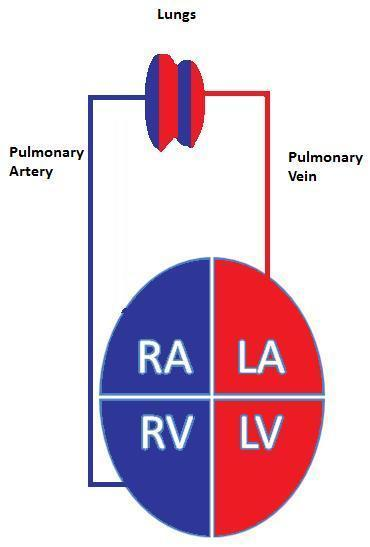
Deoxygenated blood from the right ventricle to the lungs for oxygenation is transported by blood from the right atrium into the right ventral and pulmonary arteries. Each lung produces two pulmonary veins and transfers oxygen-rich blood to the left atrium. Therefore in contrast to pulmonary veins, blood in the pulmonary arteries is low in oxygen but high in carbon dioxide.
So, the correct answer is “Option C”.
Note:
We have to remember that the deoxygenated blood is transported from the right ventricle to the lungs by the pulmonary artery. Here the blood flows through capillaries adjacent to the alveoli and is oxygenated as part of the respiration process. The bronchial arteries provide nutrients to the lungs themselves, in contrast to the pulmonary arteries. The pulmonary veins play an integral role in respiration by collecting oxygenated blood from the alveoli and returning it to the left atrium.
Complete answer:
We must remember that the left ventricle pumps blood into the aorta, which branches and delivers blood to the main areas and organs of the body in turn. Deoxygenated blood from the head, chest and arms is collected by the anterior vena cava and reaches the right atrium while the inferior vena cava gathers blood from the lower body regions. The deoxygenated blood is transferred to the right atrium by the two venae cavae.
Deoxygenated blood from the right ventricle to the lungs for oxygenation is transported by blood from the right atrium into the right ventral and pulmonary arteries. Each lung produces two pulmonary veins and transfers oxygen-rich blood to the left atrium. Therefore in contrast to pulmonary veins, blood in the pulmonary arteries is low in oxygen but high in carbon dioxide.
So, the correct answer is “Option C”.
Note:
We have to remember that the deoxygenated blood is transported from the right ventricle to the lungs by the pulmonary artery. Here the blood flows through capillaries adjacent to the alveoli and is oxygenated as part of the respiration process. The bronchial arteries provide nutrients to the lungs themselves, in contrast to the pulmonary arteries. The pulmonary veins play an integral role in respiration by collecting oxygenated blood from the alveoli and returning it to the left atrium.
Recently Updated Pages
Master Class 11 Social Science: Engaging Questions & Answers for Success

Master Class 11 Physics: Engaging Questions & Answers for Success
Master Class 11 Maths: Engaging Questions & Answers for Success
Master Class 11 Economics: Engaging Questions & Answers for Success
Master Class 11 Computer Science: Engaging Questions & Answers for Success
Master Class 11 Chemistry: Engaging Questions & Answers for Success
Trending doubts
One Metric ton is equal to kg A 10000 B 1000 C 100 class 11 physics CBSE
There are 720 permutations of the digits 1 2 3 4 5 class 11 maths CBSE
1 Quintal is equal to a 110 kg b 10 kg c 100kg d 1000 class 11 physics CBSE
State and prove Bernoullis theorem class 11 physics CBSE
Difference Between Prokaryotic Cells and Eukaryotic Cells
Which among the following are examples of coming together class 11 social science CBSE