




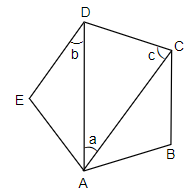
In the given regular pentagon, find the angles a, b and c.
Answer
 Verified
625.2k+ views
Hint: In order to solve this question, we should know the properties of a regular polygon, that are, all sides of a regular polygon are equal, length of every diagonal to the ${{n}^{th}}$ vertices are equal and angles between two consecutive edges of a regular polygon are equal. By using this concept, we will solve this question.
Complete step-by-step answer:
In this question, we have been given a regular pentagon ABCDE and we have been asked to find the angles a, b and c.
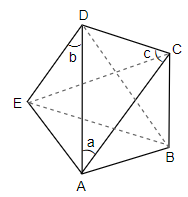
To solve this question, we should know the properties of regular polygon, that are all sides of a regular polygon are equal, length of every diagonal to the ${{n}^{th}}$ vertices are equal and angles between two consecutive edges of a regular polygon are equal. So, for pentagon ABCDE, we can write,
AB = BC = CD = DE = EA ……… (i)
AC = AD = BD = BE = CE ……… (ii)
$\angle A=\angle B=\angle C=\angle D=\angle E.........\left( iii \right)$
Now, we know that the sum of all interior angles of an ‘n’ sided polygon is given by (n-2) (180˚). So, we can say that fro pentagon ABCDE, we have n = 5, which implies,
\[\begin{align}
& \angle A+\angle B+\angle C+\angle D+\angle E=\left( 5-2 \right)\left( {{180}^{\circ }} \right)=3\times {{180}^{\circ }} \\
& \angle A+\angle B+\angle C+\angle D+\angle E={{540}^{\circ }} \\
\end{align}\]
From equation (iii), we get that all the angles are equal, so we can write the above equation as,
\[\begin{align}
& \angle A+\angle A+\angle A+\angle A+\angle A={{540}^{\circ }} \\
& 5\angle A={{540}^{\circ }} \\
& \angle A={{108}^{\circ }} \\
\end{align}\]
Hence, we can say that,
$\angle A=\angle B=\angle C=\angle D=\angle E={{180}^{\circ }}.........\left( iv \right)$
Now, let us consider the triangle ADE, we know that the sum of all angles of a triangle is equal to 180˚. So, we can write,
$\angle E+\angle ADE+\angle EAD={{180}^{\circ }}.........\left( v \right)$
Now, we know that EA = OE, from equation (i). So, we can write triangle ADE as an isosceles triangle and we know that pair of angles opposite to equal sides of triangle are equal. So, we can write,
$\angle ADE=\angle EAD=b.........\left( vi \right)$
And therefore, we can write equation (v) as,
$\angle E+\angle ADE+\angle ADE={{180}^{\circ }}$
Now, we will put the value of $\angle E$, that is, $\angle E={{108}^{\circ }}$ and $\angle ADE=b$. So, we get,
$\begin{align}
& {{108}^{\circ }}+b+b={{180}^{\circ }} \\
& 2b={{180}^{\circ }}-{{108}^{\circ }} \\
& 2b={{72}^{\circ }} \\
& b=\dfrac{{{72}^{\circ }}}{2}={{36}^{\circ }}.........\left( vii \right) \\
\end{align}$
Now, we will consider the triangle ACD. We know that AD = AC from equation (ii). So, we can say that triangle ACD is an isosceles triangle and we know that pair of angles opposite to equal sides are equal. So, we can say,
$\angle ADC=\angle ACD=c.........\left( viii \right)$
And we also know that the sum of all interior angles of a triangle is 180˚. So, we can write,
$\angle ADC+\angle ACD+\angle DAC={{180}^{\circ }}$
Now, we will substitute the values in the above equation, so we get,
$\begin{align}
& c+c+a={{180}^{\circ }} \\
& a+2c={{180}^{\circ }}.........\left( ix \right) \\
\end{align}$
Now, we know that $\angle D={{108}^{\circ }}$. We can also write it as,
$\angle ADE+\angle ADC={{108}^{\circ }}$
And we can further write $\angle ADE=b$ and $\angle ADC=c$ from equation (vi) and (vii). So, we get,
$b+c={{108}^{\circ }}$
Now, we will put the value of b in the above equation. So, we get,
36˚ + c = 108˚
C = 108˚ - 36˚ = 72˚ ……… (x)
Now, we will put the value of c from equation (x) to equation (ix) to get the value of a. So, we can write,
a + 2 (72˚) = 180˚
a + 144˚ = 180˚
a = 180˚ - 144˚
a = 36˚ ……… (xi)
Hence, from equations (vii), (x) and (xi), we get e angles a = 36˚, b = 36˚ and c = 72˚.
Note: While solving this question, we need to remember that pairs of angles opposite to equal sides of a triangle are equal and we need to know that the sum of all angles of a triangle is 180˚. And the sum of all interior angles of any ‘n’ sided polygon is (n-2) (180˚). While solving this question, we need to remember that diagonals of a regular pentagon are not angle bisectors. This can be a possible chance of mistake. And also there are chances of calculation mistakes in this question as there are a lot of calculations.
Complete step-by-step answer:
In this question, we have been given a regular pentagon ABCDE and we have been asked to find the angles a, b and c.
To solve this question, we should know the properties of regular polygon, that are all sides of a regular polygon are equal, length of every diagonal to the ${{n}^{th}}$ vertices are equal and angles between two consecutive edges of a regular polygon are equal. So, for pentagon ABCDE, we can write,
AB = BC = CD = DE = EA ……… (i)
AC = AD = BD = BE = CE ……… (ii)
$\angle A=\angle B=\angle C=\angle D=\angle E.........\left( iii \right)$
Now, we know that the sum of all interior angles of an ‘n’ sided polygon is given by (n-2) (180˚). So, we can say that fro pentagon ABCDE, we have n = 5, which implies,
\[\begin{align}
& \angle A+\angle B+\angle C+\angle D+\angle E=\left( 5-2 \right)\left( {{180}^{\circ }} \right)=3\times {{180}^{\circ }} \\
& \angle A+\angle B+\angle C+\angle D+\angle E={{540}^{\circ }} \\
\end{align}\]
From equation (iii), we get that all the angles are equal, so we can write the above equation as,
\[\begin{align}
& \angle A+\angle A+\angle A+\angle A+\angle A={{540}^{\circ }} \\
& 5\angle A={{540}^{\circ }} \\
& \angle A={{108}^{\circ }} \\
\end{align}\]
Hence, we can say that,
$\angle A=\angle B=\angle C=\angle D=\angle E={{180}^{\circ }}.........\left( iv \right)$
Now, let us consider the triangle ADE, we know that the sum of all angles of a triangle is equal to 180˚. So, we can write,
$\angle E+\angle ADE+\angle EAD={{180}^{\circ }}.........\left( v \right)$
Now, we know that EA = OE, from equation (i). So, we can write triangle ADE as an isosceles triangle and we know that pair of angles opposite to equal sides of triangle are equal. So, we can write,
$\angle ADE=\angle EAD=b.........\left( vi \right)$
And therefore, we can write equation (v) as,
$\angle E+\angle ADE+\angle ADE={{180}^{\circ }}$
Now, we will put the value of $\angle E$, that is, $\angle E={{108}^{\circ }}$ and $\angle ADE=b$. So, we get,
$\begin{align}
& {{108}^{\circ }}+b+b={{180}^{\circ }} \\
& 2b={{180}^{\circ }}-{{108}^{\circ }} \\
& 2b={{72}^{\circ }} \\
& b=\dfrac{{{72}^{\circ }}}{2}={{36}^{\circ }}.........\left( vii \right) \\
\end{align}$
Now, we will consider the triangle ACD. We know that AD = AC from equation (ii). So, we can say that triangle ACD is an isosceles triangle and we know that pair of angles opposite to equal sides are equal. So, we can say,
$\angle ADC=\angle ACD=c.........\left( viii \right)$
And we also know that the sum of all interior angles of a triangle is 180˚. So, we can write,
$\angle ADC+\angle ACD+\angle DAC={{180}^{\circ }}$
Now, we will substitute the values in the above equation, so we get,
$\begin{align}
& c+c+a={{180}^{\circ }} \\
& a+2c={{180}^{\circ }}.........\left( ix \right) \\
\end{align}$
Now, we know that $\angle D={{108}^{\circ }}$. We can also write it as,
$\angle ADE+\angle ADC={{108}^{\circ }}$
And we can further write $\angle ADE=b$ and $\angle ADC=c$ from equation (vi) and (vii). So, we get,
$b+c={{108}^{\circ }}$
Now, we will put the value of b in the above equation. So, we get,
36˚ + c = 108˚
C = 108˚ - 36˚ = 72˚ ……… (x)
Now, we will put the value of c from equation (x) to equation (ix) to get the value of a. So, we can write,
a + 2 (72˚) = 180˚
a + 144˚ = 180˚
a = 180˚ - 144˚
a = 36˚ ……… (xi)
Hence, from equations (vii), (x) and (xi), we get e angles a = 36˚, b = 36˚ and c = 72˚.
Note: While solving this question, we need to remember that pairs of angles opposite to equal sides of a triangle are equal and we need to know that the sum of all angles of a triangle is 180˚. And the sum of all interior angles of any ‘n’ sided polygon is (n-2) (180˚). While solving this question, we need to remember that diagonals of a regular pentagon are not angle bisectors. This can be a possible chance of mistake. And also there are chances of calculation mistakes in this question as there are a lot of calculations.
Recently Updated Pages
Three beakers labelled as A B and C each containing 25 mL of water were taken A small amount of NaOH anhydrous CuSO4 and NaCl were added to the beakers A B and C respectively It was observed that there was an increase in the temperature of the solutions contained in beakers A and B whereas in case of beaker C the temperature of the solution falls Which one of the following statements isarecorrect i In beakers A and B exothermic process has occurred ii In beakers A and B endothermic process has occurred iii In beaker C exothermic process has occurred iv In beaker C endothermic process has occurred

Master Class 10 Social Science: Engaging Questions & Answers for Success
Master Class 10 Science: Engaging Questions & Answers for Success
Master Class 10 Maths: Engaging Questions & Answers for Success
Master Class 10 General Knowledge: Engaging Questions & Answers for Success
Master Class 10 Computer Science: Engaging Questions & Answers for Success
Three beakers labelled as A B and C each containing 25 mL of water were taken A small amount of NaOH anhydrous CuSO4 and NaCl were added to the beakers A B and C respectively It was observed that there was an increase in the temperature of the solutions contained in beakers A and B whereas in case of beaker C the temperature of the solution falls Which one of the following statements isarecorrect i In beakers A and B exothermic process has occurred ii In beakers A and B endothermic process has occurred iii In beaker C exothermic process has occurred iv In beaker C endothermic process has occurred
Master Class 10 Social Science: Engaging Questions & Answers for Success
Master Class 10 Science: Engaging Questions & Answers for Success
Trending doubts
Explain the Treaty of Vienna of 1815 class 10 social science CBSE
In cricket, what is the term for a bowler taking five wickets in an innings?
Who Won 36 Oscar Awards? Record Holder Revealed
What is the median of the first 10 natural numbers class 10 maths CBSE
Why is it 530 pm in india when it is 1200 afternoon class 10 social science CBSE
What is deficiency disease class 10 biology CBSE