




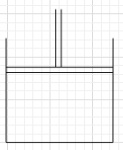
In the given figure, walls of the container and the piston are weakly conducting. The initial pressure, volume and temperature of the gas are $200kPa$, $800c{{m}^{3}}$ and 100K respectively. Find the pressure and the temperature of the gas if it is (a) slowly compressed (b) suddenly compressed to $200c{{m}^{3}}$ ($\gamma =1.5$)
Answer
 Verified
573.3k+ views
Hint: When the gas is compressed slowly, the gas maintains its equilibrium state. This means that the temperature of the gas remains constant. Use the gas equation to find the final pressure and temperature. When the gas is suddenly compressed, it undergoes adiabatic process. In a adiabatic process, $P{{V}^{\gamma }}=\text{constant}$ and
$T{{V}^{\gamma -1}}=\text{constant}$
Formula used:
$PV=nRT$
$P{{V}^{\gamma }}=\text{constant}$
$T{{V}^{\gamma -1}}=\text{constant}$
where P, V, n and T are the pressure, volume , number of molecules and temperature of the gas and R is the gas constant.
Complete step by step answer:
When the gas is compressed slowly, the gas maintains its equilibrium state. This means that the temperature of the gas remains constant. It is given that the initial temperature of the gas is 100K. Therefore, when the gas is slowly compressed to a volume of $200c{{m}^{3}}$, its temperature remains 100K.To find the final pressure of the gas we shall use the gas equation $PV=nRT$, where P, V, n and T are the pressure, volume , number of mole and temperature of the gas. R is the gas constant.For a given gas n is constant. Therefore, if T is constant then PV is also constant. This means that the product of initial pressure and volume is equal to the product of final pressure and volume.
i.e.${{P}_{i}}{{V}_{i}}={{P}_{f}}{{V}_{f}}$.
Here, ${{P}_{i}}=200kPa$, ${{V}_{i}}=800c{{m}^{3}}$ and ${{V}_{f}}=200c{{m}^{3}}$.
Then,
$\Rightarrow (200kPa)(800c{{m}^{3}})={{P}_{f}}(200c{{m}^{3}})$
$\therefore {{P}_{f}}=\dfrac{(200kPa)(800c{{m}^{3}})}{(200c{{m}^{3}})}=800kPa$.
This means that when the gas is compressed to $200c{{m}^{3}}$ slowly, its pressure increases to $800kPa$.
(b) When the gas is suddenly compressed, it undergoes adiabatic process.
In an adiabatic process, $P{{V}^{\gamma }}=\text{constant}$ …. (i).
This means that ${{P}_{i}}V_{i}^{\gamma }={{P}_{f}}V_{f}^{\gamma }$.
Substitute the known values.
$(200kPa){{(800c{{m}^{3}})}^{1.5}}={{P}_{f}}{{(200c{{m}^{3}})}^{1.5}}$
$\Rightarrow {{P}_{f}}=\dfrac{(200kPa){{(800c{{m}^{3}})}^{1.5}}}{{{(200c{{m}^{3}})}^{1.5}}}$
$\Rightarrow {{P}_{f}}=\dfrac{(200kPa){{(800c{{m}^{3}})}^{1.5}}}{{{(200c{{m}^{3}})}^{1.5}}}\\
\Rightarrow {{P}_{f}} =1600kPa$.
In adiabatic processes, the temperature and volume are related as,
$T{{V}^{\gamma -1}}=\text{constant}$.
This means that ${{T}_{i}}V_{i}^{\gamma -1}={{T}_{f}}V_{f}^{\gamma -1}$.
Substitute the known values.
$\Rightarrow (100K){{(800c{{m}^{3}})}^{1.5-1}}={{T}_{f}}{{(200c{{m}^{3}})}^{1.5-1}}$
$\Rightarrow {{T}_{f}}=\dfrac{(100K){{(800c{{m}^{3}})}^{0.5}}}{{{(200c{{m}^{3}})}^{0.5}}}\\
\therefore {{T}_{f}}=200K$.
Therefore, when the gas is suddenly compressed to a volume of $200c{{m}^{3}}$, its temperature increases to 200K and its pressure also increases to 1600kPa.
Note:Adiabatic process is a thermodynamic process in which there is no transfer of heat in or out of the gas. This means that neither the has absorbs heat nor it gives out heat.If you do not know the relation be temperature and volume, then you can use the gas equation to find the final temperature.
$T{{V}^{\gamma -1}}=\text{constant}$
Formula used:
$PV=nRT$
$P{{V}^{\gamma }}=\text{constant}$
$T{{V}^{\gamma -1}}=\text{constant}$
where P, V, n and T are the pressure, volume , number of molecules and temperature of the gas and R is the gas constant.
Complete step by step answer:
When the gas is compressed slowly, the gas maintains its equilibrium state. This means that the temperature of the gas remains constant. It is given that the initial temperature of the gas is 100K. Therefore, when the gas is slowly compressed to a volume of $200c{{m}^{3}}$, its temperature remains 100K.To find the final pressure of the gas we shall use the gas equation $PV=nRT$, where P, V, n and T are the pressure, volume , number of mole and temperature of the gas. R is the gas constant.For a given gas n is constant. Therefore, if T is constant then PV is also constant. This means that the product of initial pressure and volume is equal to the product of final pressure and volume.
i.e.${{P}_{i}}{{V}_{i}}={{P}_{f}}{{V}_{f}}$.
Here, ${{P}_{i}}=200kPa$, ${{V}_{i}}=800c{{m}^{3}}$ and ${{V}_{f}}=200c{{m}^{3}}$.
Then,
$\Rightarrow (200kPa)(800c{{m}^{3}})={{P}_{f}}(200c{{m}^{3}})$
$\therefore {{P}_{f}}=\dfrac{(200kPa)(800c{{m}^{3}})}{(200c{{m}^{3}})}=800kPa$.
This means that when the gas is compressed to $200c{{m}^{3}}$ slowly, its pressure increases to $800kPa$.
(b) When the gas is suddenly compressed, it undergoes adiabatic process.
In an adiabatic process, $P{{V}^{\gamma }}=\text{constant}$ …. (i).
This means that ${{P}_{i}}V_{i}^{\gamma }={{P}_{f}}V_{f}^{\gamma }$.
Substitute the known values.
$(200kPa){{(800c{{m}^{3}})}^{1.5}}={{P}_{f}}{{(200c{{m}^{3}})}^{1.5}}$
$\Rightarrow {{P}_{f}}=\dfrac{(200kPa){{(800c{{m}^{3}})}^{1.5}}}{{{(200c{{m}^{3}})}^{1.5}}}$
$\Rightarrow {{P}_{f}}=\dfrac{(200kPa){{(800c{{m}^{3}})}^{1.5}}}{{{(200c{{m}^{3}})}^{1.5}}}\\
\Rightarrow {{P}_{f}} =1600kPa$.
In adiabatic processes, the temperature and volume are related as,
$T{{V}^{\gamma -1}}=\text{constant}$.
This means that ${{T}_{i}}V_{i}^{\gamma -1}={{T}_{f}}V_{f}^{\gamma -1}$.
Substitute the known values.
$\Rightarrow (100K){{(800c{{m}^{3}})}^{1.5-1}}={{T}_{f}}{{(200c{{m}^{3}})}^{1.5-1}}$
$\Rightarrow {{T}_{f}}=\dfrac{(100K){{(800c{{m}^{3}})}^{0.5}}}{{{(200c{{m}^{3}})}^{0.5}}}\\
\therefore {{T}_{f}}=200K$.
Therefore, when the gas is suddenly compressed to a volume of $200c{{m}^{3}}$, its temperature increases to 200K and its pressure also increases to 1600kPa.
Note:Adiabatic process is a thermodynamic process in which there is no transfer of heat in or out of the gas. This means that neither the has absorbs heat nor it gives out heat.If you do not know the relation be temperature and volume, then you can use the gas equation to find the final temperature.
Recently Updated Pages
Basicity of sulphurous acid and sulphuric acid are

Master Class 11 Business Studies: Engaging Questions & Answers for Success
Master Class 11 Computer Science: Engaging Questions & Answers for Success
Master Class 11 Economics: Engaging Questions & Answers for Success
Master Class 12 English: Engaging Questions & Answers for Success
Master Class 12 Social Science: Engaging Questions & Answers for Success
Trending doubts
One Metric ton is equal to kg A 10000 B 1000 C 100 class 11 physics CBSE
The largest wind power cluster is located in the state class 11 social science CBSE
Explain zero factorial class 11 maths CBSE
State and prove Bernoullis theorem class 11 physics CBSE
What steps did the French revolutionaries take to create class 11 social science CBSE
Which among the following are examples of coming together class 11 social science CBSE