




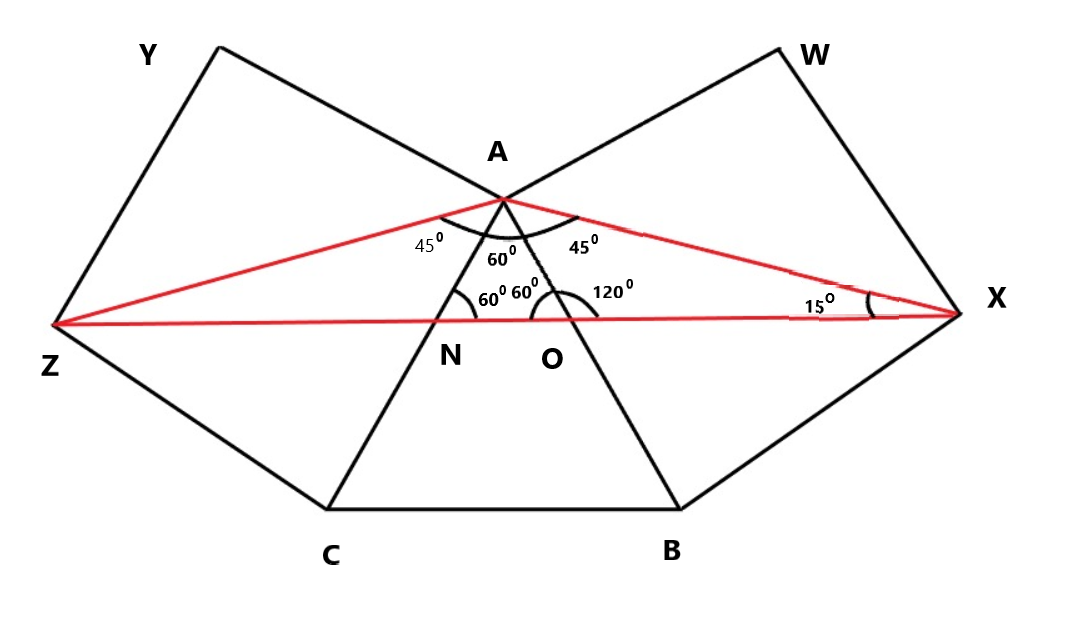
In the given figure is \[\Delta ABC\] an equilateral triangle and \[\square \text{AWXB}\] and \[\square \text{AYZE}\] are two squares. The value of \[\dfrac{1}{10}\] \[\left( \angle ZXA \right)\] is.
Answer
 Verified
577.5k+ views
Hint: Use the properties of similar triangles.
Use the angle sum property of the triangle.
Complete step by step solution:
In the given figure \[\Delta ABC\] is an equilateral and \[\square \text{AWXB}\] and \[\square \text{AYZE}\] are two squares
\[\therefore \Delta ABC\] is equilateral therefore,
\[\angle ABC=\angle BCA=\angle BAC={{60}^{\circ }}\]
Therefore \[AX\] is the diagonal of \[\square \text{AWXB}\]
As the property of square measure of all the interior angle \[\square \text{AWXB}\]is \[{{90}^{\circ }}\]
Therefore \[\angle BAW={{90}^{\circ }}\]
The diagonal of the square are bisects the angle at the vertex
Therefore \[\angle BAX=\angle AXW=\angle DAX={{45}^{\circ }}\]
Join vertex \[X\] and \[Z\] as shown in the figure
Join \[ZX\], a straight line
Line \[ZX\] cuts the side\[AB\] and \[AC\] at equilateral triangle \[\Delta ABC\] at \[O\] and \[N\] respectively.
The smaller \[\Delta AON\] is equilateral then
\[\angle NOA=\angle NAO=\angle ONA={{60}^{\circ }}\]
Line \[AO\] is cut the straight line \[XZ\]
Hence
\[\angle ZOA+\angle XOA+\angle ZOX={{180}^{\circ }}\]
\[{{60}^{\circ }}+\angle XOA={{180}^{\circ }}\]
\[\begin{align}
& \angle XOA={{180}^{\circ }}-{{60}^{\circ }} \\
&\Rightarrow \angle XOA={{120}^{\circ }} \\
\end{align}\]
Consider \[\Delta ADX\] in figure here
\[\begin{align}
& \angle XOA+\angle XAO+\angle OXA={{180}^{\circ }} \\
&\Rightarrow {{120}^{\circ }}+{{45}^{\circ }}+\angle OXA={{180}^{\circ }} \\
&\Rightarrow \angle OXA={{180}^{\circ }}-{{165}^{\circ }} \\
&\therefore \angle OXA={{15}^{\circ }} \\
\end{align}\]
Therefore
\[\dfrac{1}{10}\]\[\left( \angle ZXA \right)={{15}^{\circ }}\].
Note: The application of properties of similar triangles is necessary in this type of problems. In Geometry, a triangle is a three-sided polygon that consists of three edges and three vertices. The most important property of a triangle is that the sum of the internal angles of a triangle is equal to 180 degrees. This property is called the angle sum property of triangles.
Use the angle sum property of the triangle.
Complete step by step solution:
In the given figure \[\Delta ABC\] is an equilateral and \[\square \text{AWXB}\] and \[\square \text{AYZE}\] are two squares
\[\therefore \Delta ABC\] is equilateral therefore,
\[\angle ABC=\angle BCA=\angle BAC={{60}^{\circ }}\]
Therefore \[AX\] is the diagonal of \[\square \text{AWXB}\]
As the property of square measure of all the interior angle \[\square \text{AWXB}\]is \[{{90}^{\circ }}\]
Therefore \[\angle BAW={{90}^{\circ }}\]
The diagonal of the square are bisects the angle at the vertex
Therefore \[\angle BAX=\angle AXW=\angle DAX={{45}^{\circ }}\]
Join vertex \[X\] and \[Z\] as shown in the figure
Join \[ZX\], a straight line
Line \[ZX\] cuts the side\[AB\] and \[AC\] at equilateral triangle \[\Delta ABC\] at \[O\] and \[N\] respectively.
The smaller \[\Delta AON\] is equilateral then
\[\angle NOA=\angle NAO=\angle ONA={{60}^{\circ }}\]
Line \[AO\] is cut the straight line \[XZ\]
Hence
\[\angle ZOA+\angle XOA+\angle ZOX={{180}^{\circ }}\]
\[{{60}^{\circ }}+\angle XOA={{180}^{\circ }}\]
\[\begin{align}
& \angle XOA={{180}^{\circ }}-{{60}^{\circ }} \\
&\Rightarrow \angle XOA={{120}^{\circ }} \\
\end{align}\]
Consider \[\Delta ADX\] in figure here
\[\begin{align}
& \angle XOA+\angle XAO+\angle OXA={{180}^{\circ }} \\
&\Rightarrow {{120}^{\circ }}+{{45}^{\circ }}+\angle OXA={{180}^{\circ }} \\
&\Rightarrow \angle OXA={{180}^{\circ }}-{{165}^{\circ }} \\
&\therefore \angle OXA={{15}^{\circ }} \\
\end{align}\]
Therefore
\[\dfrac{1}{10}\]\[\left( \angle ZXA \right)={{15}^{\circ }}\].
Note: The application of properties of similar triangles is necessary in this type of problems. In Geometry, a triangle is a three-sided polygon that consists of three edges and three vertices. The most important property of a triangle is that the sum of the internal angles of a triangle is equal to 180 degrees. This property is called the angle sum property of triangles.
Recently Updated Pages
Master Class 11 English: Engaging Questions & Answers for Success

Master Class 11 Social Science: Engaging Questions & Answers for Success
Master Class 11 Maths: Engaging Questions & Answers for Success
Master Class 11 Biology: Engaging Questions & Answers for Success
Master Class 11 Physics: Engaging Questions & Answers for Success
Master Class 11 Chemistry: Engaging Questions & Answers for Success
Trending doubts
Explain the Treaty of Vienna of 1815 class 10 social science CBSE
What is the Total Duration of Football Match?
The shortest day of the year in India
In which year voting age was reduced from 21 to 18?
10 examples of evaporation in daily life with explanations
What planets have no moons Which one has only one moon class 10 physics CBSE