




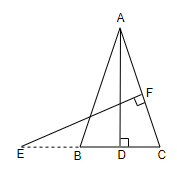
In the given figure, E is a point on side CB produced of an isosceles triangle ABC with AB = AC. If $AD\bot BC$ and $EF\bot AC$, prove that
i) $\Delta ABD\sim \Delta ECF$
ii) $AB\times EF=AD\times EC$
Answer
 Verified
638.1k+ views
Hint: In order to solve this question, we should know that two triangles are similar when either their 2 pair of angles are congruent or when their three sides are in proportion. Also, we need to remember that in the isosceles triangle, angles opposite to equal sides are congruent. So, we will use these concepts to prove the given equality.
Complete step-by-step answer:
In this question, we have been given a figure and we have been asked to prove that $\Delta ABD\sim \Delta ECF$ and $AB\times EF=AD\times EC$.
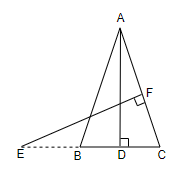
To prove this question, we should know that in an isosceles triangle, two angles opposite to equal sides are congruent. So, in the isosceles triangle, ABC with AB = AC, we can say that, $\angle ABD=\angle ACD$.
i) $\Delta ABD\sim \Delta ECF$
Now, we know that two triangles are similar if two pairs of angles are congruent or if the three sides are in proportion.
Now, in triangle ABD and triangle ECF, we have been given that $\angle ADB=\angle EFC={{90}^{\circ }}$ and we know that $\angle ABD=\angle FCD$. So, by AA criteria we can say that $\Delta ABD\sim \Delta ECF$. Hence proved.
ii) $AB\times EF=AD\times EC$
Now, we know that if two triangles are similar then its sides are in proportion. So, we can say that for, $\Delta ABD\sim \Delta ECF$, we can write $\dfrac{AB}{EC}=\dfrac{BD}{CF}=\dfrac{AD}{EF}$.
We can also write it as, $\dfrac{AB}{EC}=\dfrac{AD}{EF}$
$AB\times EF=AD\times EC$
Hence proved.
Note: While solving this question, we need to be very careful about the situations given, as each and every given information has some importance while solving the question, like AB = AC represents that angles opposite to those are congruent which helped us to prove the relation. Any silly mistake while writing the ratio of corresponding sides of both triangles in the second part should be avoided.
Complete step-by-step answer:
In this question, we have been given a figure and we have been asked to prove that $\Delta ABD\sim \Delta ECF$ and $AB\times EF=AD\times EC$.
To prove this question, we should know that in an isosceles triangle, two angles opposite to equal sides are congruent. So, in the isosceles triangle, ABC with AB = AC, we can say that, $\angle ABD=\angle ACD$.
i) $\Delta ABD\sim \Delta ECF$
Now, we know that two triangles are similar if two pairs of angles are congruent or if the three sides are in proportion.
Now, in triangle ABD and triangle ECF, we have been given that $\angle ADB=\angle EFC={{90}^{\circ }}$ and we know that $\angle ABD=\angle FCD$. So, by AA criteria we can say that $\Delta ABD\sim \Delta ECF$. Hence proved.
ii) $AB\times EF=AD\times EC$
Now, we know that if two triangles are similar then its sides are in proportion. So, we can say that for, $\Delta ABD\sim \Delta ECF$, we can write $\dfrac{AB}{EC}=\dfrac{BD}{CF}=\dfrac{AD}{EF}$.
We can also write it as, $\dfrac{AB}{EC}=\dfrac{AD}{EF}$
$AB\times EF=AD\times EC$
Hence proved.
Note: While solving this question, we need to be very careful about the situations given, as each and every given information has some importance while solving the question, like AB = AC represents that angles opposite to those are congruent which helped us to prove the relation. Any silly mistake while writing the ratio of corresponding sides of both triangles in the second part should be avoided.
Recently Updated Pages
Master Class 12 Economics: Engaging Questions & Answers for Success

Master Class 12 English: Engaging Questions & Answers for Success
Master Class 12 Social Science: Engaging Questions & Answers for Success
Master Class 12 Maths: Engaging Questions & Answers for Success
Master Class 12 Physics: Engaging Questions & Answers for Success
Master Class 10 English: Engaging Questions & Answers for Success
Trending doubts
Explain the Treaty of Vienna of 1815 class 10 social science CBSE
Who Won 36 Oscar Awards? Record Holder Revealed
Why is it 530 pm in india when it is 1200 afternoon class 10 social science CBSE
Make a sketch of the human nerve cell What function class 10 biology CBSE
What is the full form of POSCO class 10 social science CBSE
Define Potential, Developed, Stock and Reserved resources