




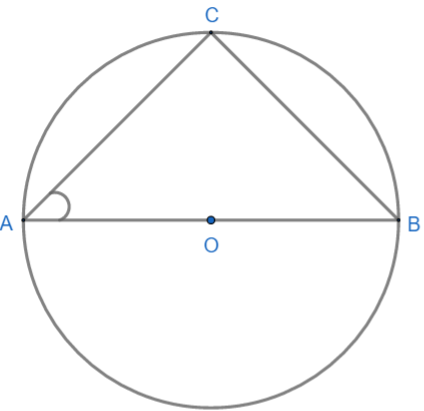
In the given figure AOB is a diameter of the circle and AC = BC. Then $\angle CAB$ is
\[\begin{align}
& A{{.30}^{\circ }} \\
& B{{.60}^{\circ }} \\
& C{{.45}^{\circ }} \\
& D{{.90}^{\circ }} \\
\end{align}\]
Answer
 Verified
603k+ views
Hint: In this question, we are given a figure of a circle in which two chords of a circle are equal and $\Delta ABC$ is formed. We need to find the $\angle CAB$. For this, we will use the following properties,
(i) Angle inscribed by the diameter on any point on the circle is equal to \[{{90}^{\circ }}\] or we can say angle inscribed in semicircle is equal to \[{{90}^{\circ }}\].
(ii) Isosceles triangle property: angles corresponding to the equal sides of the triangle are also equal.
(iii) Angle sum property: the sum of the angles of a triangle is equal to \[{{180}^{\circ }}\].
Complete step by step answer:
Here we are given the figure as,
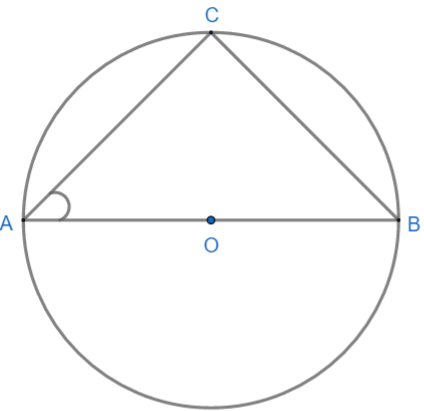
Here AOB is a diameter of the circle and AC is equal to BC. We need to find the angle $\angle CAB$.
As we know that, angle inscribed by the diameter on any point on the circle is equal to \[{{90}^{\circ }}\] or we can say that angle inscribed in a semicircle is equal to \[{{90}^{\circ }}\]. So from the figure we can say that $\angle ACB$ is inscribed by the diameter AOB and therefore it must be \[{{90}^{\circ }}\].
Hence $\angle ACB$ is equal to \[{{90}^{\circ }}\].
Now in $\Delta ACB$ we are given that AC = BC. So $\Delta ACB$ is an isosceles triangle.
We know from isosceles triangle property that angles corresponding to the equal sides are also equal. So here, $\angle CAB\text{ and }\angle CBA$ are angles corresponding to the equal sides AC and BC.
Therefore, $\angle CAB=\angle CBA$.
We know that from the angle sum property that the sum of the angles in a triangle is equal to \[{{180}^{\circ }}\]. Therefore in $\Delta ACB$,
$\angle CAB+\angle CBA+\angle ACB={{180}^{\circ }}$
Putting in the values of $\angle CAB\text{ and }\angle ACB$ we get,
$\begin{align}
& \angle CAB+\angle CAB+{{90}^{\circ }}={{180}^{\circ }} \\
& \Rightarrow 2\angle CAB={{180}^{\circ }}-{{90}^{\circ }} \\
& \Rightarrow 2\angle CAB={{90}^{\circ }} \\
\end{align}$
Dividing both sides by 2 we get,
$\begin{align}
& \Rightarrow \angle CAB=\dfrac{{{90}^{\circ }}}{2} \\
& \Rightarrow \angle CAB={{45}^{\circ }} \\
\end{align}$
Hence the required value of $\angle CAB={{45}^{\circ }}$.
So, the correct answer is “Option C”.
Note: Students should keep in mind all the properties before solving this sum. Take care of the signs while solving this sum. Students should note that ${{90}^{\circ }}$ angle is formed if the angle is inscribed by diameter only.
(i) Angle inscribed by the diameter on any point on the circle is equal to \[{{90}^{\circ }}\] or we can say angle inscribed in semicircle is equal to \[{{90}^{\circ }}\].
(ii) Isosceles triangle property: angles corresponding to the equal sides of the triangle are also equal.
(iii) Angle sum property: the sum of the angles of a triangle is equal to \[{{180}^{\circ }}\].
Complete step by step answer:
Here we are given the figure as,
Here AOB is a diameter of the circle and AC is equal to BC. We need to find the angle $\angle CAB$.
As we know that, angle inscribed by the diameter on any point on the circle is equal to \[{{90}^{\circ }}\] or we can say that angle inscribed in a semicircle is equal to \[{{90}^{\circ }}\]. So from the figure we can say that $\angle ACB$ is inscribed by the diameter AOB and therefore it must be \[{{90}^{\circ }}\].
Hence $\angle ACB$ is equal to \[{{90}^{\circ }}\].
Now in $\Delta ACB$ we are given that AC = BC. So $\Delta ACB$ is an isosceles triangle.
We know from isosceles triangle property that angles corresponding to the equal sides are also equal. So here, $\angle CAB\text{ and }\angle CBA$ are angles corresponding to the equal sides AC and BC.
Therefore, $\angle CAB=\angle CBA$.
We know that from the angle sum property that the sum of the angles in a triangle is equal to \[{{180}^{\circ }}\]. Therefore in $\Delta ACB$,
$\angle CAB+\angle CBA+\angle ACB={{180}^{\circ }}$
Putting in the values of $\angle CAB\text{ and }\angle ACB$ we get,
$\begin{align}
& \angle CAB+\angle CAB+{{90}^{\circ }}={{180}^{\circ }} \\
& \Rightarrow 2\angle CAB={{180}^{\circ }}-{{90}^{\circ }} \\
& \Rightarrow 2\angle CAB={{90}^{\circ }} \\
\end{align}$
Dividing both sides by 2 we get,
$\begin{align}
& \Rightarrow \angle CAB=\dfrac{{{90}^{\circ }}}{2} \\
& \Rightarrow \angle CAB={{45}^{\circ }} \\
\end{align}$
Hence the required value of $\angle CAB={{45}^{\circ }}$.
So, the correct answer is “Option C”.
Note: Students should keep in mind all the properties before solving this sum. Take care of the signs while solving this sum. Students should note that ${{90}^{\circ }}$ angle is formed if the angle is inscribed by diameter only.
Recently Updated Pages
Master Class 12 Economics: Engaging Questions & Answers for Success

Master Class 12 English: Engaging Questions & Answers for Success
Master Class 12 Social Science: Engaging Questions & Answers for Success
Master Class 12 Maths: Engaging Questions & Answers for Success
Master Class 12 Physics: Engaging Questions & Answers for Success
Master Class 10 English: Engaging Questions & Answers for Success
Trending doubts
Explain the Treaty of Vienna of 1815 class 10 social science CBSE
Why is it 530 pm in india when it is 1200 afternoon class 10 social science CBSE
What is the full form of POSCO class 10 social science CBSE
Define Potential, Developed, Stock and Reserved resources
Which Country Has the Largest Border with India?
Complete the sentence with the most appropriate word class 10 english CBSE