




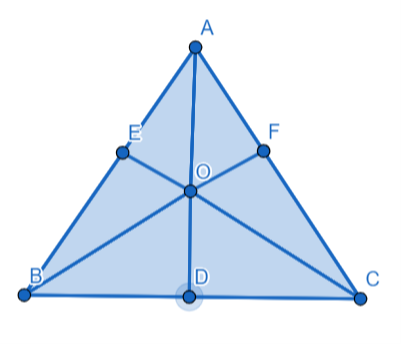
In the given figure, AD, BF and CF are medians of a triangle ABC and O is a point of concurrency of medians. If AD = 6 cm, then OD is equal to:
\[\begin{align}
& (A)\text{ 2 cm} \\
& \text{(B) 3 cm} \\
& \text{(C) 4 cm} \\
& \text{(D) }\dfrac{2}{3}cm \\
\end{align}\]
Answer
 Verified
597.6k+ views
Hint: First of all, we have to understand the definition of median. A median that passes through a vertex divides the opposite side of the vertex into two parts. The point of concurrency of all medians is called the centroid of \[\Delta ABC\]. The centroid of \[\Delta ABC\] divided the median in the ratio of \[2:1\]. From the question, we are having the length of median AD. By using this concept, we can find the value of OD.
Complete step by step solution:
Before solving the question, we should know the definition of median and its properties. A median that passes through a vertex divides the opposite side of the vertex into two parts. The point of concurrency of all medians is called the centroid of \[\Delta ABC\]. We know that the centroid of \[\Delta ABC\] divided the median in the ratio of \[2:1\].
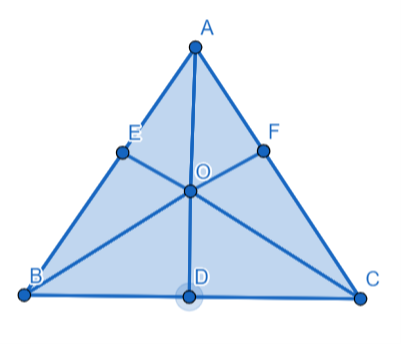
Let us assume \[\Delta ABC\] whose vertices are A, B and C respectively. Let AD, BF and CE are the medians passing through the vertices A, B and C respectively. A median pass through A divides the side BC into two equal parts. In the same way, median through vertex B divides the side AC into two equal parts. In the same way, median through vertex C divides the side AB into equal parts. Let us assume the intersection of medians AD, BF and CE be point O. This point O represents the centroid of \[\Delta ABC\]. The point O divides the line AD, BF and CF in the ratio 2:1.
So, we get
\[\begin{align}
& AO:OD=2:1 \\
& BO:OF=2:1 \\
& CO:OE=2:1 \\
\end{align}\]
From the question, it was given that AD = 6 cm.
AD can be divided by point O in the ratio \[2:1\].
We get
\[\dfrac{AO}{OD}=\dfrac{2}{1}=2\]
\[\Rightarrow AO=2OD......(1)\]
From the diagram, it is clear that
\[AD=AO+OD.....(2)\]
Now we will substitute equation (2) in equation (1).
\[AD=3OD\]
We know that the length of AD is equal to 6 cm.
\[\begin{align}
& \Rightarrow 3OD=6cm \\
& \Rightarrow OD=2cm \\
\end{align}\]
From this it is clear that the length of OD is equal to 2 cm.
Hence, option (A) is correct.
Note: We know that the centroid divides the median in the ratio \[2:1\]. Some students may have misconceptions and they may write \[OD:AO=2:1\].
If this misconception is followed,
We get \[\dfrac{OD}{AO}=\dfrac{2}{1}\]
By using cross multiplication, we get
\[OD=2AO.....(1)\]
\[AD=AO+OD....(2)\]

Now we will substitute equation (1) in equation (2).
\[AD=3AO....(3)\]
From equation (3), we get
\[\begin{align}
& \Rightarrow 3AO=6cm \\
& \Rightarrow AO=2cm....(4) \\
\end{align}\]
Now we will substitute equation (4) in equation (2).
\[\Rightarrow OD=4cm\]
So, it is clear that this will give an incorrect answer.
Complete step by step solution:
Before solving the question, we should know the definition of median and its properties. A median that passes through a vertex divides the opposite side of the vertex into two parts. The point of concurrency of all medians is called the centroid of \[\Delta ABC\]. We know that the centroid of \[\Delta ABC\] divided the median in the ratio of \[2:1\].
Let us assume \[\Delta ABC\] whose vertices are A, B and C respectively. Let AD, BF and CE are the medians passing through the vertices A, B and C respectively. A median pass through A divides the side BC into two equal parts. In the same way, median through vertex B divides the side AC into two equal parts. In the same way, median through vertex C divides the side AB into equal parts. Let us assume the intersection of medians AD, BF and CE be point O. This point O represents the centroid of \[\Delta ABC\]. The point O divides the line AD, BF and CF in the ratio 2:1.
So, we get
\[\begin{align}
& AO:OD=2:1 \\
& BO:OF=2:1 \\
& CO:OE=2:1 \\
\end{align}\]
From the question, it was given that AD = 6 cm.
AD can be divided by point O in the ratio \[2:1\].
We get
\[\dfrac{AO}{OD}=\dfrac{2}{1}=2\]
\[\Rightarrow AO=2OD......(1)\]
From the diagram, it is clear that
\[AD=AO+OD.....(2)\]
Now we will substitute equation (2) in equation (1).
\[AD=3OD\]
We know that the length of AD is equal to 6 cm.
\[\begin{align}
& \Rightarrow 3OD=6cm \\
& \Rightarrow OD=2cm \\
\end{align}\]
From this it is clear that the length of OD is equal to 2 cm.
Hence, option (A) is correct.
Note: We know that the centroid divides the median in the ratio \[2:1\]. Some students may have misconceptions and they may write \[OD:AO=2:1\].
If this misconception is followed,
We get \[\dfrac{OD}{AO}=\dfrac{2}{1}\]
By using cross multiplication, we get
\[OD=2AO.....(1)\]
\[AD=AO+OD....(2)\]
Now we will substitute equation (1) in equation (2).
\[AD=3AO....(3)\]
From equation (3), we get
\[\begin{align}
& \Rightarrow 3AO=6cm \\
& \Rightarrow AO=2cm....(4) \\
\end{align}\]
Now we will substitute equation (4) in equation (2).
\[\Rightarrow OD=4cm\]
So, it is clear that this will give an incorrect answer.
Recently Updated Pages
Master Class 10 Computer Science: Engaging Questions & Answers for Success

Master Class 10 General Knowledge: Engaging Questions & Answers for Success
Master Class 10 English: Engaging Questions & Answers for Success
Master Class 10 Social Science: Engaging Questions & Answers for Success
Master Class 10 Maths: Engaging Questions & Answers for Success
Master Class 10 Science: Engaging Questions & Answers for Success
Trending doubts
What is the median of the first 10 natural numbers class 10 maths CBSE
Which women's tennis player has 24 Grand Slam singles titles?
Who is the Brand Ambassador of Incredible India?
Why is there a time difference of about 5 hours between class 10 social science CBSE
Write a letter to the principal requesting him to grant class 10 english CBSE
State and prove converse of BPT Basic Proportionality class 10 maths CBSE