




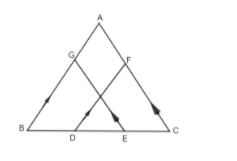
In the given figure: \[AB||FD,AC||GE,BD=CE;\] prove that
(i) BG = DF
(ii) CF = EG
Answer
 Verified
615.3k+ views
Hint: We are asked to show that BG = DF and CF = EG. We will first show that \[\Delta GBE\cong \Delta FDC.\] To do so, we will use that corresponding angles are equal when two parallels are cut by the traversal. As, AB||FD gives us \[\angle GBE=\angle FDC\] and AC||GE gives us \[\angle GEB=\angle FCD,\] using Angle – Side – Angle (ASA) congruence rule, we have \[\Delta GBE\cong \Delta FDC\] and then using the corresponding parts.
Complete step-by-step answer:
We are given that,
\[AB||FD,AC||GE,BD=CE\]
First of all, we have,
\[BD=CE\]
Adding DE to both the sides, we get,
\[BD+DE=CE+DE\]
\[\Rightarrow BE=DC....\left( i \right)\]
Now, as AB||FD, then BE will be the traversal. So, we get,
\[\angle GBE=\angle FDC.....\left( ii \right)\left[ \text{Corresponding Angle} \right]\]
Similarly, as AC||GE and BC act as the traversal, so, we get,
\[\angle GEB=\angle FCD.....\left( iii \right)\left[ \text{Corresponding pair of angles are equal} \right]\]
Now, in triangle GBE and triangle FDC, we have,
\[\angle GBE=\angle FDC\left[ \text{Using }\left( ii \right) \right]\]
\[BE=DC\left[ \text{Using }\left( i \right) \right]\]
\[\angle GEB=\angle FCD\left[ \text{Using }\left( iii \right) \right]\]
So, by Angle – Side – Angle Congruence rule, we get that,
\[\Delta GBE\cong \Delta FDC\]
In the Congruent triangle, the corresponding parts are equal. So, we get,
BG = DF (By CPCT, as triangle GBE is congruent to triangle FDC)
GE = CF (By CPCT, as triangle GBE is congruent to triangle FDC)
Note: Students should note that adding the same quantity to both sides of the equality will not affect equality and that is why we can add DE to both sides of BD = CE. When two lines are parallel, the corresponding angles are always equal.
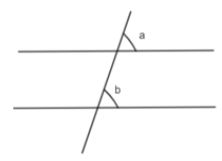
Here, angle a is equal to angle b.
Complete step-by-step answer:
We are given that,
\[AB||FD,AC||GE,BD=CE\]
First of all, we have,
\[BD=CE\]
Adding DE to both the sides, we get,
\[BD+DE=CE+DE\]
\[\Rightarrow BE=DC....\left( i \right)\]
Now, as AB||FD, then BE will be the traversal. So, we get,
\[\angle GBE=\angle FDC.....\left( ii \right)\left[ \text{Corresponding Angle} \right]\]
Similarly, as AC||GE and BC act as the traversal, so, we get,
\[\angle GEB=\angle FCD.....\left( iii \right)\left[ \text{Corresponding pair of angles are equal} \right]\]
Now, in triangle GBE and triangle FDC, we have,
\[\angle GBE=\angle FDC\left[ \text{Using }\left( ii \right) \right]\]
\[BE=DC\left[ \text{Using }\left( i \right) \right]\]
\[\angle GEB=\angle FCD\left[ \text{Using }\left( iii \right) \right]\]
So, by Angle – Side – Angle Congruence rule, we get that,
\[\Delta GBE\cong \Delta FDC\]
In the Congruent triangle, the corresponding parts are equal. So, we get,
BG = DF (By CPCT, as triangle GBE is congruent to triangle FDC)
GE = CF (By CPCT, as triangle GBE is congruent to triangle FDC)
Note: Students should note that adding the same quantity to both sides of the equality will not affect equality and that is why we can add DE to both sides of BD = CE. When two lines are parallel, the corresponding angles are always equal.
Here, angle a is equal to angle b.
Recently Updated Pages
Master Class 11 English: Engaging Questions & Answers for Success

Master Class 11 Maths: Engaging Questions & Answers for Success
Class 11 Question and Answer - Your Ultimate Solutions Guide
Master Class 11 Biology: Engaging Questions & Answers for Success
Master Class 11 Physics: Engaging Questions & Answers for Success
Master Class 11 Accountancy: Engaging Questions & Answers for Success
Trending doubts
Explain the Treaty of Vienna of 1815 class 10 social science CBSE
Who Won 36 Oscar Awards? Record Holder Revealed
What is the median of the first 10 natural numbers class 10 maths CBSE
Why is it 530 pm in india when it is 1200 afternoon class 10 social science CBSE
Why is there a time difference of about 5 hours between class 10 social science CBSE
What is the full form of POSCO class 10 social science CBSE