




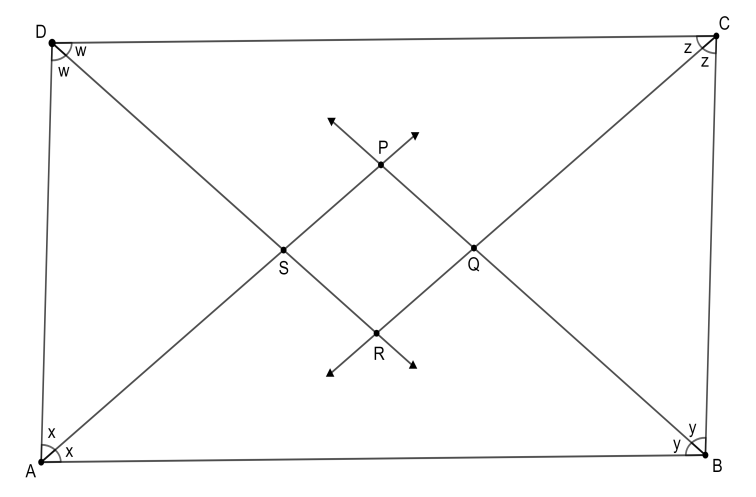
In the given figure, $ABCD$ is a parallelogram. The quadrilateral $PQRS$ is exactly
(a) a square
(b) a parallelogram
(c) a rectangle
(d) a rhombus
Answer
 Verified
585.6k+ views
Hint: We will use the fact that $ABCD$ is a parallelogram and quadrilateral $PQRS$ is formed due to the intersections of the angle bisectors of the angles of parallelogram $ABCD$. We will use the congruence of opposite angles and the properties of adjacent angles of a parallelogram. We will look at $\Delta DRC$, $\Delta APQ$, $\Delta BQZ$ and $\Delta ASD$ and the sum of the angles of these triangles.
Complete step-by-step answer:
We know that the adjacent angles of a parallelogram are supplementary. Therefore, we have
$\begin{align}
& 2x+2y=180{}^\circ \\
& 2y+2z=180{}^\circ \\
& 2z+2w=180{}^\circ \\
& 2w+2x=180{}^\circ \\
\end{align}$
Dividing by 2 on both sides of all four equations, we get the following set of equations,
$\begin{align}
& x+y=90{}^\circ \\
& y+z=90{}^\circ \\
& z+w=90{}^\circ \\
& w+x=90{}^\circ \\
\end{align}$
Now, consider $\Delta APB$. The sum of the angles of a triangle is $180{}^\circ $. Therefore, we have
$x+y+\angle APB=180{}^\circ $.
We have already noted that $x+y=90{}^\circ $. This implies that $\angle APB=90{}^\circ $.
Similarly, in $\Delta DRC$, $w+z+\angle DRC=180{}^\circ $. Substituting $w+z=90{}^\circ $, we get $\angle DRC=90{}^\circ $
Now, we know that opposite angles are congruent. Hence, $\angle ASD=\angle PSR$ and $\angle BQC=\angle PQR$.
Let us consider $\Delta ASD$. Taking the sum of all the angles of this triangle, we get $x+w+\angle ASD=180{}^\circ $. Again, we already know that $x+w=90{}^\circ $. Hence, we have $\angle ASD=90{}^\circ $ and therefore, $\angle PSR=90{}^\circ $.
Now, considering $\Delta BQC$ and adding all the angles of this triangle, we get $y+z+\angle BQC=90{}^\circ $.
As $y+z=90{}^\circ $ , we get $\angle BQC=90{}^\circ $. And because $\angle BQC$ is the opposite angle of $\angle PQR$, we have $\angle PQR=90{}^\circ $.
Now, in quadrilateral $PQRS$, all four angles are $90{}^\circ $. Hence, it is a rectangle.
So, the correct answer is “Option C”.
Note: From the given information in the question, we are able to conclude that all the angles of the quadrilateral $PQRS$ are right angles. But we have no information to comment on the sides of this quadrilateral. Since, we cannot claim that all sides of this quadrilateral $PQRS$ are equal, we cannot say that it is a square.
Complete step-by-step answer:
We know that the adjacent angles of a parallelogram are supplementary. Therefore, we have
$\begin{align}
& 2x+2y=180{}^\circ \\
& 2y+2z=180{}^\circ \\
& 2z+2w=180{}^\circ \\
& 2w+2x=180{}^\circ \\
\end{align}$
Dividing by 2 on both sides of all four equations, we get the following set of equations,
$\begin{align}
& x+y=90{}^\circ \\
& y+z=90{}^\circ \\
& z+w=90{}^\circ \\
& w+x=90{}^\circ \\
\end{align}$
Now, consider $\Delta APB$. The sum of the angles of a triangle is $180{}^\circ $. Therefore, we have
$x+y+\angle APB=180{}^\circ $.
We have already noted that $x+y=90{}^\circ $. This implies that $\angle APB=90{}^\circ $.
Similarly, in $\Delta DRC$, $w+z+\angle DRC=180{}^\circ $. Substituting $w+z=90{}^\circ $, we get $\angle DRC=90{}^\circ $
Now, we know that opposite angles are congruent. Hence, $\angle ASD=\angle PSR$ and $\angle BQC=\angle PQR$.
Let us consider $\Delta ASD$. Taking the sum of all the angles of this triangle, we get $x+w+\angle ASD=180{}^\circ $. Again, we already know that $x+w=90{}^\circ $. Hence, we have $\angle ASD=90{}^\circ $ and therefore, $\angle PSR=90{}^\circ $.
Now, considering $\Delta BQC$ and adding all the angles of this triangle, we get $y+z+\angle BQC=90{}^\circ $.
As $y+z=90{}^\circ $ , we get $\angle BQC=90{}^\circ $. And because $\angle BQC$ is the opposite angle of $\angle PQR$, we have $\angle PQR=90{}^\circ $.
Now, in quadrilateral $PQRS$, all four angles are $90{}^\circ $. Hence, it is a rectangle.
So, the correct answer is “Option C”.
Note: From the given information in the question, we are able to conclude that all the angles of the quadrilateral $PQRS$ are right angles. But we have no information to comment on the sides of this quadrilateral. Since, we cannot claim that all sides of this quadrilateral $PQRS$ are equal, we cannot say that it is a square.
Recently Updated Pages
Master Class 10 Computer Science: Engaging Questions & Answers for Success

Master Class 10 General Knowledge: Engaging Questions & Answers for Success
Master Class 10 English: Engaging Questions & Answers for Success
Master Class 10 Social Science: Engaging Questions & Answers for Success
Master Class 10 Maths: Engaging Questions & Answers for Success
Master Class 10 Science: Engaging Questions & Answers for Success
Trending doubts
What is the median of the first 10 natural numbers class 10 maths CBSE
Which women's tennis player has 24 Grand Slam singles titles?
Who is the Brand Ambassador of Incredible India?
Why is there a time difference of about 5 hours between class 10 social science CBSE
Write a letter to the principal requesting him to grant class 10 english CBSE
State and prove converse of BPT Basic Proportionality class 10 maths CBSE