




In the given figure, a square is inscribed in a circle with centre O.
Find: \[\angle OCB\]. Is BD a diameter of the circle?
Answer
 Verified
597.9k+ views
Hint:
Here we will first draw the diagonals of the square. Then we will use the property of the diagonals of the square to get the value of the angle BOC. Then we will use the property of the sum of all the interior angles of a triangle to get the value of the angle OCB.
Complete Step by Step Solution:
It is given that ABCD is a square which is inscribed in a circle with centre O.
AC and BD are the diagonal of the square ABCD. We know the property of the square that diagonals of the square intersect each other at a right angle i.e. at \[90^\circ \].
Therefore, the angle BOC is \[\angle BOC = 90^\circ \].
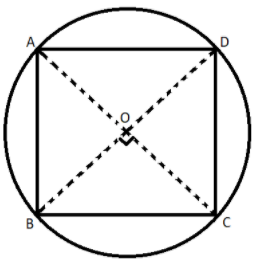
We know that the sum of all the interior angles of a triangle is equal to \[180^\circ \]. So, by using this condition we will write the sum of all the angle of the triangle BOC, we get
\[\angle OBC + \angle OCB + \angle BOC = 180^\circ \]
Also, the angle OBC is equal to the angle OCB i.e. \[\angle OBC = \angle OCB\]. Therefore, we get
\[\angle OCB + \angle OCB + 90^\circ = 180^\circ \]
Subtracting \[90^\circ \] from both sides, we get
\[ \Rightarrow 2\angle OCB = 180^\circ - 90^\circ = 90^\circ \]
Dividing both sides by 2, we get
\[ \Rightarrow \angle OCB = \dfrac{{90^\circ }}{2} = 45^\circ \]
Hence the value of the angle \[\angle OCB\] is equal to \[45^\circ \].
We can see that the diagonal BD of the square is equal to the diameter of the circle with the center O.
Therefore, BD is the diameter of the circle.
Note:
Diagonals of the square is also the angle bisector of the angle of the end vertices of that diagonal of the square. In geometry, bisection is the division of something into two equal parts. There are two main types of bisectors and they are line segment bisector and angle bisector. A line segment bisector is a line or line segment that divides the line into two equal parts or which passes through the midpoint of the line segment. An angle bisector is the line or line segment that divides an angle into two equal parts.
Here we will first draw the diagonals of the square. Then we will use the property of the diagonals of the square to get the value of the angle BOC. Then we will use the property of the sum of all the interior angles of a triangle to get the value of the angle OCB.
Complete Step by Step Solution:
It is given that ABCD is a square which is inscribed in a circle with centre O.
AC and BD are the diagonal of the square ABCD. We know the property of the square that diagonals of the square intersect each other at a right angle i.e. at \[90^\circ \].
Therefore, the angle BOC is \[\angle BOC = 90^\circ \].
We know that the sum of all the interior angles of a triangle is equal to \[180^\circ \]. So, by using this condition we will write the sum of all the angle of the triangle BOC, we get
\[\angle OBC + \angle OCB + \angle BOC = 180^\circ \]
Also, the angle OBC is equal to the angle OCB i.e. \[\angle OBC = \angle OCB\]. Therefore, we get
\[\angle OCB + \angle OCB + 90^\circ = 180^\circ \]
Subtracting \[90^\circ \] from both sides, we get
\[ \Rightarrow 2\angle OCB = 180^\circ - 90^\circ = 90^\circ \]
Dividing both sides by 2, we get
\[ \Rightarrow \angle OCB = \dfrac{{90^\circ }}{2} = 45^\circ \]
Hence the value of the angle \[\angle OCB\] is equal to \[45^\circ \].
We can see that the diagonal BD of the square is equal to the diameter of the circle with the center O.
Therefore, BD is the diameter of the circle.
Note:
Diagonals of the square is also the angle bisector of the angle of the end vertices of that diagonal of the square. In geometry, bisection is the division of something into two equal parts. There are two main types of bisectors and they are line segment bisector and angle bisector. A line segment bisector is a line or line segment that divides the line into two equal parts or which passes through the midpoint of the line segment. An angle bisector is the line or line segment that divides an angle into two equal parts.
Recently Updated Pages
Master Class 12 Economics: Engaging Questions & Answers for Success

Master Class 12 English: Engaging Questions & Answers for Success
Master Class 12 Social Science: Engaging Questions & Answers for Success
Master Class 12 Maths: Engaging Questions & Answers for Success
Master Class 12 Physics: Engaging Questions & Answers for Success
Master Class 10 English: Engaging Questions & Answers for Success
Trending doubts
Explain the Treaty of Vienna of 1815 class 10 social science CBSE
Why is it 530 pm in india when it is 1200 afternoon class 10 social science CBSE
What is the full form of POSCO class 10 social science CBSE
Define Potential, Developed, Stock and Reserved resources
Which Country Has the Largest Border with India?
Choose the feminine form of the given noun Fox AFoxess class 10 english CBSE