




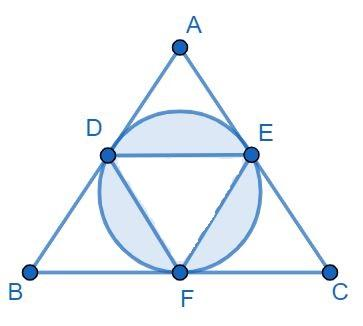
In the given diagram, ABC is an equilateral triangle whose side is $2\sqrt{3}cm$. A circle is drawn which passes through the midpoints D,E and F of its sides. The area of the shaded region is:
a) $\dfrac{1}{4}\left( 4\pi -3\sqrt{3} \right)c{{m}^{2}}$
b) $\dfrac{1}{4}\left( 2\pi -\sqrt{3} \right)c{{m}^{2}}$
c) $\dfrac{1}{4}\left( \pi -3\sqrt{3} \right)c{{m}^{2}}$
d) $\dfrac{1}{4}\left( 3\pi -\sqrt{3} \right)c{{m}^{2}}$
Answer
 Verified
642k+ views
Hint: We will use the proportionality theorem to show that $\Delta DEF$ is an equilateral triangle. Area of the equilateral triangle is equal to $\dfrac{\sqrt{3}}{4}{{a}^{2}}$, where a is the side of an equilateral triangle. Also, area of circle is given by formula $\pi {{r}^{2}}$ here the given circle is circumscribe in $\Delta ABC$, so radius of circle is equal to $\dfrac{\Delta }{S}$ here $\Delta $ is area of equilateral triangle and ‘S’ is the half of the perimeter of $\Delta ABC$. Shaded region is given by area of circle – area of $\Delta ABC$.
Complete step-by-step answer:
It is given in the question that ABC is an equilateral triangle whose side is $2\sqrt{3}cm$. A circle is drawn which passes through the mid-points D,E and F of its sides, then we have to find out the area of the shaded region.
The triangle proportionality theorem states that if a line is parallel to one side of a triangle and it intersects the other two sides, then it divides those sides proportionally.
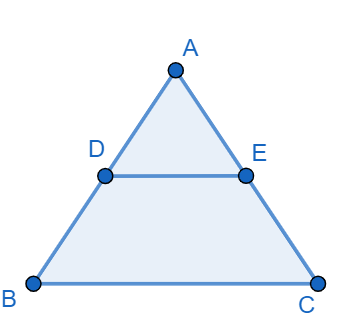
Here DE is half of BC.
It is noted that the smaller triangle is also equilateral because all the sides of the triangle DEF are exactly half of the sides of triangle ABC.
On the basis of proportionality theorem, $BE=\dfrac{BC}{2}$, $EF=\dfrac{AB}{2}$ and $DE=\dfrac{AC}{2}$.
In the given question figure,
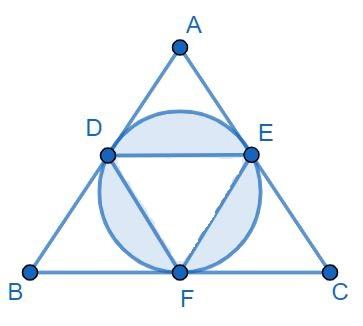
Circle is inscribed in the equilateral triangle ABC, the radius of circle is given by $\dfrac{\Delta }{S}$ because the circle is inscribed in the equilateral $\Delta ABC$, here $\Delta $ is area of equilateral triangle and ‘S’ is the half of the perimeter of $\Delta ABC$.
S is calculated as $\dfrac{\text{Sum of perimeter}}{2}$
= $\dfrac{2\sqrt{3}+2\sqrt{3}+2\sqrt{3}}{2}=3\sqrt{3}$.
Therefore radius of circle $=\dfrac{\dfrac{\sqrt{3}}{4}{{\left( 2\sqrt{3} \right)}^{2}}}{3\sqrt{3}}=\dfrac{\dfrac{\sqrt{3}}{4}\times 4\times 3}{3\sqrt{3}}$, which can be calculated as
= $\dfrac{3\sqrt{3}}{3\sqrt{3}}=1$.
Hence area of circle = $\pi {{r}^{2}}=3.14\times {{1}^{2}}=3.14c{{m}^{2}}=\pi c{{m}^{2}}$.
Now area of smaller equilateral triangle DEF with side $a=\dfrac{2\sqrt{3}}{2}cm$ is $=\dfrac{\sqrt{3}}{4}{{\left( \dfrac{2\sqrt{3}}{2} \right)}^{2}}=\dfrac{3\sqrt{3}}{4}c{{m}^{2}}$.
Therefore the area of required region is given as $=area\text{ }of\text{ }circle\text{ }-\text{ }area\text{ }of\text{ }\Delta DEF$, putting the values we get,
$=\left( \pi -\dfrac{3\sqrt{3}}{4} \right)c{{m}^{2}}$ which can be written as
$=\dfrac{1}{4}\left( 4\pi -3\sqrt{3} \right)c{{m}^{2}}$.
Thus option a) is the correct answer.
Note: Usually students do miss-calculate in finding the radius of the circle. Many students do not know that we can calculate the radius of an inscribed circle using formula \[r=\dfrac{\Delta }{S}\]. Also, some students take S as a perimeter whereas actually it is half of the perimeter.
Complete step-by-step answer:
It is given in the question that ABC is an equilateral triangle whose side is $2\sqrt{3}cm$. A circle is drawn which passes through the mid-points D,E and F of its sides, then we have to find out the area of the shaded region.
The triangle proportionality theorem states that if a line is parallel to one side of a triangle and it intersects the other two sides, then it divides those sides proportionally.
Here DE is half of BC.
It is noted that the smaller triangle is also equilateral because all the sides of the triangle DEF are exactly half of the sides of triangle ABC.
On the basis of proportionality theorem, $BE=\dfrac{BC}{2}$, $EF=\dfrac{AB}{2}$ and $DE=\dfrac{AC}{2}$.
In the given question figure,
Circle is inscribed in the equilateral triangle ABC, the radius of circle is given by $\dfrac{\Delta }{S}$ because the circle is inscribed in the equilateral $\Delta ABC$, here $\Delta $ is area of equilateral triangle and ‘S’ is the half of the perimeter of $\Delta ABC$.
S is calculated as $\dfrac{\text{Sum of perimeter}}{2}$
= $\dfrac{2\sqrt{3}+2\sqrt{3}+2\sqrt{3}}{2}=3\sqrt{3}$.
Therefore radius of circle $=\dfrac{\dfrac{\sqrt{3}}{4}{{\left( 2\sqrt{3} \right)}^{2}}}{3\sqrt{3}}=\dfrac{\dfrac{\sqrt{3}}{4}\times 4\times 3}{3\sqrt{3}}$, which can be calculated as
= $\dfrac{3\sqrt{3}}{3\sqrt{3}}=1$.
Hence area of circle = $\pi {{r}^{2}}=3.14\times {{1}^{2}}=3.14c{{m}^{2}}=\pi c{{m}^{2}}$.
Now area of smaller equilateral triangle DEF with side $a=\dfrac{2\sqrt{3}}{2}cm$ is $=\dfrac{\sqrt{3}}{4}{{\left( \dfrac{2\sqrt{3}}{2} \right)}^{2}}=\dfrac{3\sqrt{3}}{4}c{{m}^{2}}$.
Therefore the area of required region is given as $=area\text{ }of\text{ }circle\text{ }-\text{ }area\text{ }of\text{ }\Delta DEF$, putting the values we get,
$=\left( \pi -\dfrac{3\sqrt{3}}{4} \right)c{{m}^{2}}$ which can be written as
$=\dfrac{1}{4}\left( 4\pi -3\sqrt{3} \right)c{{m}^{2}}$.
Thus option a) is the correct answer.
Note: Usually students do miss-calculate in finding the radius of the circle. Many students do not know that we can calculate the radius of an inscribed circle using formula \[r=\dfrac{\Delta }{S}\]. Also, some students take S as a perimeter whereas actually it is half of the perimeter.
Recently Updated Pages
Master Class 11 English: Engaging Questions & Answers for Success

Master Class 11 Social Science: Engaging Questions & Answers for Success
Master Class 11 Maths: Engaging Questions & Answers for Success
Master Class 11 Biology: Engaging Questions & Answers for Success
Master Class 11 Physics: Engaging Questions & Answers for Success
Master Class 11 Chemistry: Engaging Questions & Answers for Success
Trending doubts
Explain the Treaty of Vienna of 1815 class 10 social science CBSE
What is the full form of POSCO class 10 social science CBSE
Define Potential, Developed, Stock and Reserved resources
The diagonals of a rhombus are 10cm and 24cm Find the class 10 maths CBSE
One number is chosen from numbers 1 to 200 Find the class 10 maths CBSE
Why is Venus called Earths sister planet class 10 physics CBSE