




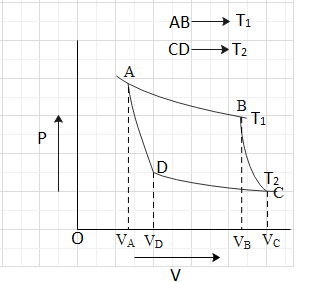
In the following P-V diagram of an ideal gas, AB and CD are isothermal whereas BC and DA are adiabatic processes. The value of \[\dfrac{{{V}_{B}}}{{{V}_{C}}}\] is:
\[\begin{align}
& \text{A}\text{. =}\dfrac{{{V}_{A}}}{{{V}_{D}}} \\
& \text{B}\text{. }<\dfrac{{{V}_{A}}}{{{V}_{D}}} \\
& \text{C}\text{. }>\dfrac{{{V}_{A}}}{{{V}_{D}}} \\
& \text{D}\text{. cannot say} \\
\end{align}\]
Answer
 Verified
618k+ views
Hint: Here in the given P-V graph there are two processes isothermal and adiabatic. When the system goes from A to B and C to D, the isothermal process is happening and when it goes from B to C and D to A, an adiabatic process is taking place. We have to find the relation between the volumes at the point A, B, C and D which can be obtained by using pressure-volume relationship for the isothermal and adiabatic process.
Formula used:
\[\begin{align}
& {{P}_{1}}{{V}_{1}}={{P}_{2}}{{V}_{2}}\text{(Isothermal process)} \\
& {{P}_{1}}V_{1}^{\gamma }={{P}_{2}}V_{2}^{\gamma }\text{(Adiabatic process)} \\
\end{align}\]
Complete step-by-step solution:
In the isothermal process, there is no change in the temperature of the system undergoing change. From Boyle’s law for an ideal gas, the pressure is inversely proportional to the volume of the gas at a fixed temperature. When the initial and final temperature is same then the relation in between the initial and final volume and pressure of the gas can be given as
\[{{P}_{1}}{{V}_{1}}={{P}_{2}}{{V}_{2}}\]
Where \[{{P}_{1}}\] is the initial pressure, \[{{P}_{2}}\] is final pressure, \[{{V}_{1}}\] is the initial volume and \[{{V}_{2}}\] is the final volume.
Hence for AB which is isothermal process we can write
\[\begin{align}
& {{P}_{A}}{{V}_{A}}={{P}_{B}}{{V}_{B}} \\
& \Rightarrow {{P}_{B}}=\dfrac{{{P}_{A}}{{V}_{A}}}{{{V}_{B}}}\text{ }....................\text{(i)} \\
\end{align}\]
Similarly for CD we can write
\[\begin{align}
& {{P}_{C}}{{V}_{C}}={{P}_{D}}{{V}_{D}} \\
& \Rightarrow {{P}_{D}}=\dfrac{{{P}_{C}}{{V}_{C}}}{{{V}_{D}}}\text{ }....................\text{(ii)} \\
\end{align}\]
In an adiabatic process there is no transfer of heat between any two system and the relation between initial and final pressure and volume of the gas is given as
\[{{P}_{1}}V_{1}^{\gamma }={{P}_{2}}V_{2}^{\gamma }\]
Where \[{{P}_{1}}\] is the initial pressure, \[{{P}_{2}}\] is final pressure, \[{{V}_{1}}\]is the initial volume, \[{{V}_{2}}\] is the final volume and \[\gamma \] is the ratio of specific heat at constant volume and constant pressure.
So for BC which is adiabatic process we can write
\[{{P}_{B}}V_{B}^{\gamma }={{P}_{C}}V_{C}^{\gamma }\]
Substituting value of \[{{P}_{B}}\] from equation (i), we get
\[\begin{align}
& \Rightarrow \dfrac{{{P}_{A}}{{V}_{A}}V_{B}^{\gamma }}{{{V}_{B}}}\text{= }{{P}_{C}}V_{C}^{\gamma } \\
& \Rightarrow {{P}_{A}}{{V}_{A}}V_{B}^{\gamma -1}={{P}_{C}}V_{C}^{\gamma } \\
& \Rightarrow \dfrac{{{P}_{C}}}{{{P}_{A}}}\text{=}\dfrac{{{V}_{A}}V_{B}^{\gamma -1}}{V_{C}^{\gamma }}\text{ }...................\text{(iii)} \\
\end{align}\]
Similarly for DA we can write
\[{{P}_{D}}V_{D}^{\gamma }={{P}_{A}}V_{A}^{\gamma }\]
Substituting value of\[{{P}_{D}}\] from equation (ii), we get
\[\begin{align}
& \Rightarrow \dfrac{{{P}_{C}}{{V}_{C}}V_{D}^{\gamma }}{{{V}_{D}}}\text{= }{{P}_{A}}V_{A}^{\gamma } \\
& \Rightarrow {{P}_{C}}{{V}_{C}}V_{D}^{\gamma -1}={{P}_{A}}V_{A}^{\gamma } \\
& \Rightarrow \dfrac{{{P}_{C}}}{{{P}_{A}}}=\dfrac{V_{A}^{\gamma }}{{{V}_{C}}V_{D}^{\gamma -1}} \\
\end{align}\]
Substituting value of \[\dfrac{{{P}_{C}}}{{{P}_{A}}}\] from equation (iii), we get
\[\begin{align}
& \Rightarrow \dfrac{{{V}_{A}}V_{B}^{\gamma -1}}{V_{C}^{\gamma }}=\dfrac{V_{A}^{\gamma }}{{{V}_{C}}V_{D}^{\gamma -1}} \\
& \Rightarrow \dfrac{{{V}_{C}}V_{B}^{\gamma -1}}{V_{C}^{\gamma }}=\dfrac{V_{A}^{\gamma }}{{{V}_{A}}V_{D}^{\gamma -1}} \\
& \Rightarrow \dfrac{V_{B}^{\gamma -1}}{V_{C}^{\gamma -1}}=\dfrac{V_{A}^{\gamma -1}}{V_{D}^{\gamma -1}} \\
& \Rightarrow {{\left( \dfrac{{{V}_{B}}}{{{V}_{C}}} \right)}^{\gamma -1}}={{\left( \dfrac{{{V}_{A}}}{{{V}_{D}}} \right)}^{\gamma -1}} \\
& \Rightarrow \dfrac{{{V}_{B}}}{{{V}_{C}}}=\dfrac{{{V}_{A}}}{{{V}_{D}}} \\
\end{align}\]
Hence option A is correct.
Note: The above equation is a general equation giving the relation between the volumes of the gas undergoing the isothermal and adiabatic process. If any three values are known we can find the fourth value. Also, note that the equation used for the adiabatic process is for ideal gas for the reversible process.
Formula used:
\[\begin{align}
& {{P}_{1}}{{V}_{1}}={{P}_{2}}{{V}_{2}}\text{(Isothermal process)} \\
& {{P}_{1}}V_{1}^{\gamma }={{P}_{2}}V_{2}^{\gamma }\text{(Adiabatic process)} \\
\end{align}\]
Complete step-by-step solution:
In the isothermal process, there is no change in the temperature of the system undergoing change. From Boyle’s law for an ideal gas, the pressure is inversely proportional to the volume of the gas at a fixed temperature. When the initial and final temperature is same then the relation in between the initial and final volume and pressure of the gas can be given as
\[{{P}_{1}}{{V}_{1}}={{P}_{2}}{{V}_{2}}\]
Where \[{{P}_{1}}\] is the initial pressure, \[{{P}_{2}}\] is final pressure, \[{{V}_{1}}\] is the initial volume and \[{{V}_{2}}\] is the final volume.
Hence for AB which is isothermal process we can write
\[\begin{align}
& {{P}_{A}}{{V}_{A}}={{P}_{B}}{{V}_{B}} \\
& \Rightarrow {{P}_{B}}=\dfrac{{{P}_{A}}{{V}_{A}}}{{{V}_{B}}}\text{ }....................\text{(i)} \\
\end{align}\]
Similarly for CD we can write
\[\begin{align}
& {{P}_{C}}{{V}_{C}}={{P}_{D}}{{V}_{D}} \\
& \Rightarrow {{P}_{D}}=\dfrac{{{P}_{C}}{{V}_{C}}}{{{V}_{D}}}\text{ }....................\text{(ii)} \\
\end{align}\]
In an adiabatic process there is no transfer of heat between any two system and the relation between initial and final pressure and volume of the gas is given as
\[{{P}_{1}}V_{1}^{\gamma }={{P}_{2}}V_{2}^{\gamma }\]
Where \[{{P}_{1}}\] is the initial pressure, \[{{P}_{2}}\] is final pressure, \[{{V}_{1}}\]is the initial volume, \[{{V}_{2}}\] is the final volume and \[\gamma \] is the ratio of specific heat at constant volume and constant pressure.
So for BC which is adiabatic process we can write
\[{{P}_{B}}V_{B}^{\gamma }={{P}_{C}}V_{C}^{\gamma }\]
Substituting value of \[{{P}_{B}}\] from equation (i), we get
\[\begin{align}
& \Rightarrow \dfrac{{{P}_{A}}{{V}_{A}}V_{B}^{\gamma }}{{{V}_{B}}}\text{= }{{P}_{C}}V_{C}^{\gamma } \\
& \Rightarrow {{P}_{A}}{{V}_{A}}V_{B}^{\gamma -1}={{P}_{C}}V_{C}^{\gamma } \\
& \Rightarrow \dfrac{{{P}_{C}}}{{{P}_{A}}}\text{=}\dfrac{{{V}_{A}}V_{B}^{\gamma -1}}{V_{C}^{\gamma }}\text{ }...................\text{(iii)} \\
\end{align}\]
Similarly for DA we can write
\[{{P}_{D}}V_{D}^{\gamma }={{P}_{A}}V_{A}^{\gamma }\]
Substituting value of\[{{P}_{D}}\] from equation (ii), we get
\[\begin{align}
& \Rightarrow \dfrac{{{P}_{C}}{{V}_{C}}V_{D}^{\gamma }}{{{V}_{D}}}\text{= }{{P}_{A}}V_{A}^{\gamma } \\
& \Rightarrow {{P}_{C}}{{V}_{C}}V_{D}^{\gamma -1}={{P}_{A}}V_{A}^{\gamma } \\
& \Rightarrow \dfrac{{{P}_{C}}}{{{P}_{A}}}=\dfrac{V_{A}^{\gamma }}{{{V}_{C}}V_{D}^{\gamma -1}} \\
\end{align}\]
Substituting value of \[\dfrac{{{P}_{C}}}{{{P}_{A}}}\] from equation (iii), we get
\[\begin{align}
& \Rightarrow \dfrac{{{V}_{A}}V_{B}^{\gamma -1}}{V_{C}^{\gamma }}=\dfrac{V_{A}^{\gamma }}{{{V}_{C}}V_{D}^{\gamma -1}} \\
& \Rightarrow \dfrac{{{V}_{C}}V_{B}^{\gamma -1}}{V_{C}^{\gamma }}=\dfrac{V_{A}^{\gamma }}{{{V}_{A}}V_{D}^{\gamma -1}} \\
& \Rightarrow \dfrac{V_{B}^{\gamma -1}}{V_{C}^{\gamma -1}}=\dfrac{V_{A}^{\gamma -1}}{V_{D}^{\gamma -1}} \\
& \Rightarrow {{\left( \dfrac{{{V}_{B}}}{{{V}_{C}}} \right)}^{\gamma -1}}={{\left( \dfrac{{{V}_{A}}}{{{V}_{D}}} \right)}^{\gamma -1}} \\
& \Rightarrow \dfrac{{{V}_{B}}}{{{V}_{C}}}=\dfrac{{{V}_{A}}}{{{V}_{D}}} \\
\end{align}\]
Hence option A is correct.
Note: The above equation is a general equation giving the relation between the volumes of the gas undergoing the isothermal and adiabatic process. If any three values are known we can find the fourth value. Also, note that the equation used for the adiabatic process is for ideal gas for the reversible process.
Recently Updated Pages
Master Class 12 Economics: Engaging Questions & Answers for Success

Master Class 12 English: Engaging Questions & Answers for Success
Master Class 12 Social Science: Engaging Questions & Answers for Success
Master Class 12 Maths: Engaging Questions & Answers for Success
Master Class 12 Physics: Engaging Questions & Answers for Success
Master Class 9 General Knowledge: Engaging Questions & Answers for Success
Trending doubts
One Metric ton is equal to kg A 10000 B 1000 C 100 class 11 physics CBSE
Difference Between Prokaryotic Cells and Eukaryotic Cells
Two of the body parts which do not appear in MRI are class 11 biology CBSE
Find the value of the expression given below sin 30circ class 11 maths CBSE
1 ton equals to A 100 kg B 1000 kg C 10 kg D 10000 class 11 physics CBSE
Draw a diagram of nephron and explain its structur class 11 biology CBSE