




In the following figure O is a point on the diagonal AC of parallelogram ABCD. Prove that $ar\left( \Delta AOB \right)=ar\left( \Delta AOD \right)$
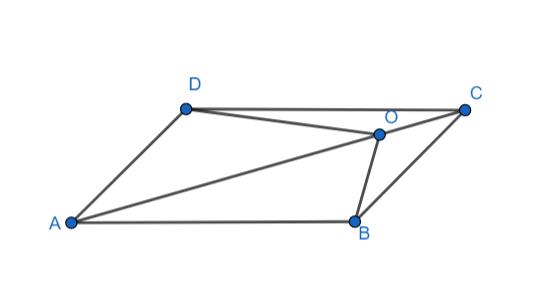
Answer
 Verified
614.4k+ views
Hint: Join BD and mark E as the point of intersection of BD with AC. Use the fact that the diagonals of a parallelogram bisect each other to prove that E is the midpoint of BD. Now, use the fact that the median of a triangle divides the triangle into two triangles of equal area. Hence prove that the areas of the triangles ADE and ABE are equal. Similarly, prove that the areas of the triangle BOE and DOE are equal and hence prove that the areas of the triangles AOD and AOB are equal.
Complete step-by-step answer:
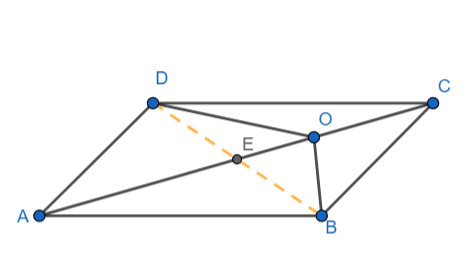
Given: ABCD is a parallelogram. O is a point on the diagonal AC.
To prove: Triangles AOD and AOB are equal in area, i.e. $ar\left( \Delta AOB \right)=ar\left( \Delta AOD \right)$
Construction: Join BD and let it intersect AC at E
Proof:
We know that the diagonals of a parallelogram bisect each other. Hence, we have AC bisects BD
Hence, E is the midpoint of BD.
Now, in triangle ABD, we have E as the midpoint of BD.
Hence, $ar\left( \Delta AED \right)=ar\left( \Delta AEB \right)\text{ }\left( i \right)$(Because the median of a triangle divides the triangle into two triangles of equal area.)
In triangle BOD, we have E as the midpoint of BD.
Hence we have $ar\left( \Delta BOE \right)=ar\left( \Delta DOE \right)\text{ }\left( ii \right)$(Because the median of a triangle divides the triangle into two triangles of equal area.)
Adding equation (i) and equation (ii), we get
$ar\left( \Delta AED \right)+ar\left( \Delta DOE \right)=ar\left( \Delta BOE \right)+ar\left( \Delta AEB \right)$
From the above diagram, we have
$ar\left( \Delta AED \right)+ar\left( \Delta DOE \right)=ar\left( \Delta AOD \right)$ and $ar\left( \Delta BOE \right)+ar\left( \Delta AEB \right)=ar\left( \Delta AOB \right)$
Hence, we have
$ar\left( \Delta AOD \right)=ar\left( \Delta AOB \right)$
Hence proved.
Note: Alternative solution:
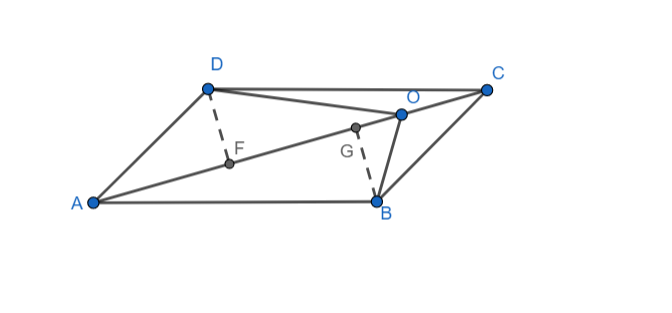
Draw perpendiculars DF and BG on diagonal AC.
Now, we know that the diagonal of a parallelogram divides the parallelogram into two congruent triangles.
Hence, we have
$ar\left( \Delta ACD \right)=ar\left( \Delta ABD \right)$
We know that the area of a triangle is half the product of base and height.
Hence, we have
$ar\left( \Delta ACD \right)=\dfrac{1}{2}DF\times AC$ and $ar\left( \Delta ACB \right)=\dfrac{1}{2}BG\times AC$
Hence, we have
$\begin{align}
& \dfrac{1}{2}DF\times AC=\dfrac{1}{2}AC\times BG \\
& \Rightarrow DF=BG \\
\end{align}$
Now, we have
$ar\left( \Delta AOD \right)=\dfrac{1}{2}DF\times AO$ and $ar\left( \Delta AOB \right)=\dfrac{1}{2}BG\times AO$
Hence, we have
$\dfrac{ar\left( \Delta AOD \right)}{ar\left( \Delta AOB \right)}=\dfrac{DF}{BG}=\dfrac{DF}{DF}=1$
Multiplying both sides by $ar\left( \Delta AOB \right)$, we get
$ar\left( \Delta AOD \right)=ar\left( \Delta AOB \right)$
Complete step-by-step answer:
Given: ABCD is a parallelogram. O is a point on the diagonal AC.
To prove: Triangles AOD and AOB are equal in area, i.e. $ar\left( \Delta AOB \right)=ar\left( \Delta AOD \right)$
Construction: Join BD and let it intersect AC at E
Proof:
We know that the diagonals of a parallelogram bisect each other. Hence, we have AC bisects BD
Hence, E is the midpoint of BD.
Now, in triangle ABD, we have E as the midpoint of BD.
Hence, $ar\left( \Delta AED \right)=ar\left( \Delta AEB \right)\text{ }\left( i \right)$(Because the median of a triangle divides the triangle into two triangles of equal area.)
In triangle BOD, we have E as the midpoint of BD.
Hence we have $ar\left( \Delta BOE \right)=ar\left( \Delta DOE \right)\text{ }\left( ii \right)$(Because the median of a triangle divides the triangle into two triangles of equal area.)
Adding equation (i) and equation (ii), we get
$ar\left( \Delta AED \right)+ar\left( \Delta DOE \right)=ar\left( \Delta BOE \right)+ar\left( \Delta AEB \right)$
From the above diagram, we have
$ar\left( \Delta AED \right)+ar\left( \Delta DOE \right)=ar\left( \Delta AOD \right)$ and $ar\left( \Delta BOE \right)+ar\left( \Delta AEB \right)=ar\left( \Delta AOB \right)$
Hence, we have
$ar\left( \Delta AOD \right)=ar\left( \Delta AOB \right)$
Hence proved.
Note: Alternative solution:
Draw perpendiculars DF and BG on diagonal AC.
Now, we know that the diagonal of a parallelogram divides the parallelogram into two congruent triangles.
Hence, we have
$ar\left( \Delta ACD \right)=ar\left( \Delta ABD \right)$
We know that the area of a triangle is half the product of base and height.
Hence, we have
$ar\left( \Delta ACD \right)=\dfrac{1}{2}DF\times AC$ and $ar\left( \Delta ACB \right)=\dfrac{1}{2}BG\times AC$
Hence, we have
$\begin{align}
& \dfrac{1}{2}DF\times AC=\dfrac{1}{2}AC\times BG \\
& \Rightarrow DF=BG \\
\end{align}$
Now, we have
$ar\left( \Delta AOD \right)=\dfrac{1}{2}DF\times AO$ and $ar\left( \Delta AOB \right)=\dfrac{1}{2}BG\times AO$
Hence, we have
$\dfrac{ar\left( \Delta AOD \right)}{ar\left( \Delta AOB \right)}=\dfrac{DF}{BG}=\dfrac{DF}{DF}=1$
Multiplying both sides by $ar\left( \Delta AOB \right)$, we get
$ar\left( \Delta AOD \right)=ar\left( \Delta AOB \right)$
Recently Updated Pages
Basicity of sulphurous acid and sulphuric acid are

Master Class 10 English: Engaging Questions & Answers for Success
Master Class 10 Social Science: Engaging Questions & Answers for Success
Master Class 10 Computer Science: Engaging Questions & Answers for Success
Class 10 Question and Answer - Your Ultimate Solutions Guide
Master Class 10 General Knowledge: Engaging Questions & Answers for Success
Trending doubts
Who is known as the "Little Master" in Indian cricket history?
A boat goes 24 km upstream and 28 km downstream in class 10 maths CBSE
Write a letter to the principal requesting him to grant class 10 english CBSE
Who Won 36 Oscar Awards? Record Holder Revealed
Why is there a time difference of about 5 hours between class 10 social science CBSE
Draw a diagram to show how hypermetropia is correc class 10 physics CBSE