




In the figure,$\angle PQT = p,\angle TSR = q{\text{ and }}\angle {\text{PTQ = 60}}$. Then p+q equals in degree is
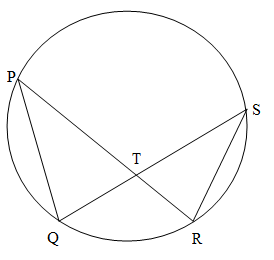
A. 300
B. 30
C. 120
D. 60
Answer
 Verified
597k+ views
Hint: First of all we will do construction in the figure given in the questions. After this, we will use a theorem to find the value of $\angle QPT$. In $\vartriangle PQT$, we have two unknown angles and a known angle which is ${60^0}$. Applying the sum of angle theorems in $\vartriangle PQT$, we will get the p+q.
Complete step by step solution:
First of all, we will do construction.
Construction: Join Q to R.
QR is the common segment on which two angles are made.
Given: $\angle PQT = p,\angle TSR = q{\text{ = }}\angle {\text{PTQ = 60}}$
The diagram for the question is given below:
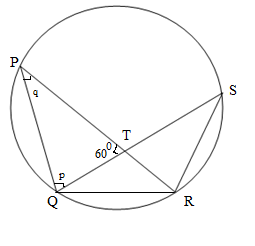
Now , we will use a theorem to find the value of an angle in $\vartriangle PQT$.
Theorem: Angles made on the same segment are equal.
On the segment QR two angles are made.$\angle QSR{\text{ }}$and$\angle QPT$. Therefore, using above theorem, we can say that:
$\angle QPT = \angle QSR{\text{ = }}\angle {\text{TSR = q}}$.
Therefore, in the $\vartriangle PQT$, we have:
$\angle PQT = p,{\text{ }}\angle {\text{PTQ = 60 and }}\angle {\text{QPT = q}}$.
We know that in a triangle the sum of all angles is equal to ${180^0}$.
Therefore, ,in the $\vartriangle PQT$, we can write:
$\angle PQT + \angle {\text{PTQ + }}\angle {\text{QPT = 18}}{{\text{0}}^0}$
Putting the values of $\angle PQT = p,{\text{ }}\angle {\text{QPT = q and }}\angle {\text{PTQ = 60}}$ , we get:
$ \Rightarrow p + q + {60^0} = {180^0}$
$ \Rightarrow p + q = {180^0} - {60^0} = {120^0}$.
So, option C is correct.
Note: In this type of question, you should do construction if required so that further solving the question becomes easy. Here you must remember the theorem related to angle made on the segment. You should also know that the angle made by a segment at the centre of the circle is twice the angle made by the same segment elsewhere on the circle.
Complete step by step solution:
First of all, we will do construction.
Construction: Join Q to R.
QR is the common segment on which two angles are made.
Given: $\angle PQT = p,\angle TSR = q{\text{ = }}\angle {\text{PTQ = 60}}$
The diagram for the question is given below:
Now , we will use a theorem to find the value of an angle in $\vartriangle PQT$.
Theorem: Angles made on the same segment are equal.
On the segment QR two angles are made.$\angle QSR{\text{ }}$and$\angle QPT$. Therefore, using above theorem, we can say that:
$\angle QPT = \angle QSR{\text{ = }}\angle {\text{TSR = q}}$.
Therefore, in the $\vartriangle PQT$, we have:
$\angle PQT = p,{\text{ }}\angle {\text{PTQ = 60 and }}\angle {\text{QPT = q}}$.
We know that in a triangle the sum of all angles is equal to ${180^0}$.
Therefore, ,in the $\vartriangle PQT$, we can write:
$\angle PQT + \angle {\text{PTQ + }}\angle {\text{QPT = 18}}{{\text{0}}^0}$
Putting the values of $\angle PQT = p,{\text{ }}\angle {\text{QPT = q and }}\angle {\text{PTQ = 60}}$ , we get:
$ \Rightarrow p + q + {60^0} = {180^0}$
$ \Rightarrow p + q = {180^0} - {60^0} = {120^0}$.
So, option C is correct.
Note: In this type of question, you should do construction if required so that further solving the question becomes easy. Here you must remember the theorem related to angle made on the segment. You should also know that the angle made by a segment at the centre of the circle is twice the angle made by the same segment elsewhere on the circle.
Recently Updated Pages
Master Class 10 Computer Science: Engaging Questions & Answers for Success

Master Class 10 General Knowledge: Engaging Questions & Answers for Success
Master Class 10 English: Engaging Questions & Answers for Success
Master Class 10 Social Science: Engaging Questions & Answers for Success
Master Class 10 Maths: Engaging Questions & Answers for Success
Master Class 10 Science: Engaging Questions & Answers for Success
Trending doubts
What is the median of the first 10 natural numbers class 10 maths CBSE
Which women's tennis player has 24 Grand Slam singles titles?
Who is the Brand Ambassador of Incredible India?
Why is there a time difference of about 5 hours between class 10 social science CBSE
Write a letter to the principal requesting him to grant class 10 english CBSE
State and prove converse of BPT Basic Proportionality class 10 maths CBSE