




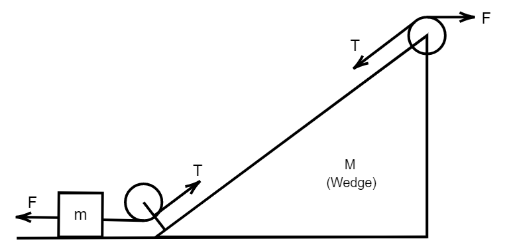
In the figure shown, the acceleration of wedge is (neglect friction):
Answer
 Verified
540.9k+ views
Hint: To solve this problem find the forces acting on the wedge due to the applied force on the string using free body diagrams or Newton’s laws of motion. To find the forces and its component on the block use Newton’s second law which states that the net force acting on a system is equal to the mass times the acceleration of the system.
Formula used:
The Newton’s law is given by,
\[F = ma\]
where $m$ is the mass and a is the acceleration of the system.
Complete step by step answer:
We know that Newton's second law states that the total force acting on a body is equal to the mass times the acceleration of the system. So, here we have to find the force acting on the wedge due to the force on the string. We can do that easily by dividing the force acting into components and looking for any force acting on the wedge. So, if we draw the free body diagram we can see that,
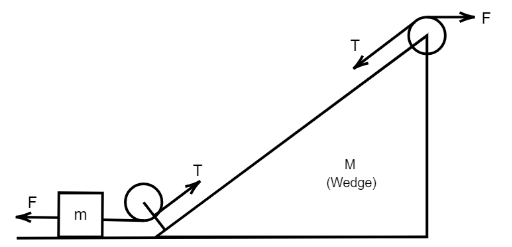
\[F = T\]
Equation of motion of the block $m$.
\[T = F = ma\]
So, due to the force acting there is a tension in the string this tension will generate the same amount of force on the block kept horizontal. So, all of the forces are balanced and no component of forces are acting on the wedge. The force is acting only on the block and the string.
Hence, the total force acting on the wedge is zero.
Note:To solve this type of force problem just draw the force diagram or free body diagram of the system to find the required force which is acting. We can also find it by using Newton’s law of motion directly by mathematical derivation but for complicated problems that may lead to complicated calculations also. So, it is advised to use a force diagram to find the forces acting on the system or body rather easily.
Formula used:
The Newton’s law is given by,
\[F = ma\]
where $m$ is the mass and a is the acceleration of the system.
Complete step by step answer:
We know that Newton's second law states that the total force acting on a body is equal to the mass times the acceleration of the system. So, here we have to find the force acting on the wedge due to the force on the string. We can do that easily by dividing the force acting into components and looking for any force acting on the wedge. So, if we draw the free body diagram we can see that,
\[F = T\]
Equation of motion of the block $m$.
\[T = F = ma\]
So, due to the force acting there is a tension in the string this tension will generate the same amount of force on the block kept horizontal. So, all of the forces are balanced and no component of forces are acting on the wedge. The force is acting only on the block and the string.
Hence, the total force acting on the wedge is zero.
Note:To solve this type of force problem just draw the force diagram or free body diagram of the system to find the required force which is acting. We can also find it by using Newton’s law of motion directly by mathematical derivation but for complicated problems that may lead to complicated calculations also. So, it is advised to use a force diagram to find the forces acting on the system or body rather easily.
Recently Updated Pages
Master Class 11 Social Science: Engaging Questions & Answers for Success

Master Class 11 Chemistry: Engaging Questions & Answers for Success
Master Class 12 Business Studies: Engaging Questions & Answers for Success
Master Class 12 Chemistry: Engaging Questions & Answers for Success
Master Class 12 Biology: Engaging Questions & Answers for Success
Class 12 Question and Answer - Your Ultimate Solutions Guide
Trending doubts
One Metric ton is equal to kg A 10000 B 1000 C 100 class 11 physics CBSE
Difference Between Prokaryotic Cells and Eukaryotic Cells
Two of the body parts which do not appear in MRI are class 11 biology CBSE
Explain zero factorial class 11 maths CBSE
10 examples of friction in our daily life
Name the Largest and the Smallest Cell in the Human Body ?