




In the figure, O is the centre of a circle and angle $\angle OBA=60{}^\circ $ . Then \[\angle ACB\] equals:
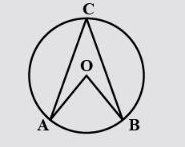
A.$60{}^\circ $
B.$75{}^\circ $
C.$120{}^\circ $
D.$30{}^\circ $
Answer
 Verified
632.1k+ views
Hint:Start by using the property that angles opposite to equal sides are equal followed by the theorem that angle at the centre of the circle is twice the angle at the circumference.
Complete step-by-step answer:
Now let us start the above question by making some constructions according to our needs. .
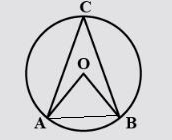
Now using the theorem that the angle at the circumference of a circle is half of the angle at the centre of the same circle, we can say:
$\angle ACB=\dfrac{1}{2}\angle AOB...........(i)$
Now applying the property that angles opposite to equal sides of a triangle are equal in $\Delta AOB$, in which AO=AB=radius, we get
$\angle BAO=60{}^\circ $
We also know that the sum of all the angles of a triangle is equal to $180{}^\circ $ .
$\therefore \angle AOB+\angle OBA+\angle OAB=180{}^\circ $
Now we will put the known values in the equation. On doing so, we get
$\angle AOB+60{}^\circ +60{}^\circ =180{}^\circ $
$\Rightarrow \angle AOB=60{}^\circ $
Now we will substitute the value of $\angle AOB$ in equation (i). On doing so, we get
$\angle ACB=\dfrac{1}{2}\times 60{}^\circ =30{}^\circ $
Therefore the answer to the above question is option (d) $30{}^\circ $ .
Note: Remember that the theorems related to cyclic quadrilateral are not valid for any regular quadrilateral. Also, it is prescribed to learn all the basic theorems related to circle as they are regularly used in the questions related to circles and cyclic quadrilaterals, as we did in the above question.
Complete step-by-step answer:
Now let us start the above question by making some constructions according to our needs. .
Now using the theorem that the angle at the circumference of a circle is half of the angle at the centre of the same circle, we can say:
$\angle ACB=\dfrac{1}{2}\angle AOB...........(i)$
Now applying the property that angles opposite to equal sides of a triangle are equal in $\Delta AOB$, in which AO=AB=radius, we get
$\angle BAO=60{}^\circ $
We also know that the sum of all the angles of a triangle is equal to $180{}^\circ $ .
$\therefore \angle AOB+\angle OBA+\angle OAB=180{}^\circ $
Now we will put the known values in the equation. On doing so, we get
$\angle AOB+60{}^\circ +60{}^\circ =180{}^\circ $
$\Rightarrow \angle AOB=60{}^\circ $
Now we will substitute the value of $\angle AOB$ in equation (i). On doing so, we get
$\angle ACB=\dfrac{1}{2}\times 60{}^\circ =30{}^\circ $
Therefore the answer to the above question is option (d) $30{}^\circ $ .
Note: Remember that the theorems related to cyclic quadrilateral are not valid for any regular quadrilateral. Also, it is prescribed to learn all the basic theorems related to circle as they are regularly used in the questions related to circles and cyclic quadrilaterals, as we did in the above question.
Recently Updated Pages
Master Class 11 Social Science: Engaging Questions & Answers for Success

Master Class 11 Physics: Engaging Questions & Answers for Success
Master Class 11 Maths: Engaging Questions & Answers for Success
Master Class 11 Economics: Engaging Questions & Answers for Success
Master Class 11 Computer Science: Engaging Questions & Answers for Success
Master Class 11 Chemistry: Engaging Questions & Answers for Success
Trending doubts
One Metric ton is equal to kg A 10000 B 1000 C 100 class 11 physics CBSE
There are 720 permutations of the digits 1 2 3 4 5 class 11 maths CBSE
1 Quintal is equal to a 110 kg b 10 kg c 100kg d 1000 class 11 physics CBSE
State and prove Bernoullis theorem class 11 physics CBSE
Difference Between Prokaryotic Cells and Eukaryotic Cells
Which among the following are examples of coming together class 11 social science CBSE